On Friday, March 20, Paul L. Friedman of the Federal District Court in Washington delivered a decisive defense of democracy in a case involving the Trump Administration’s assault on press freedom. He ruled that the Pentagon’s policy of issuing press passes only to reporters who pledged not to publish stories unless they were approved by the Trump administration was a blatant violation of the First Amendment.
Friedman provided a rousing defense of press freedom and its role in American democracy. And he offered a model of how judges and citizens can stand up for democracy at a time when it is under attack in this country.
Friedman pulled no punches but stuck to the facts, was precise in his analysis, and was attentive to the history that has shaped the First Amendment. His opinion was, in its form as well as its substance, a refutation of the Trump Administration’s practices of deception, bluster, and utter disregard for that history.
Whatever happens to Friedman’s decision when it is reviewed by higher courts, he has done us all a service by making a record of one aspect of the federal government’s sustained assault on the American Constitution. The judge used his opinion to memorialize this moment and to conjure a fundamentally different, better reality in which political leaders respect and protect constitutional norms.
Friedman wasted no time in doing that work.
His forty-page opinion begins: “(T)he primary purpose of the 1st amendment is to enable the press to publish what it will and the public to read what it chooses, free of any official proscription. Those who drafted the First Amendment believed that the nation's security requires a Free Press and an informed people and that such security is endangered by the governmental suppression of political speech.”
“That principle,” he added, “has preserved the nation's security for almost 250 years. It must not be abandoned now.”
Though he did not cite it, his words echoed a defense of press freedom and an exposition of its essential role in a democracy, written fifty-five years ago by Supreme Court Justice Hugo Black. “Both the history and language of the First Amendment,” Black said, “support the view that the press must be left free to publish news, whatever the source, without censorship, injunctions, or prior restraints.”
“In the First Amendment,” he observed, “the Founding Fathers gave the free press the protection it must have to fulfill its essential role in our democracy. The press was to serve the governed, not the governors. The Government's power to censor the press was abolished so that the press would remain forever free to censure the Government. The press was protected so that it could bare the secrets of government and inform the people.”
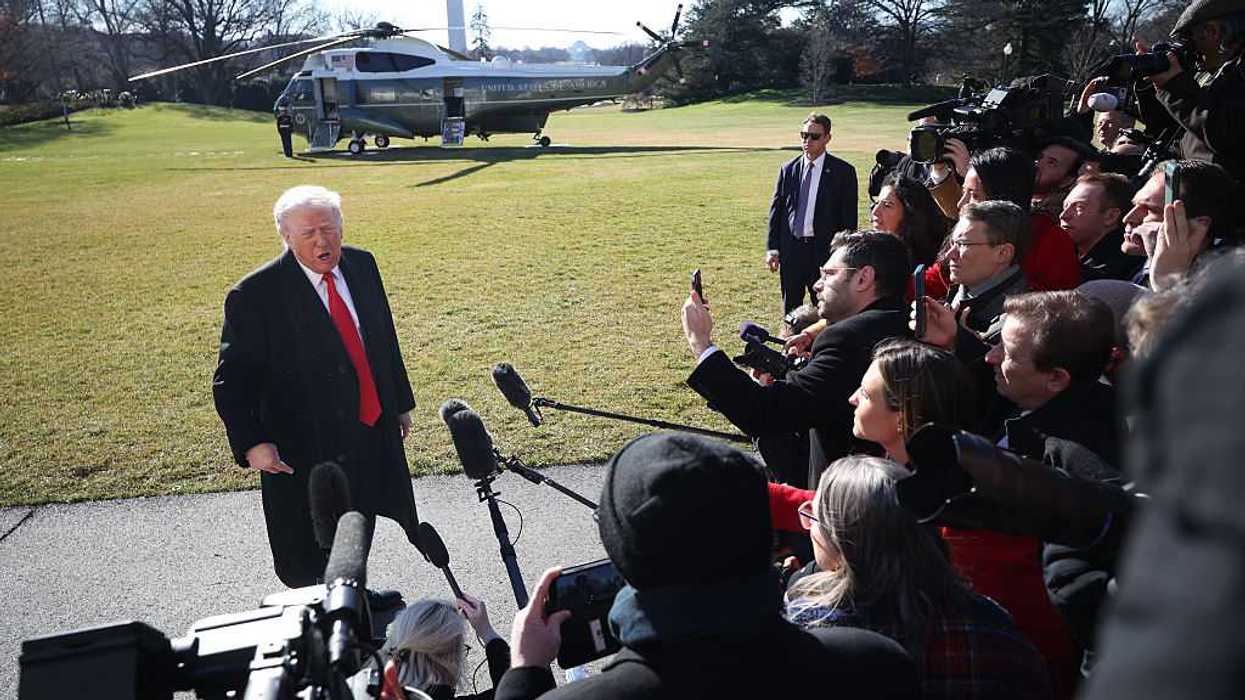
From the moment President Trump came on the political scene, he has offered a very different view of the press. He has called them the “enemy of the American people.”
In his first term in the Oval Office, We Verify estimates that Trump “used the expression ‘fake news’ 840 times.” Since then, he has accused news media of spreading “fake news” thousands of times.
His favorite targets are CNN (he regularly calls it "Fake News CNN"), The New York Times, The Washington Post, NBC News / MSNBC, and ABC News. He repeatedly denigrates individual reporters who publish unflattering accounts of him or his administration.
He has popularized the term “fake news” to undermine public confidence in the mainstream press and discredit any reporting he dislikes.
As the journalist Marvin Kalb explained in 2018, “(L)anguage like this ventured into dangerous territory. Twentieth-century dictators—notably, Stalin, Hitler, and Mao—had all denounced their critics, especially the press, as ‘enemies of the people.’ Their goal was to delegitimize the work of the press as ‘fake news’ and create confusion in the public mind about what’s real and what isn’t; what can be trusted and what can’t be. That, it seems, is also Trump’s goal.”
Not long after he returned to power, the president showed his hand when he banned The Associated Press from the White House press pool for refusing to refer to the Gulf of Mexico by his preferred name, The Gulf of America. His colleagues in the administration have joined in trashing the press.
One of the most ardent of those people has been Secretary of Defense Pete Hegseth, whose press policy Judge Friedman struck down. For example, on March 13, Hegseth criticized reporters for their coverage of the war in Iran.
Following the president’s lead, he directed his ire at CNN. “The sooner David Ellison takes over that network,” Hegseth said, “the better.” As The Guardian notes, “Ellison, a Trump ally, is the frontrunner to acquire CNN’s parent company, Warner Bros Discovery, and has reportedly told Trump administration officials he would make sweeping changes to the network should the deal close.”
Last fall, Hegseth took the usual step of laying out a series of conditions to which reporters seeking press passes to cover the Pentagon had to agree, among them “requiring them to sign a pledge to only report information officially authorized for release, even if unclassified.“ Almost all major news outlets refused to do so and, in December, 2025, the New York Times filed suit.
Hegseth’s department was hardly subtle about what it was trying to achieve. As Judge Friedman notes, Pentagon Press Secretary Kingsley Wilson called the journalists and news organizations who refused to sign the pledge, “’propagandists who ‘stopped telling the truth' and ‘continue to lie.’” He explained that the purpose of the new regulations was to ensure that members of the press who cover the Pentagon are ”’ on board and willing to serve our commander in chief.’”
The press corps that the Pentagon wanted, the judge continues, consisted of “’individuals and outlets who had expressed ideological agreement with and support for the Trump administration in the past.’”
Judge Friedman said that what the Pentagon was doing was “’ An egregious form of content discrimination ‘in which ‘the government targets not subject matter, but particular views taken by speakers on a subject.’” He characterized Hegseth’s “true purpose” and his policy’s “practical effect” as being “To weed out disfavored journalist those who were not, in the department's view, ‘on board and willing to serve’-and replace them with news outlets that are.”
Friedman labeled the Pentagon policy “viewpoint discrimination, full stop.” At the same time, he did not call anyone names, exaggerate, or denigrate those whose actions and policies he criticized.
In the end, the judge was clear in linking the health of democracy with the fate of a free press. As he put it, “in light of the country's recent incursion into Venezuela and its ongoing war with Iran, it is more important than ever that the public have access to information from a variety of perspectives about what its government is doing so that the public can support government policies, if it wants to support them, protest if it wants to protest and decide based on full, complete, and open information who they're going to vote for in the next election.”
Justice Black would be proud, as would George Washington, who complained about “The complexion of some of our newspapers….(whose coverage suggested) That inveterate political dissensions existed among us and that we are on the verge of disunion.” But he reminded Americans that any “evil” done by newspapers must be placed in opposition to the infinite benefits resulting from a Free Press.”
It is for all of us to remember Washington's words and to join Judge Friedman in defending press freedom so that we can fulfill our roles as democratic citizens.
Austin Sarat is the William Nelson Cromwell professor of jurisprudence and political science at Amherst College.








 Scenes from Favela Rocinha, Brazil - (R-L) Rows of brick homes, Hugo Balta on a motorcycle taxi, and steep, winding roadsHugo Balta