
Skip to content
Search

Latest Stories

Follow Us:
Top Stories

New coalition on the left to fight suppression and misinformation

curbside voter registration

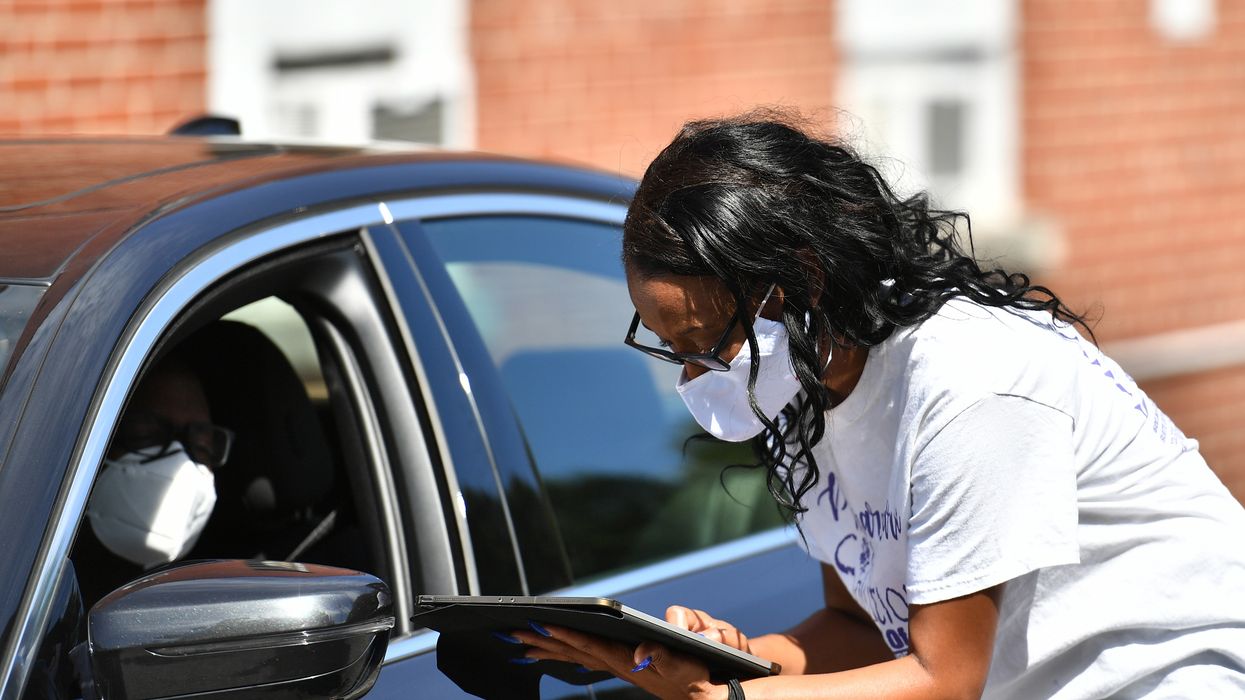
A volunteer registers a voter during a curbside registration drive in Atlanta over Labor Day weekend.

Paras Griffin/Getty Images

Sixteen liberal political and organizing groups are joining forces with Let America Vote — a democracy reform organization that fights big money and voter suppression — to create a coalition dedicated to getting all Americans access to the information they need to vote this November.

While many of these groups typically focus on other issues — like gun violence prevention, abortion rights and veterans' benefits — they are joining forces for the next two months as a part of the Save the Vote campaign in hopes of making voting safer and easier.

The coalition will share messaging and grassroots organizing efforts to battle misinformation and keep voters abreast of the work being done to guarantee the election is safe, secure and fair. The presumed hope is that will benefit like-minded voters, whose ballots will break solidly for Joe Biden and other Democrats.


"Extreme voter suppression combined with a global pandemic is making it uniquely difficult for people to vote, and know how to vote, in what will be the most consequential election of our lifetimes — an election where the literal future of democracy is on the ballot," Let America Vote President Tiffany Muller said in a statement.

Launched Wednesday, the campaign has broken down its work into three key categories:

  • Countering misinformation, particularly President Trump's unfounded claims about the vote-by-mail system.
  • Recruiting poll workers, absentee ballot collectors, voter registration volunteers and voter protection monitors, as well as returning absentee ballots.
  • Providing voters in battleground states with details about how to vote safely during the Covid-19 crisis.

"This far-reaching coalition is stepping up to make sure we have safe, secure, accessible, and fair elections. That's the only way our democracy can deliver a government that is truly accountable to the people. Every American must have an equal voice," Muller said.

For a full list of organizations participating in the coalition, check here.

Read More

ball under basketball ring
Photo by Markus Spiske on Unsplash

Fairness and Inclusion in Women’s Sports

Two former NBA players have said they want to play in the Women’s National Basketball Association (WNBA). Enes Kanter Freedom and Royce White announced their intent to enter the WNBA draft, claiming—falsely—that they identify as women to force the WNBA to clarify its policy, which restricts participation to women without defining what it means to be a woman. The players’ announcement followed closely on the heels of WNBA player Sophie Cunningham’s public comments that it was “common sense” that only “biological women” be permitted to compete in the WNBA. Cunningham’s comments drew competing rallies to her games, either supporting or denouncing her stance. Her statement was preceded by the first Supreme Court ruling on eligibility for female sports competitions at the school and college level, a ruling that does not apply to professional sports. In West Virginia v. B. P. J., the Supreme Court affirmed that U.S. states may legally bar transgender girls and women from female school or collegiate sports teams, leaving states to decide.

Public discussion of this issue has been deeply polarized. Some on the political left have asserted that “trans women are women” and that anyone who opposes their participation in elite women’s sports is a bigot. Meanwhile, some on the political right have presented trans women athletes as male athletes stealing women’s trophies. This is a classic case of affective polarization—a phenomenon in which people feel their identities, values, or rights are at stake. They become less willing to consider alternative perspectives and demonize those with opposing views.

Keep ReadingShow less
 In an aerial view, the Stargate Oracle AI data center campus.

In an aerial view, the Stargate Oracle AI data center campus is seen on August 26, 2026 in Abilene, Texas

Brandon Bell/Getty Images

Is AI Worth the Cost to Communities?

Picture a family living on a quiet street in an idyllic small town. Then a data center moves in next door. Trees are knocked down for a sprawling industrial campus, an enormous windowless building rises, and a maddening hum continues day and night. The family closes its windows, abandons the backyard, and struggles to sleep. Open space disappears, electric bills rise, and the company announces plans to expand—all in the name of jobs, tax revenue, and so-called progress.

While the family is fictional, its experience is not. Across the country, communities are confronting noise, rising electricity demand, water consumption, lost open space, and data centers approved with little public discussion. These costs raise a question the technology industry would rather avoid: Are the promised benefits of the artificial-intelligence boom worth what communities are being asked to sacrifice?

Keep ReadingShow less
Judge's hand holding wooden hammer

A lawyer breaks down 'rule of law' using everyday analogies—sports, board games—to explain why recent government actions threaten this founding principle.

naruecha jenthaisong/Getty Images

The Rule of Law Is Simple—and Essential to American Democracy

This series from Lawyers Defending American Democracy connects the words of the Declaration of Independence and the Constitution to current events that threaten democracy and the justice system. Each piece highlights the unique responsibility lawyers carry—through their oath, professional obligations, and roles in their communities—to help the public understand what’s at risk and to speak out when democratic principles are under threat. LDAD’s call to action is straightforward: as the Founders once did, we must recognize threats to constitutional values, demand accountability, and act to defend them.

Before the first No Kings rally last year, I carefully hand-lettered a sign that I thought perfectly encapsulated the day's theme. On one side, it read “IN THIS COUNTRY, THE RULE OF LAW IS KING." On the other, it read, "A GOVERNMENT OF LAWS, NOT OF MEN (John Adams)." I carried my sign proudly, certain that it would be a big hit. But the only reaction I got was someone asking me, “Are you a lawyer?” I wonder what gave me away.

Keep ReadingShow less
Texas City, Galveston County, industrial skyline.

Texas City, Galveston County, industrial skyline. While still battling legal challenges over a map in 2021 that voting rights advocates said diluted the voting power of Black and Latino voters, Galveston County has now redrawn its precinct lines again, just months before the 2026 general election.

Getty Images

What We Know About Galveston County’s Redistricting and What It Means for Voters

Galveston County’s decision to redraw local precinct lines this year between the primary and general elections means some voters could cast general election ballots in contests where they had no say in the primary, unless the courts intervene.

Election experts say they’re not aware of any prior instance where this has happened. Galveston County’s latest round of changes is adding new complications to a long-running lawsuit over the maps the county had adopted in 2021, and voting rights advocates say the new maps could further dilute Black and Latino voting power in the county.

Keep ReadingShow less