



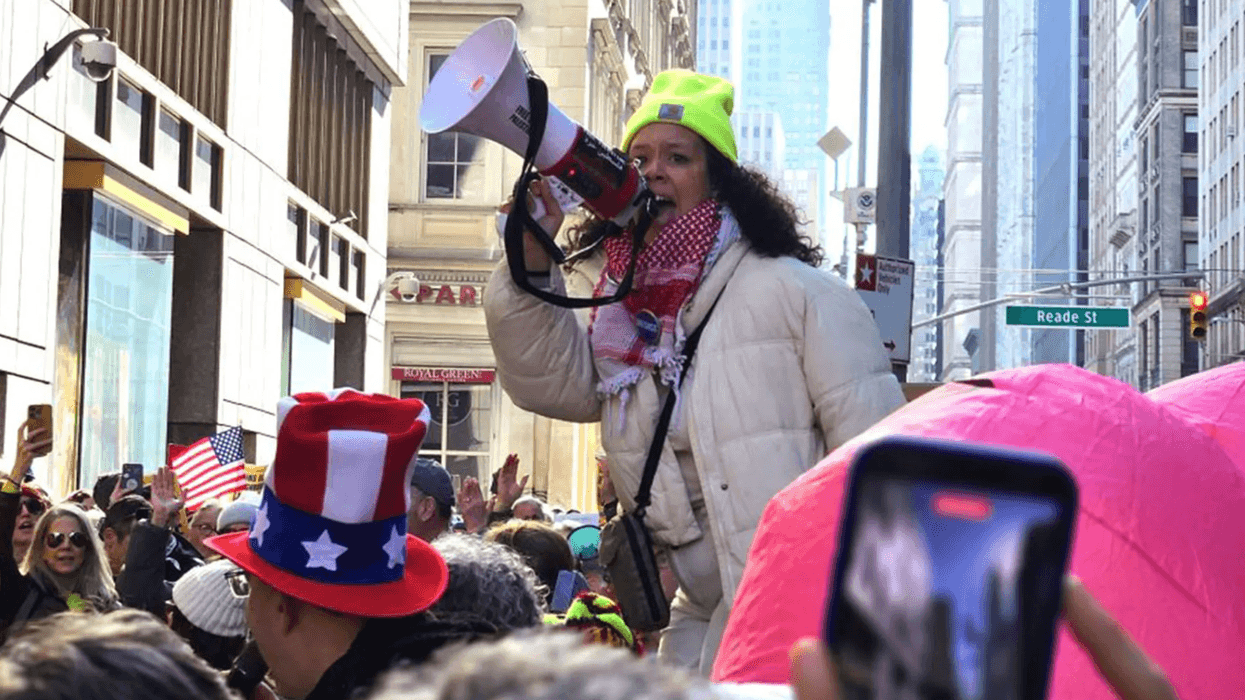

On a cold early-February evening in New York City, the first of what would become several “ICE Out Sing-Ins” was held.
Co-hosted by two ensembles – the Resistance Revival Chorus and the Jerriese Johnson Gospel Choir – as well as New York City’s Interfaith Alliance, the event’s purpose was singular: Teach the hundreds who assembled at Manhattan’s Middle Church a set of songs to sing at protests against the Trump administration and U.S. Immigration and Customs Enforcement.
When the Resistance Revival Chorus led the crowd in singing a particularly poignant piece – “Hold On,” by Vermont song leader Heidi Wilson – a ripple began to visibly spread. A few choir members reached out to embrace one another, followed by more. Within a minute, the entire ensemble was as bonded physically as they were musically, and spiritually.
The moment serves as a metaphor for the broader, growing use this year of singing – group singing, specifically – as a form of resistance. Many see it as a powerful act of intention, rippling out from a center until it touches all who are open to it.
The renewed interest in group singing as a protest tool – often associated with demonstrations in the 1960s and early 1970s related to the civil rights struggle and denouncing the Vietnam War – cropped up after organizers in Minneapolis began responding to the killings of Renee Good and Alex Pretti at the hands of ICE agents. In January, a small group there began singing, in English and in Spanish, to help console and unite a grieving community. Hundreds joined in. Videos of Singing Resistance, a musical grassroots collective based in Minneapolis, quickly went viral.
Now, organizers in dozens of other cities are forming their own chapters after seeing those early examples. Though Singing Resistance is focused on immigrant solidarity and anti-ICE campaigning, there is an expectation – and a hope – that group singing may soon be used at protests around other acts committed by the Trump administration, such as recent bombings in Iran.
Famous musicians have already taken notice. Singer-songwriter Brandi Carlile recently led some 15,000 people in singing protest songs – and was joined onstage at one point by members of Singing Resistance – at a solidarity concert she hosted in Minnesota. Performers from Bruce Springsteen to Sara Bareilles have been sharing new protest songs as well.
ArinMaya, co-musical director of the Resistance Revival Chorus, says “this moment we’re in now, it’s a continuation” of work she and others have been doing. “Music, and song, and the power of song keeps us lifted, keeps us encouraged, keeps spirits high.”
And many of these organizers and song leaders – those lifting others’ spirits through music – are women, as they have been through history.
‘Just like a tree that’s planted by the water’
In the U.S., protest singing has been a tool for organizers since the nation’s founding – literally. Songs like “Yankee Doodle” and “Free Americay” were used to push back against British imperialism as often as muskets.
Singing also helped shape other sea changes in American history, from the movement to abolish slavery in the 1800s, to the Women’s Suffrage and Labor movements of the early 1900s, on into the farmworkers’ strikes, Civil Rights marches and anti-war demonstrations that would follow several decades later.
Sometimes people would sing new compositions in chorus with one another; other times, it would be familiar tunes featuring new lyrics. Many of both forms were taught, and often penned, by women. African-American spirituals like “Go Down Moses,” often sung by Harriet Tubman herself, “Which Side Are You On?” written by union organizer Florence Reece, “We Shall Not Be Moved,” a hymn-turned-protest-song performed often by the Freedom Singers, gospel singer Shirley Caesar’s own “This Joy” and many others would regularly be sung as groups organized against oppression, theirs and others.
- YouTube youtu.be
Tammy Kernodle, a PhD of music history and a professor at Miami University in Ohio, notes that organizers turned to group singing, time and time again, as a form of “embodied resistance,” or, “when a group of people or a person goes into a space and they use their bodies to disrupt the energy of that space.” And these physical acts – from sit-ins to singing – are unavoidably powerful, she adds, because “everything stops” for it.
Throughout the history of American protests, women have often served as song leaders. That includes suffragist Ethel Smyth, workers’ rights activist Aunt Molly Jackson and domestic-worker-turned-folk-singer Odetta, as well as those involved in mixed-gender ensembles like the Hutchinson Family Singers of the abolitionist movement, and the Freedom Singers and Sweet Honey in the Rock (founded by another prominent activist, Bernice Johnson Reagon) of the Civil Rights era.
One of Kernodle’s favorite examples is voting-rights activist Fannie Lou Hamer. “We know [her] as an orator. We know her from the ‘64 Democratic Convention. But she always began those speeches with songs. And she would have people sing” with her. Noted farmworker rights activist Dolores Huerta also used music to protest unfair working conditions for migrants, despite being better known as a speaker.
Indeed, “women played an essential but often underrated role in such movements,” says Dorian Lynskey, author of “33 Revolutions Per Minute: A History of Protest Songs.” A lengthy list of prominent women artists have woven social justice into their musical work over the years, too, he notes — Marian Anderson, Billie Holiday, Aretha Franklin, Joan Baez, Sinéad O’Connor and Erykah Badu, and groups like Le Tigre and Pussy Riot. But it’s the on-the-ground, in-group singing that Lynskey says is “perhaps the most natural expression of solidarity and unity of purpose.”
Beheld, a vocal ensemble based in Washington, D.C., that’s performed at conferences, demonstrations and even the vigil following U.S. Supreme Court Justice Ruth Bader Ginsburg’s September 2020 death, has woven that same spirit of women’s sung resistance into their work. One of its members, Julie James, explains that “there’s a symbolism of [group singing]” that makes it a potent protest tool. “The many are greater than the one. When you lift your voice with someone else’s, there’s this alchemy that happens, and it’s just holy.”
It’s the kind of singing civil rights leader Dr. Martin Luther King himself once called “the soul of the movement.”
‘We who believe in freedom cannot rest’
In the past several decades, however, group singing at protests has waned. The collective musical work never stopped – but it stopped being centered as an integral part of marches and demonstrations. If singing does occur, it’s usually done individually by featured artists, and is still scant at best. Experts suggest a combination of reasons.
“We’ve lost community spaces where people are used to singing together,” says Chelsea MacMillan, who is heading up much of the actions of the New York City chapter of Singing Resistance, and who is a full-time climate organizer with Greenfaith. Even congregational singing in houses of worship is on the decline. And, she continues, “singing has become so professionalized,” with reality talent competitions such as FOX’s “American Idol” warping mass perception of the very act of singing into something one should only do if they excel at it – or be mocked for if they don’t.
Lynskey offers another theory: The encroachment of American individualism into the music itself. Consider songs like “We Shall Overcome” and “Give Peace a Chance,” once popular at protests. And, “note the use of ‘we:’ ‘We shall overcome, ‘All we are saying is give peace a chance.’” It’s not a spirit seen in modern pop music, he adds.
 Hundreds gathered to sing together in protest of U.S. Immigration and Customs Enforcement violence as part of a national Singing Resistance call to action. (Candice Helfand-Rogers)
The 1990s also saw deep cuts in music programs at U.S. public schools. And more recently, the Covid pandemic did its own damage, turning group singing into dangerous super-spreader events, for a time.
So while communal, crowd-involved singing moments still happen at concerts, and organizations like the Gaia Music Collective have been bringing accessible choral experiences to an increasing number of cities over the past few years, the practice is simply no longer an organic, expected part of American culture – or American protests. “We’re not going to religious spaces anymore; we’re not singing in schools; there aren’t community spaces for singing,” MacMillan summarizes.
But once all eyes were drawn to Minnesota earlier this year, people were opened up once more to the ways in which music can be used in organizing – and the ways in which it can be woven into protests with intention. And women organizers and song leaders – like the members of the Resistance Revival Chorus, Singing Resistance and Beheld, those who kept the practice alive and waiting – have now been hopping on this current spike in interest to effectively guide folks back en masse.
But it’s not just about making everyone feel good, these experts add. As ArinMaya notes, group singing “doesn’t happen in a vacuum. It has to be connected to action.” MacMillan points, for example, to the ways in which Minnesota organizers used group singing as a cry for ICE agents to defect, through songs like “It’s Okay to Change Your Mind” by Minneapolis song leader Annie Schlaefer. (The tactic is inspired by the Serbian “Otpor!” movement of the 1990s to oust dictator Slobodan Milošević – by, in part, encouraging members of his regime to step away.)
These organizations also do work beyond song-leading. Through their online channels, they share news updates and other critical pieces of information, and partner with like-minded groups to further the social-justice work. And, Carlile’s concert wasn’t just about “vibes” – it raised over $600,000 for families affected by ICE activity.
The movement has grown legs. In Lower Manhattan’s Foley Square, next to the building where ICE detainees are taken, several hundred people gathered at the end of February as part of a nationwide day of musical action organized by Singing Resistance. There were dozens of such rallies around the U.S. – in all, over 90 gatherings were hosted, and over $100,00 was raised by attendees to aid immigrants directly.
And, organizers add, over 230 Singing Resistance groups have now been formed.
Standing and singing in solidarity with the Lower Manhattan assembly was Brad Lander, former New York City comptroller and current Congressional candidate. He was drawn to attend the event, and to lead the crowd in singing African-American spiritual and anti-war song “Down By the Riverside,” after watching protesters in Minneapolis sing “It’s Okay to Change Your Mind” outside of ICE agents’ hotels.
“They found this way of showing how furious they are at the murders of Renee Good and Alex Pretti … and also found this beautiful song” for expressing that rage, he said. “People are steadfast – but soulfully so. And that comes out in the songs.”
‘Here comes the dawn’
As part of its ongoing efforts, Singing Resistance has shared a toolkit for organizers throughout the country, including a full songbook with tunes like “Hold On” – the song that created the ripple effect seen at that first packed event in New York City’s Middle Church.
The song’s simple-yet-fervent melody and slower tempo make it more of a prayer than a rallying cry – and movements need that spirit, too, says Melinda St. Louis of Beheld. “Something I’ve been loving about what is happening in this moment, what is happening in Minneapolis, and what is happening in uprisings all over the country is, it’s not just all f—ing wanting to punch something all the time.”
“There’s something to group singing that [reminds us] not everything has to be a fist in the air,” she continues. “Sometimes it is the embrace. It’s the wiping of a tear. It is just a human touch.”
And, she and several other sources noted, this too is often women’s work: Caring when it’s difficult, loving with bruised hearts, pouring from drained cups. Showing up unsteady, yet ready.
Gathering the scared and the tired and transforming that exhausted assembly into a robust choir.
Yet there is joy derived on both sides of that effort, “Hold On” composer Wilson says. Joy, and restoration, and hope for something better on the horizon. “In this moment, collective singing offers us a chance to stand up against rising authoritarianism and violence in a way that is also simultaneously creating the world that we want to inhabit – one rooted in love.”
Women Are Reviving a Historic Resistance Tactic at Protests: Singing originally appeared on The Story Exchange, published on The 19th, and is reshared with permission.












The President Invited Iran to Bomb My Home