
If you asked Gavin Newsom, Ben Shapiro, or Donald Trump whether they put voters first, all three would say yes.
They would say it confidently.
They would say it sincerely.
But they aren’t being honest with themselves, or you.
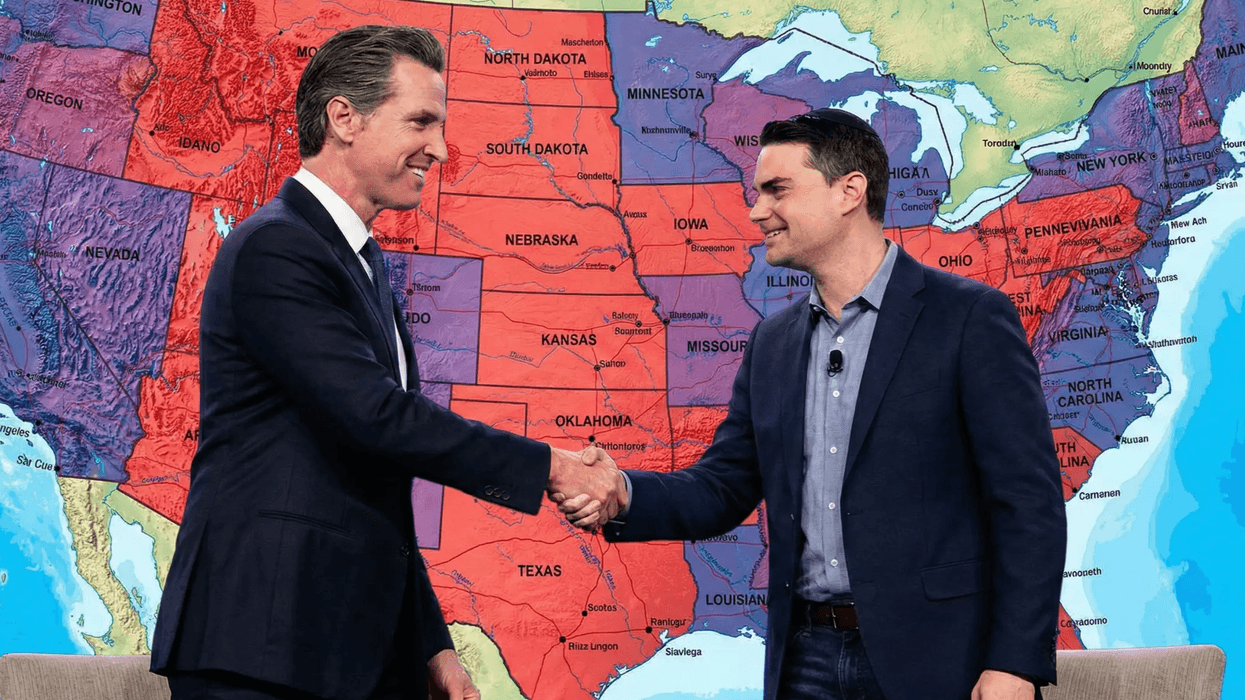
As a perfect example, Shapiro appeared on California governor Newsom’s podcast, and the expectation was that there would be conflict. An anti-Trump Democratic governor and one of the country’s most influential conservative commentators, supposedly, don’t agree on much…
But they did on one of the most important issues related to representation itself.
When the conversation came to gerrymandering, both Newsom and Shapiro agreed that allowing political parties to diminish the voting power of voters who don’t join their party is an acceptable thing to do.
That’s the definition of putting a party before “We the People” of this country. This is a “just join the party” view of the government that is more associated with countries like China and North Korea than the United States of America.
Newsom and Shapiro openly acknowledge that gerrymandering is a legitimate political strategy. One side does it, so the other side has to do it too. To refuse would be naïve. To stop would be unilateral disarmament.
Shapiro goes further, arguing that gerrymandering is not election rigging at all. It is simply how politics has always worked.
Newsom does not push back. He accepts the premise.
When honesty exposes the problem
There is something refreshing about the candor. No pretending this is about fairness. No claim that voters are being empowered. Just a clear admission that drawing districts to secure power is normal, expected, and necessary.
But honesty without accountability is not courage. It is a confession without consequence.
- YouTube youtu.be
Because what Newsom and Shapiro are really agreeing on is this: party power matters more than voter choice.
Donald Trump has said the same thing in different ways. Sometimes bluntly. Sometimes recklessly. He pressures officials, undermines trust in elections, and openly treats the system as something to be bent to maintain advantage.
Democrats condemn him for it, often rightly.
Yet when Democrats manipulate district lines to lock in power, it is suddenly described as pragmatism. Strategy. Playing the game the right way.
Ben Shapiro criticizes Trump for delegitimizing elections, again often rightly. But in the same breath, he shrugs off gerrymandering as a perfectly acceptable tool to ensure the “right” outcomes.
Different styles. Same result.
What voters actually think
Here is where the political class and the public sharply diverge.
Recent, credible national polling shows that voters across parties strongly oppose partisan control over redistricting and want a fundamentally different system. According to a Common Cause–commissioned national poll of more than 2,000 registered voters:
- 77% of Americans support independent commissions made up of citizens, not politicians, to draw district lines.
- 60% of Americans oppose partisan mid-decade redistricting.
- Majorities of Democrats, Republicans, and independents alike say it is bad for the country when one party controls how voting districts are drawn.
- Even among 2024 Donald Trump voters, 60% support Congressional action to stop partisan redistricting.
This isn’t marginal or hyper-partisan sentiment. It’s broad public consensus that the current system of political mapmaking is not working.
Power first, voters second
Gerrymandering is not an abstract process. It has very real consequences.
It creates safe seats.
Safe seats eliminate competition.
Eliminated competition rewards ideological extremes.
Candidates no longer need to persuade broad electorates. They only need to survive primaries or please party leadership. Accountability disappears. Polarization accelerates.
Then those same leaders go on podcasts, television shows, and panels to complain that politics has become too partisan.
This is not complicated.
You cannot complain about polarization while defending the system that guarantees it.
You cannot claim to support voting rights while endorsing maps designed to predetermine outcomes.
You cannot put party first and still pretend voters come first.
Why independents are not surprised
Independent voters see this clearly because they live with it every election cycle.
They are the fastest-growing segment of the electorate and the least represented. Gerrymandered districts are not drawn for them. They are drawn to protect party bases, punish competition, and minimize uncertainty.
From the voter’s perspective, the effect is the same regardless of ideology. Their choices are constrained before they ever cast a ballot. The district is engineered upstream. The winner is often decided long before Election Day.
That reality is why so many voters disengage. Not because they are apathetic, but because they are rational.
The irony no one wants to confront
The irony of the Newsom–Shapiro moment is not that they agree.
It is that they agree while claiming to oppose the very outcomes their agreement guarantees.
They recognize that politics feels broken.
They acknowledge that trust is eroding.
They lament extreme partisanship.
And then they defend the mechanism that causes all of it.
This is the core problem in American politics today. Not left versus right. Not red versus blue. It is a shared incentive structure that rewards control over consent.
What real reform would require
If leaders are willing to admit that gerrymandering works, the next step should be unavoidable.
- Independent redistricting commissions with real authority
- Competitive districts that force broad appeal
- Electoral systems that reward persuasion rather than power retention
Those reforms would weaken parties and strengthen voters. Which is precisely why they remain so rare.
Instead, voters are offered resignation disguised as realism: This is just how politics works. This is the price of winning. This is unavoidable.
It is not unavoidable. It is a choice.
And when figures as different as Gavin Newsom, Ben Shapiro, and Donald Trump all make the same choice, voters should pay attention.
Because when everyone in power agrees, it is usually not the voters who benefit.
Gavin Newsom, Ben Shapiro, and Donald Trump Finally Agree on a Major Voting Rights Issue was originally published by Independent Voter News and is republished with permission.