




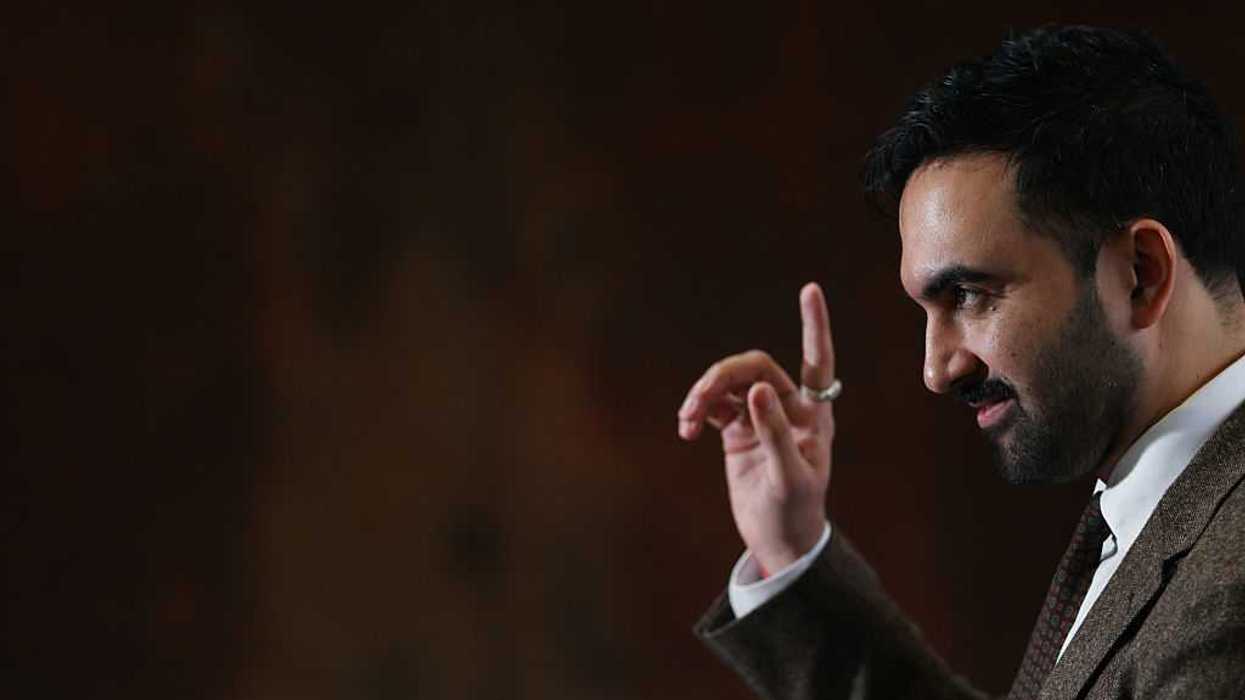
I obviously can’t say with certainty what kind of private advice President Barack Obama, AOC, Bernie Sanders, and other DNC establishment consultants may have given New York City Mayor-elect Zohran Mamdani during the campaign or in the days after his victory, but I can make an educated guess.
My guess is that they counseled him to subside a bit with the tumult, recede in the background, quietly focus heads-down on delivering something “concrete” (and do it fast) by working with the people who hold power, including the governor, his two senators, the congressional delegation, and especially Minority Leader Hakeem Jeffries.
And so, not even one month into the transition, and we’re already seeing the imprints of that advice.
Pointed case in point: Chi Ossé, a young Brooklyn councilmember known for his outspoken progressive stance and willingness to challenge the Democratic establishment, inspired and energized by Mamdani’s win, has emerged as a potential insurgent rival to Hakeem Jeffries in the coming 2026 Democratic primaries. Ossé, like Mamdani, is a Democratic Socialist, and just like Mamdani was back in the fall of 2024, he is a very long shot as things stand. Flush with his landslide victory, one would have thought that Mamdani would declare him his first official protege and put all his weight behind supporting him.
But according to both Politico and The Daily News, instead of siding with his fellow Democratic Socialist, Mamdani has “spoken to the Brooklyn lawmaker more than once to talk him out of running and has distanced himself from the effort” to mount that challenge. And when pressed about whether he supports Ossé, Mamdani has retreated to a tightly controlled line: “I ran to deliver on an affordability agenda, and that agenda continues to be my focus.” And behind closed doors, as reported by the Daily News, he has pleaded: “I believe that endorsing [Osse] makes it […] more difficult to deliver on the life-changing policies that more than 1 million New Yorkers voted for just two weeks ago.”
The establishment’s handlers could not have drafted a more compliant sentence.
The thing is that this is exactly the wrong thing to do at this moment, when the embers of victory are still glowing.
If Mamdani wants to deliver on his promises to his constituents, he needs to take seriously the basic reality that is about to confront him. In order to govern, he needs to focus on building a governing power base strong enough to withstand establishment roadblock obstructions that are bound to be thrown on his path.
Doing this requires keeping his base united and energised, and the battle he has been waging is going well, while flexing his political muscle by helping elect and establish real allies and fellow mission travellers rather than count on domesticated figures who call their caution “strategic” but have mastered the art of protecting the very status quo that sustains their careers. In other words, Mamdani needs people who share his worldview, not those who, as Ossé rightly puts it, “have failed to deliver a vision that we can all believe in.”
And that means backing, nurturing, and multiplying insurgents, not abandoning them in the name of staying on good terms with the very establishment that never wanted him elected in the first place and does not wish him well.
Now imagine if Mamdani were not to shy away from Ossé’s challenge to Jeffries but instead embraced it as part of his governing strategy.
Imagine him helping build a campaign for Ossé that dethrones Jeffries or even comes close to unseating him. Either outcome would shift the balance of power, making it Jeffries who must stay in Mamdani’s good graces rather than the other way around. If Jeffries loses, he becomes a moot issue (and even better, a cautionary to the establishment keeping their distance from the insurgency), replaced by a congressional ally, making Mamdani the de facto leader of the party, well positioned to run for a congressional seat or the governorship in 2030. And if Jeffries wins by a narrow margin, he would still have every incentive to keep Mamdani close and perhaps even work to help re-elect him as mayor in 2029 or governor in 2030.
Beyond such calculations, if Mamdani were to signal early on and unmistakably that his mission is a principled one, that he will not be turned into a Cuomo-stripe horse trader, that he would rather fail while fighting Deep Gotham on behalf of his constituents and upholding the principles they elected him to defend than succeed by keeping the machinery of business as usual running, he would force the fundamental realignment he needs to advance the decisions the establishment will do everything in its power to resist. He would show that his election was not a ceremonial victory but the opening salvo of a project aimed at fundamentally changing the balance of power.
The worst thing that Mamdani could do now is behave as though the establishment’s cooperation is necessary for him to govern. It is not. The establishment’s obstruction is already guaranteed. What matters is whether he prepares the public to recognize that obstruction for what it is and ensures that they remain behind him, loud, engaged, and visible. Because his power comes from the people, not from political operatives who are intent on draining that power by urging him to cooperate with them, only for him to end up with neither real results nor a movement worthy of the name.
This is the moment for Mamdani to paint a clear picture: That the biggest obstacles to his agenda will not come from Republicans but from within his own party; that those obstacles can only be overcome by a movement strong enough to make obstruction politically dangerous; and that such a movement can only grow if he backs leaders who share his commitments, not those who have been absorbed and neutralized by the system.
If Mamdani imagines that he can deliver a couple of marquee promises while leaving the rest of the machinery intact, then he will prove to have been as naïve as his opponents accused him of being. The establishment is not afraid that he will govern modestly. They are afraid that he will govern boldly. They do not fear a mayor who passes a few programs here and there. What they fear is a bold mayor who inspires bold successors. Because, to state the obvious, their goal is not to help him succeed. Their goal is to ensure that he becomes a cautionary tale and a lesson to all would-be insurgents that the path to power ends in co-optation.
Keep in mind this tidbit, which may come as a surprise or even a shock if you were not aware: Just like New York Senator Chuck Schumer, Barack Obama never officially endorsed Zohran Mamdani, even when it was clear that he was going to win. Yes, Obama can claim that he doesn’t endorse local elections. But then again he did endorse Karen Bass in Los Angeles for her Mayoral race in 2022. So what’s the difference? The difference is that she is a dyed-in-the-wool establishment Democrat with a decade in Congress and a term as chair of the Congressional Black Caucus. Mamdani is not. Mamdani is not part of the Big Establishment Family.
And so what does this tell us?
This tells us that the only way to defeat the deeply embedded logic of an establishment that thinks that it is entitled to play chess and strategic pursuit with the will of the people is to fight not as an isolated figure but as the tip of a spear. Let them try to obstruct him, not alone, but in full view, and against a mobilized, expanding movement, with the people visibly behind him, continually in the game, engaged, with their ranks swelling as the battle for their dignity rages on and as the ugly mask of a shaken establishment falls time and again with every confrontation. Let his opponents fight not just him but a generation rising behind him. That is how real power is built against an establishment that will not relinquish it without a bitter fight.Ahmed Bouzid is the co-founder of The True Representation Movement.










The President Invited Iran to Bomb My Home