


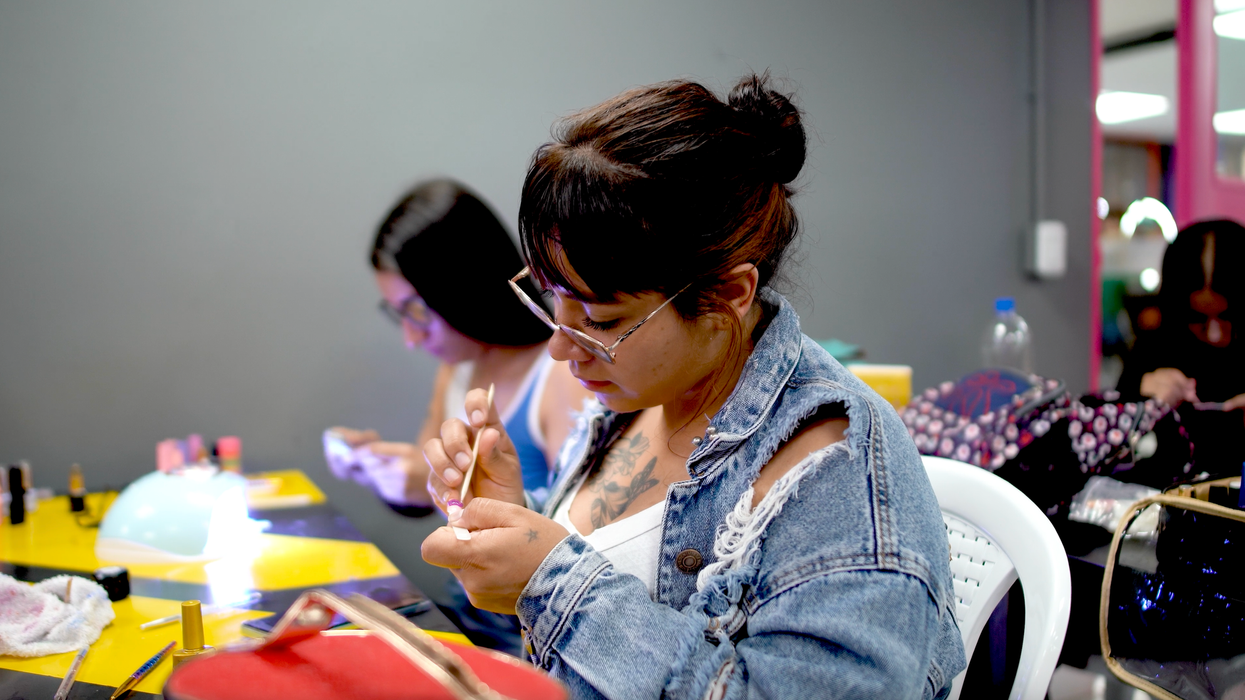

It is graduation day in central Medellín. A hundred young people adjust the bright orange lanyards around their necks as they wait for their certificates in hairdressing and barbering. Families fill the room and record every moment. Among the graduates is seventeen-year-old Luisa Fernanda from Santo Domingo Savio. She remembers joining the program when staff visited her neighborhood and wrote down the names of young people. She says the call changed her life.
“They helped me leave a lot of drugs behind and stop spending so much time in the street doing things I should not be doing. I started focusing on what I like. Thanks to Parceros, I can say I moved forward,” she said. She now studies makeup and says the training helps her clear her mind. “I stay in the program because my mentor is always there for me. She advises me, checks on me, and pushes me. That changed me a lot.”
Her story reflects the strength of Parceros, a Medellín initiative that supports youth aged 10 to 28 who face pressure from criminal groups or live in homes under strain. The program’s director, Paulina Patiño, describes Parceros as a word rooted in companionship and support. For her, the name captures the work. The team walks with young people who want to change their lives and treats them first as human beings with equal dignity and potential. From there, they open doors to education, work, and stability.
That philosophy shapes the program. Counselors offer steady emotional support and work closely with families. Staff help young people stay in school or enroll in vocational courses. Local businesses provide training and first jobs. Graduations like this one are the visible result of months of slow, patient work.
And, according to Patiño, programs like Parceros show how community support shapes more than personal outcomes. “When young people feel safe and connected, they trust their schools and local institutions more. That trust is the base of civic life. It is hard for any community to talk about public safety or participation if its teenagers do not feel grounded or seen", she added.
The connection to the United States is direct. Many Latino families in the U.S. face similar stressors linked to economic pressure and limited access to community programs. Census data show that about one in four Latino children lives in a low-income household. The overall poverty rate for Hispanic individuals is about 15 percent, and the median household income for Latino families remains below the national average at about $65,500. National education statistics show that Latino students have lower access to after-school programs and attend schools with fewer counselors and fewer mental health resources.
These gaps in housing, income, and school support do not stay in the private sphere. They spill into civic engagement. Young people who feel pushed to the margins are less likely to join local programs, attend public meetings, or vote when they become adults. Strengthening support for Latino youth is also a way to strengthen the civic fabric in many U.S. cities.
Research from the Annie E Casey Foundation finds that youth in high stress environments do better when they receive mentoring, emotional support, and early exposure to work. CDC data also show that teens with at least one trusted adult in a school or community program are up to 40 percent more likely to stay engaged in school and avoid unsafe situations. The mix that Parceros uses mirrors what many community groups across the U.S. are trying to offer: steady adults, safe spaces, and clear routes toward a first job.
Later in the ceremony, another graduate adjusts his orange lanyard and smiles at his family. Eighteen year old Miguel Ángel Berrío Calle is also from Santo Domingo Savio. He heard about Parceros almost by chance. “I was at my aunt’s house when they arrived. They explained the program, took my information, and said they would only call a few people. I had the honor of being one of them,” he says.
Until recently, Miguel had no interest in barbering. That changed when he saw the course as a chance to learn something new. “I came in without experience. I did not know anything. Thanks to the professor and the academy, now I can do more and I want to continue. This is not the end for me,” he says. He plans to keep training after graduation.
Miguel talks openly about how the program reshaped his direction. “Before Parceros I spent a lot of time in the street and used many vices. My mind was not clear. I did not know what I was going to do with my life. I had many depressive moments,” he says. “Now I have a clear goal. I want to continue in barbering, learn more, and move forward with more confidence.” What he values most is simple. “The mentors. The teachings. More confidence in myself. Following my goals with the help of God.”
Stories like Luisa’s and Miguel’s echo the experiences of many Latino teenagers in the United States who navigate uncertainty, limited resources, or unstable environments. Community organizations in U.S. cities often work with teens who are unsure of their next steps or disconnected from school. The most effective programs follow the same pattern seen in Medellín. They offer emotional support, a safe environment, and a practical route into work.
Many U.S. cities are, in fact, debating how to fund youth programs, community safety, and mental health support. Research shows these investments matter. Parceros offers a working example of how steady mentoring and job pathways reduce risk and keep young people connected to their neighborhoods. It gives policymakers a concrete model rather than an abstract idea.
Fresno recently set aside one million dollars for a youth jobs corps that introduces teenagers to work, mentoring, and civic engagement while city leaders consider relaunching a youth commission. In Baltimore, local officials and the youth fund expanded grants for summer and after school programs so more young people can access stable adults, training, and safe spaces. Both efforts reflect pieces of what Parceros offers in Medellín steady guidance, practical skills, and community ties that help young people stay connected to school, work, and public life.
By the time graduates in Medellín step forward to receive their certificates, they have already gone through a long process of rebuilding trust, forming new habits, and imagining a future they once thought unreachable. For U.S. readers, especially in communities with growing Latino populations, the scene serves as a reminder. A young person’s direction can change when a community offers steady care, meaningful mentorship, and clear opportunities.
Alex Segura is a bilingual, multiple-platform journalist based in Southern California.