


Last week brought more bad news for American democracy when the Pew Research Center released survey results showing that “Americans are more likely than people in other countries surveyed in 2025 to question the morality of their fellow countrymen.” As Pew reports, “The United States is the only place we surveyed where more adults (ages 18 and older) describe the morality and ethics of others living in the country as bad (53%) than as good (47%).”
It is one thing for people in a democracy to disagree about policies or who should lead the country. It is quite another for them to think of their fellow countrymen as immoral. Without a presumption of goodwill, even among those with whom we disagree, democratic politics runs aground.
Right from the start, political leaders in this country have recognized the importance of a kind of civic affection in democratic life. Without it, they feared our political system would always be on the verge of civil strife.
In 1790, President George Washington sent a remarkable letter to the Hebrew Congregation of Newport, Rhode Island. In it, he laid out a kind of democratic creed.
“May the children of the stock of Abraham who dwell in this land,” he wrote, “continue to merit and enjoy the good will of the other inhabitants—while everyone shall sit in safety under his own vine and fig tree and there shall be none to make him afraid.” By stressing “good will,” Washington highlighted a civic disposition without which democracy cannot flourish.
Six years later, Washington returned to that theme in his Farewell address. It was addressed to “Friends and Citizens” and expressed Washington’s hope “that your union and brotherly affection may be perpetual.”
Washington famously called attention to “the baneful effects of the spirit of party,” which, he warned, “agitates the community with ill-founded jealousies and false alarms, kindles the animosity of one part against another, foments occasionally riot and insurrection.”
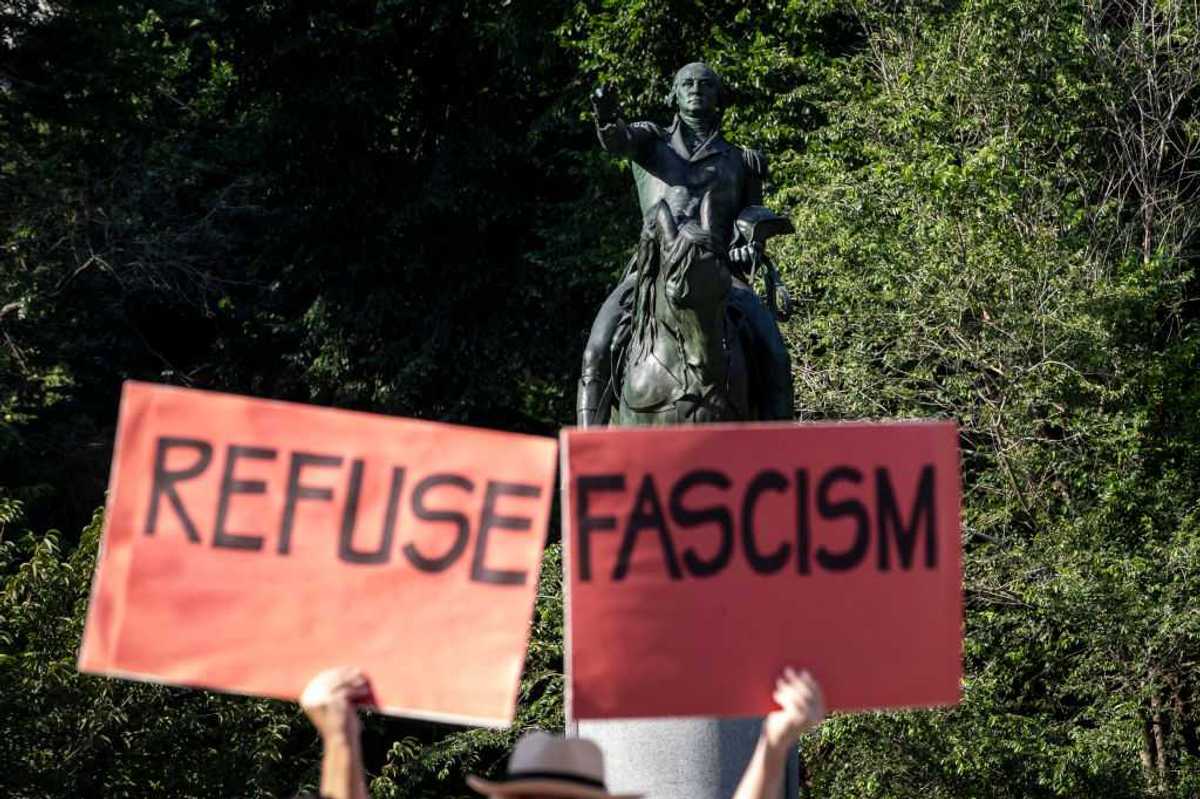
Poor George must be rolling over in his grave.
On March 4, 1801, Thomas Jefferson, echoing Washington, began his inaugural address with the salutation “Friends and fellow-citizens.” He urged his listeners to “unite with one heart and one mind [and] restore to social intercourse that harmony and affection without which liberty, and even life itself, are but dreary things.”
“Every difference of opinion,” Jefferson added, “is not a difference of principle. We have called by different names brethren of the same principle. We are all Republicans, we are all Federalists.’”
“Brethren of the same principle,” you wouldn’t know it from reading the results of the Pew survey.
And then there is Abraham Lincoln, who, on the cusp of the Civil War, also thought of citizenship through the lens of friendship. “We are not enemies, but friends,” he said.
“Though passion may have strained,” Lincoln observed, “it must not break our bonds of affection. The mystic chords of memory… will yet swell the chorus of the Union, when again touched, as surely they will be, by the better angels of our nature.”
Seems almost quaint to read the words of Washington, Jefferson, and Lincoln at a time when the current president takes every opportunity to demonize his opponents. But that is why it is particularly important for Americans to recall them and work to rekindle the spirit of civic friendship that those leaders praised.
Political philosophers have taken Washington, Jefferson, and Lincoln’s admonitions as inspirations to explore what civic friendship entails. For example, Hannah Arendt argues that “friendship among citizens …(is) a readiness to share the world with other men.” It is not “sentimental” or “intimately personal.”
For Arendt, the kind of friendship that democracy demands is expressed in “the constant interchange of talk…(among) citizens.” Civic friendship, Professor Roger Berkowitz explains, “is Arendt’s wager that a common world can be built not through domination but through the ongoing work of speaking, listening, and staying in relation. It is an austere hope: that among people who disagree, the world can still appear, and appear in common.”
Civic friendship requires, Berkowitz points out, “that we see each other as more than our opinions, to stay in relation even when arguments fail, and to preserve the trust without which no common world can survive. Without friendship, even courts, newspapers, and universities become instruments of suspicion and struggle. With friendship, the world regains its coherence.”
As the Pew survey shows, regaining such coherence in the United States will not be easy. But the poll results suggest that political division, in itself, does not necessarily lead to seeing others as bad people.
India, Israel, and Nigeria are marked by political conflict every bit as intense as it is in the United States. But in India, only 9% of the population says that others' morality and ethics are bad. In Israel, that figure is 27%, and in Nigeria, it is 29%.
Political scientists argue that Americans have come to demonize others and see them as immoral because, over the last half-century, our identities and sense of self have become wrapped up with our party affiliations. We think that if the other side wins, our very way of life will be destroyed.
In this way, policy differences become matters of life and death, and policies that we don’t like, and the people who support them, are seen not just as wrong but as evil.
But our tendency to view each other as immoral or unethical is also a product of ignorance and misinformation. As Johns Hopkins University Professor Lilliana Mason notes, “We all overestimate the extent to which people in the other party are extreme in terms of the policies. We also overestimate the degree to which the party is made up of groups that we kind of think of as like the stereotypical groups associated with the party.”
”Republicans,” she explains, “think that the Democratic Party is majority Black. It’s not. Democrats think that the Republican Party is majority wealthy people who make over $250,000 a year. It’s actually like 2 percent.”
When “political scientists and sociologists,” Mason adds, “have done experiments where we correct people’s misperceptions… it actually makes them hate the other party less because they hadn’t realized that the party wasn’t made up of maybe people they didn’t like or wasn’t made up of people who are really extreme in their policy preferences. We are overestimating the extent to which the other party is made up of people that we assume we would really dislike.”
Correcting such misimpressions is a good place to start in addressing America’s civic friendship crisis. Another place to start is supporting places like schools and libraries that bring people together while honoring their differences.
The words of Washington, Jefferson, and Lincoln remind us that repairing the breach documented by Pew does not require us to wait for direction from Washington, DC. We can begin the repair work needed where we live, study, and work.
The future of our democracy depends on doing so.
Austin Sarat is the William Nelson Cromwell professor of jurisprudence and political science at Amherst College.