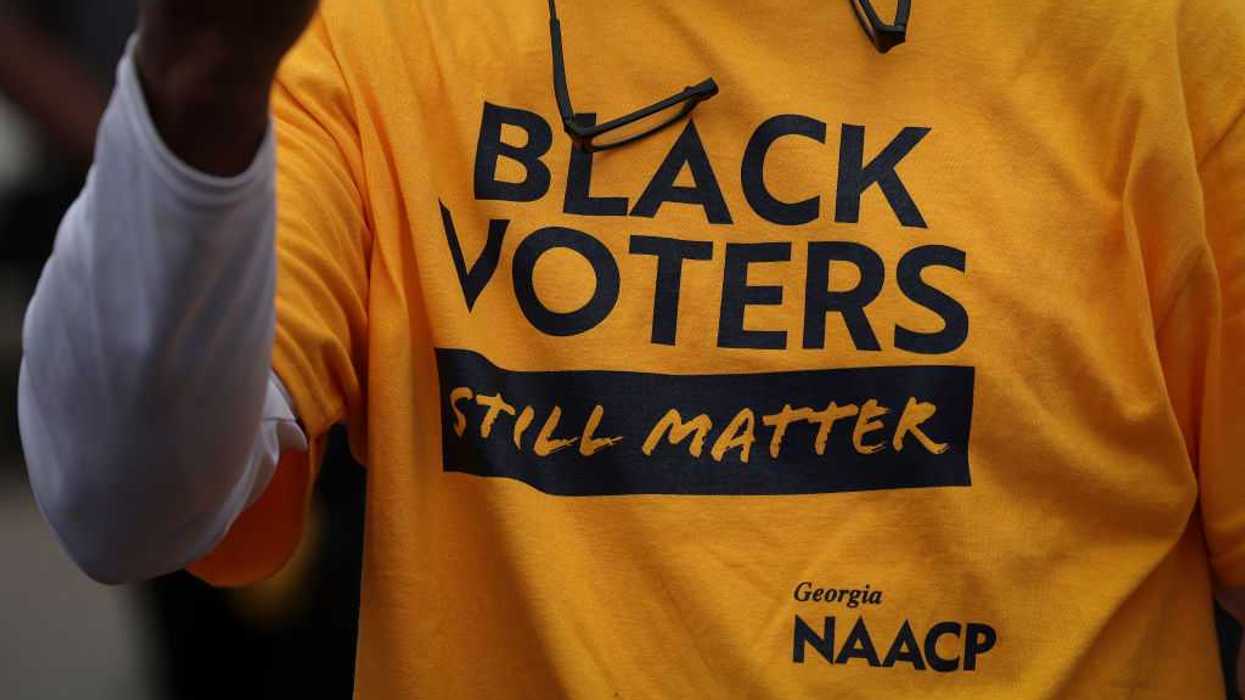


The day before we flew to Alabama to lead a civil rights and leadership trek with 30 MBA students, the Supreme Court issued its decision in Louisiana v. Callais, a case we were watching closely in light of our upcoming trip. Writing for the majority, Justice Alito substantially narrowed Section 2 of the Voting Rights Act of 1965, ruling that states may draw congressional district lines on partisan grounds even when the practical effect, and many argue the intention, is to dilute Black voting power. Justice Kagan, in dissent, called it the completion of the majority’s “demolition” of the Act.
It was with this backdrop that our students stood with us on the Edmund Pettus Bridge in Selma, Alabama—the very place that birthed the Voting Rights Act, where the courageous actions of a small group of people helped, as Rev. Martin Luther King Jr. so famously put it, “bend the arc of the moral universe towards justice.”
We had just left Brown Chapel, where we met the extraordinary Joyce O’Neill, a small but mighty woman of 76 who told us in incredible detail about crossing that bridge on Bloody Sunday as a teenager and about her churchgoing mother, a beloved teacher in Selma who always followed the rules. And yet, in the spring of 1965, she would turn away from her students to face the chalkboard so she wouldn’t be culpable while her students slipped out the door to prepare to march.
The bridge is smaller than you might expect, with a gentle arch and very little traffic, which makes it harder to understand how hundreds of people walking peacefully across it could have been met with the terrorizing sight of Alabama State Troopers on horseback, with billy clubs and tear gas. We had spent the previous day in Montgomery at the Equal Justice Initiative’s Legacy Museum and at the National Memorial for Peace and Justice, where more than 800 steel monuments hang suspended, one for each county where a known lynching occurred. As we moved through both sites, we kept asking the students a single question: “What does this have to do with you?” Many of them knew about Rosa Parks and Dr. King’s speeches, but the history they’d learned was one almost exclusively of triumph. Standing on that bridge, the Court’s ruling felt less like legal news and more like a lesson in moral leadership.
Ours was a diverse group of students, as was fitting, led by two women who would not have been expected to be standing there together in 1965: one of us black, and one of us white, both colleagues and friends at Dartmouth’s Tuck School of Business. Dr. Ella Bell has spent her career studying race, power, and institutions, and Ashley Zwick led the Tuck Research Center on Workplace Inclusion under Dr. Bell’s direction. We have found that our differences, honestly engaged, are a pathway to deeper learning. This trip was an expression of that conviction. It was also, for Dr. Bell, one of the last acts of teaching. After a long and distinguished career, Dr. Bell is retiring from Dartmouth later this month, and she chose to spend some of her final days as a faculty member not in an Ivory Tower, but in Selma, Alabama. We think that tells you something about what we both believe the university is for.
We have been leaders and teachers in some of the most elite business schools in this country. Our students will run companies, sit on boards, manage large institutions, and make decisions that touch thousands of lives. They have learned to read balance sheets, build effective teams, and navigate crises. What these schools do not emphasize enough is the importance of understanding history through the lens of social change, and the role of leaders in either creating more equity or diminishing it.
This isn’t only a criticism of business education. Universities are under increasing pressure to demonstrate return on investment and to prove that the degrees they issue are worth the escalating cost of tuition. This too is important, but not at any cost. Universities, at their highest purpose, have a unique role in American life: to produce active and engaged citizens. When you stand at the 43-foot-tall Monument to Freedom in Montgomery, Alabama, and read some of the 122,000 surnames of formerly enslaved people, something shifts. Several of our Black students were able to look up their family names and locate them on that monument—to place themselves in that history in the very place where it happened.
Universities that are serious about leadership should be asking what it means to develop leaders for a democracy that is visibly under strain. The answer cannot be more case studies, another speaker series, or a required ethics course that students treat as a box to check on the path to graduation, and a job at McKinsey. It has to include immersion in the actual history of American civic life, in the places where that history was made and is still being contested. This means genuine investment and institutional commitment from University leadership, in the form of funding and teaching resources.
Bryan Stevenson, whose Equal Justice Initiative built the remarkable Legacy Sites that our students walked through, has written that we are all implicated in the history of racial injustice in America—that the question is not whether we will engage with it, but whether we will do so honestly. Universities that send graduates into positions of power without that honest engagement are not neutral. They are complicit in a civic illiteracy that has real consequences, as Louisiana v. Callais makes plain.
Universities cannot restore what the Court has narrowed. But they can decide what they teach and where, and what kind of graduates they are trying to produce. They can fund programs that take students to the places where American democracy was tested most severely. They can treat this not as a supplement to leadership education but as its foundation.
As we stood together on the hallowed ground of Selma, Alabama, we couldn’t help but remark on the fact that these students who stood beside us will be in positions of influence when the next chapters of this argument are written. What they carry from that afternoon—the scale of what was sacrificed, the fragility of what was won, the immediacy of what is now at risk is not incidental to their education.
It may be the most important thing they learn about leadership in Business School.
Ashley Zwick is the former Executive Director of the Research Center on Workplace Inclusion at Dartmouth College.
Dr. Ella Bell is Professor of Business Administration at the Tuck School of Business at Dartmouth College, where she teaches Wicked Societal Challenges. She is retiring from Dartmouth in May 2026 after a distinguished career studying race, power, and institutions.