

Remember back in the 1970s, when the headlines blared warnings about an economic disease plaguing the U.S. economy? It was called “stagflation.” It’s a rare economic affliction in which inflation is high, unemployment is rising, and overall economic growth is slowing, all at the same time. Five decades ago, it caused major havoc to the national economy because it’s a tough disease for the economic doctors to cure. And now, like the hockey-masked villain in those Friday the 13th movies that seems to never die, a number of economic experts fear that: “Stagflation is baa-aaack!”
The U.S. last experienced stagflation starting in 1973, which seems like a long time ago back when Tony Orlando and Dawn’s "Tie a Yellow Ribbon Round the Ole Oak Tree" was top of the charts. That's when the Organization of the Petroleum Exporting Countries (OPEC), run by Middle East oil-producing nations, imposed an oil embargo, cut production, and banned exports to the U.S. and other nations supporting Israel during the Yom Kippur War. That action caused oil prices to quadruple, leading to severe oil and gas shortages and long-term changes in energy policy.
That was followed by the 1979 crisis ("My Sharona" top of the Top 100), triggered by an interruption in oil production as a result of the Iranian Revolution, which overthrew the U.S.-backed Shah of Iran. The price for a barrel of oil increased tenfold from $4 dollars in 1973 to nearly $40 by 1980. Rising oil prices in turn increased the costs of other goods, resulting in decreased spending on a range of goods and services. That led to reduced economic output by businesses and reductions in hiring that contributed to increased unemployment and lower wages. That in turn contributed to growing government deficits and debt amidst continuing inflationary pressures. A downward economic cycle seized the national economy, with no easy solutions.
Economic theory turned on its head
And thus the word stagflation entered the nation’s vocabulary. Usually, when inflation is high, it’s because economic growth is also high. In normal times, the two work hand in glove, and the natural policy intervention by the Federal Reserve is to raise interest rates, slow down spending, and cool off the economy. That is a classic economic textbook resolution.
But when the scourge of stagflation hit in the 70s, it was a horse of a different color. Attempts to manage the crisis, including large interest rate hikes to double-digits by the Federal Reserve in the late 70s and early 80s, killed off economic growth and pushed unemployment even higher. In what was termed a “double-digit peak,” the unemployment rate rose significantly alongside high inflation, contradicting previous economic theories that suggested an inverse relationship. Unemployment spiked, reaching roughly 9% in 1975 and continuing to climb toward a post World War II peak of nearly 11% by the early 1980s. Meanwhile, the inflation rate reached 13.3% by 1979, a hyper-inflation that the U.S. hadn’t seen since World War II.
All of this resulted in severe recessions in the 1970s and early 1980s. The combination of price shocks from the OPEC embargo and the Iranian revolution, combined with interest rate hikes to contain the price spiral, caused businesses to cut jobs and put millions of people out of work. The economy spiraled into a double-trouble vortex, and the confused experts couldn’t figure out which economic levers were the rights one to pull. The impact of these energy crises became a defining geopolitical and economic moment in U.S. history.
Is history repeating itself today?
Do we see those conditions percolating in today’s economy? An increasing number of economists, including those at Goldman Sachs, fear the answer is creeping toward a “yes.” But are they right? Let’s look at the evidence.
First, the economy today is generally weak, despite what President Trump says, as evidenced by low job creation, slowly rising unemployment, slowing economic growth, and inflation that has ticked upward even as the prices of key goods like groceries, housing, and energy remain stubbornly high. Add to that the uncertainty and impact of Trump’s tariffs, especially following the recent Supreme Court ruling overturning 70% of the tariffs. Falling consumer sentiment contributes to a general sense of unease.
But the biggest factor adding to stagflation concerns over the economy is unquestionably the current U.S./Israeli attacks against Iran. Iran has retaliated by shutting down oil shipping lanes in the nearby Strait of Hormuz, through which passes approximately 20% of the world’s oil supply. That has resulted in a sudden rise in the price of oil. Brent crude oil prices have experienced extreme volatility, surging to over $119 per barrel at one point before easing back to the $100–$113 range and, most recently, to $95 per barrel following Tuesday’s two-week ceasefire between the White House and Iran.
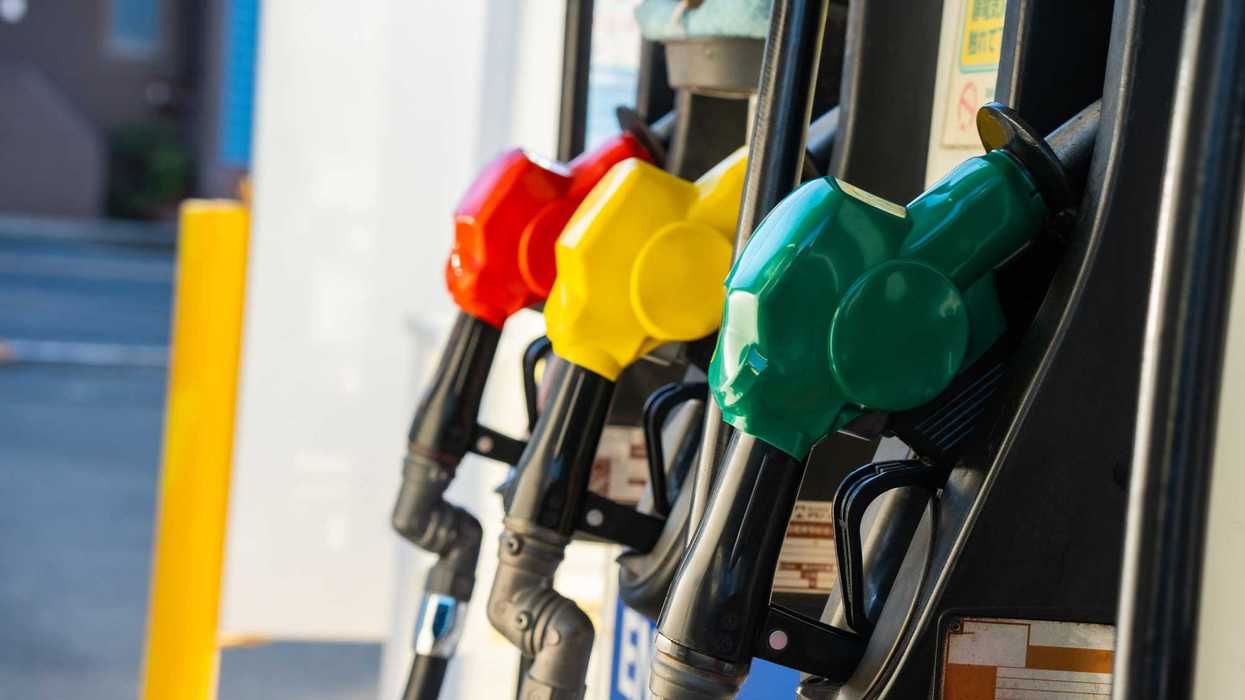
That’s still about a 36% increase since the war began. And U.S. gas prices have risen to a national average over $4.12 a gallon, according to the AAA motor club, an increase of 39% since the attacks against Iran started. U.S. diesel prices have increased even more quickly, to $5.65 per gallon, up 55 percent. Some are calling this the US-Iran “war tax.”
Although the U.S. is not as dependent on oil exports from the Middle East as we used to be, domestic prices are still impacted because of the close interconnection between global energy markets. Trump’s national energy policy of “Drill baby drill” has not insulated American consumers from his foreign policy debacles.
Quite the opposite, the war against Iran threatens to drive up not only energy prices for transportation but also other consumer costs, which if the two-week ceasefire doesn’t hold, will in turn eventually start dampening economic growth. Oil executives and petro market analysts are warning that if Iran does not allow the Strait of Hormuz to be permanently reopened by late April, oil-supply disruptions will get significantly worse and last far longer.
“The oil shock could destroy demand and dent global growth, with potential stagflation implications,” Lisa Shalett, chief investment officer at Morgan Stanley Wealth Management, wrote in a research note. “Each day the war rages, we see a reckoning slowly approaching.”
According to these experts, the clock is ticking on whether the economic and market fallout from the war will at some point escalate sharply. Depending on the duration of the ceasefire, a new oil shock may be building.
Differences between today and the 1970s
But there are some key differences between today and the 1970s that undermine the “stagflation is coming” prediction. Some of the differences are obvious.
For starters, the price of oil in the 1970s saw a tenfold increase over the course of the decade, and so far, we are nowhere near that level. And while the unemployment rate has inched up to 4.3% from an extremely low 3.4% several years ago, that’s still a far cry from the double-digit unemployment during the 1970s oil price surges. True, the employment rate today – the number of working Americans – has declined somewhat under Trump, with a notable loss of 92,000 jobs in February followed by a slight rebound in March. But these numbers haven’t yet reached anywhere near a 1970s level.
Similarly with inflation, where core consumer prices have risen to about 3 percent, which signals persistent inflation trends worth watching. But that’s far from the double-digit inflation from the 1970s oil shocks. And while the economy’s growth slowed in Trump’s first year to 2.1% compared to 2.9% in President Joe Biden’s last two years, nevertheless, a recession doesn’t seem to be in sight.
Whither goes the price of oil
The real wild card here is the price of oil. If the recent ceasefire does not hold, future prices will continue to be plagued by uncertainty. Just last week, the spot price for a barrel of oil, which reflects the real-time market price for a barrel of crude oil available for immediate delivery, shot up to $141.36, the highest level since the 2008 financial crisis. Such stratospheric numbers reflect the world’s ongoing financial jitters.
Nevertheless, Federal Reserve Chair Jerome Powell recently said during a press conference, “When we use the term ‘stagflation,’ I always have to point out that was a 1970s term at a time when unemployment was in double figures, and inflation was really high. And that’s not the case right now. We actually have unemployment really close to longer run normal. And we have inflation that's one percentage point above that. I would reserve the term stagflation for a much more serious set of circumstances. That is not the situation we are in…It's nothing like what they faced in the 1970s.”
Fair enough. But the Federal Reserve chair’s role is to be reassuring. After the president, he is the chief cheerleader of the economy. Despite the ceasefire, President Trump has requested $1.5 trillion for defense in the 2027 budget, and the Pentagon is asking for a $200 billion budget supplemental to fight a longer war than President Trump originally promised.
So the White House doesn’t seem to think the war with Iran is truly over. It remains to be seen what the situation will look like six months from now. I would not be surprised if the price of oil keeps bouncing up and down like a ping pong ball, along with all its usual impacts on the prices of transportation, energy, groceries, and other products that will greatly impact American consumers.
Steven Hill was policy director for the Center for Humane Technology, co-founder of FairVote, and political reform director at New America. See more of his writing at his Substack newsletter DemocracySOS.