


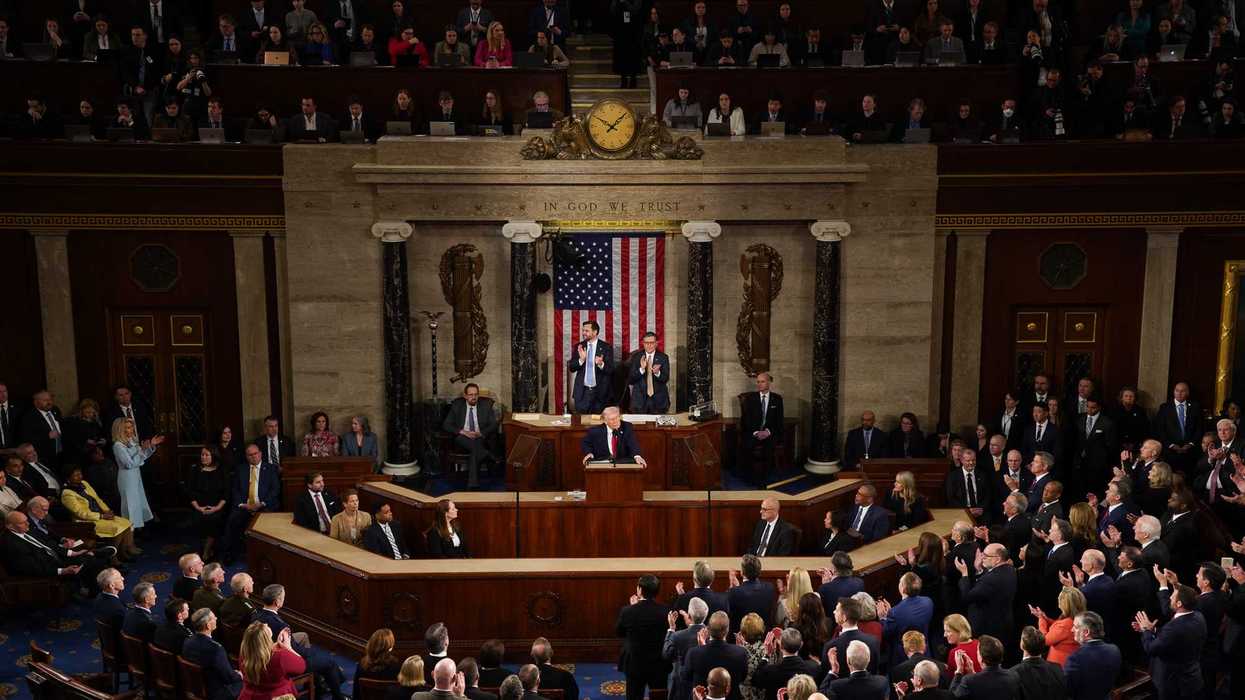

WASHINGTON — President Donald Trump used the longest State of the Union address in U.S. history on Tuesday night to argue that Americans are already experiencing “a turnaround for the ages” thanks to his agenda. But moments of disruption inside the House chamber and reactions from lawmakers afterward suggested Democrats and even some Republicans dispute his claims.
Trump’s address offered a snapshot of how the White House is trying to frame the economy heading into an election year. The administration sought to present easing inflation, falling prices, and rising wages as settled facts.
“He talked about affordability and how everything is cheaper now — beef, vegetables, gas, automobiles — none of which is true,” Rep. Adelita Grijalva, D-Ariz., told reporters on her way out of the chamber.
Throughout the address, Trump repeatedly argued that inflation is no longer a defining economic problem. He said inflation is “plummeting,” arguing that after one year in office, Americans are already benefiting from lower everyday costs, including groceries, gasoline, and housing.
“After just one year, I can say with dignity and pride that we have achieved a transformation like no one has ever seen before and a turnaround for the ages,” Trump said.
Recent inflation data showed some cooling, but prices continued to rise. According to the latest Consumer Price Index, headline inflation eased from 2.7% in December 2025 to 2.4% in January 2026, indicating that price increases were slowing rather than outright falling. Core inflation, which excludes food and energy, remains elevated, underscoring that many household costs are still rising, just at a slower pace. Still, slower inflation does not translate into lower prices, particularly for goods and services that surged during the peak inflation period.
The White House reinforced the president’s message during the speech. At 9:37 p.m., while Trump was addressing Congress, the administration released an article declaring that “Trump is delivering real relief” and “reversing Biden’s economic disaster.” The release closely mirrored the president’s remarks, signaling a coordinated effort to frame the economic moment as one of improvement rather than transition.
Inside the chamber, Democrats reacted skeptically to that portrayal. Some visibly shook their heads as Trump listed examples of falling prices. The pushback reflected a broader dispute over whether aggregate economic indicators align with voters’ lived experiences.
After the address, Rep. Adelita Grijalva, D-Ariz., said the president’s description of affordability did not match what she hears from businesses and families in her district. Small business owners continue to report the risk of closure due to higher costs, she said.
Questions about credibility extended beyond domestic policy. When Trump claimed to have ended eight wars during his time in office, Rep. Rashida Tlaib, D-Mich., shouted that the statement was false. The president was referring to the Cambodian-Thai border crisis, which escalated into a direct armed conflict on July 24, 2025.
That tension resurfaced later in the speech when Trump turned to Russia and Ukraine. While he said he was working to bring an end to the war, he did not explicitly name Russia as the aggressor. The omission drew visible reactions from both parties, particularly given that the address coincided with the fourth anniversary of Russia’s full-scale invasion of Ukraine.
“He did not call out who is the aggressor and say that we stand with Ukraine,” Sen. Chris Coons, D-Del., told reporters in the Capitol's National Statuary Hall.
Criticisms were also raised inside Trump’s party.
“If I had to pick two items of the speech that were on the bad side, that would be one of them,” Rep. Don Bacon, R-Neb., told reporters in the Capitol.
The economic and foreign policy moments underscored the stakes of the address in an election year. Public opinion data suggests he faces a skeptical electorate. A recent Pew Research Center survey found that 61% of Americans disapprove of the way Trump is handling his job as president. A separate CNN/SSRS poll conducted in mid-February showed a similar pattern, with 63% disapproval
The same CNN/SSRS survey found that 57% of Americans said the economy and cost of living were the issues they most wanted Trump to address in his State of the Union.André Hiroki covers business for Medill on the Hill.
The Fulcrum is committed to nurturing the next generation of journalists. Learn how by clicking HERE.













The President Invited Iran to Bomb My Home