
Skip to content
Search

Latest Stories

Top Stories

Video: voting rights, the filibuster, and the state of the Senate

Voting Rights, the Filibuster, and the State of the Senate

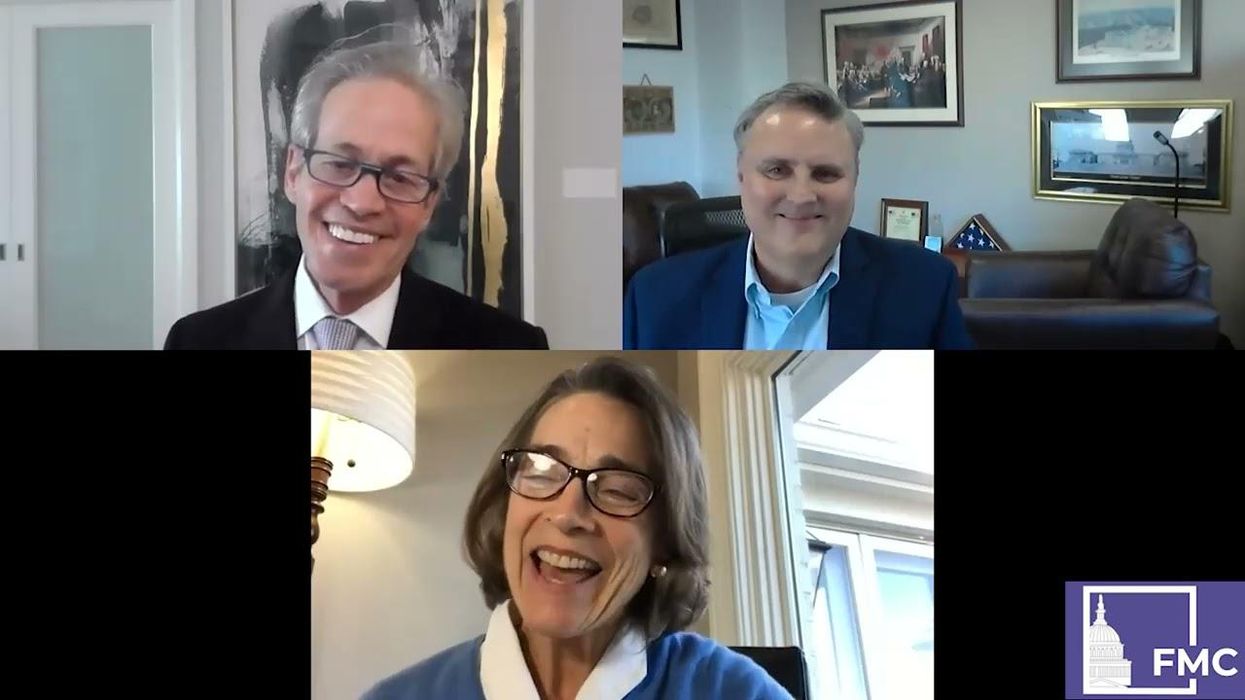
From social media to cable news, all the American public sees from our leaders are partisan attacks and hyperbolic rhetoric, but that's not the way it has to be. To prove it, Former Members of Congress (FMC) and the Fulcrum have joined forces to bring you Congress at a Crossroads.

The monthly video series brings together Former Members of both parties to discuss the structural issues in today's Congress, as well as the hottest political issues. They won't always agree, but they will always treat each other with respect and civility. This month, our host, FMC CEO Pete Weichlein sat down with Former Senators Blanche Lincoln (D-AR) and Norm Coleman (R-MN) to discuss voting rights, the legislative filibuster, and what the state of the Senate is like now given the recent battle over these issues.

Read More

Mount Vernon

Mount Vernon is located on the banks of the Potomac River in Fairfax County, Virginia.

Getty Images, Bogdan Okhremchuk

What Washington’s Humble Grave Reveals About American Exceptionalism and the Rule of Law

If you want to understand what makes the United States exceptional on an emotional level, take an in-person or virtual trip to both Mt. Vernon, Virginia, and Paris, France. At Mt. Vernon, you can tour the preserved and reconstructed plantation of George Washington, viewing what the tour claims is the first compost bin in the nation and reading about the particular way he organized his gardens.

The most important part, though, is his grave. The first President of the most powerful nation on Earth rests in a modest brick mausoleum about ten feet high, built into a hillside. The plain white room containing the sarcophagi of Washington and his wife is barely larger than the two coffins themselves.

Keep ReadingShow less
Mount Vernon

Mount Vernon is located on the banks of the Potomac River in Fairfax County, Virginia.

Getty Images, Bogdan Okhremchuk

What Washington’s Humble Grave Reveals About American Exceptionalism and the Rule of Law

If you want to understand what makes the United States exceptional on an emotional level, take an in-person or virtual trip to both Mt. Vernon, Virginia, and Paris, France. At Mt. Vernon, you can tour the preserved and reconstructed plantation of George Washington, viewing what the tour claims is the first compost bin in the nation and reading about the particular way he organized his gardens.

The most important part, though, is his grave. The first President of the most powerful nation on Earth rests in a modest brick mausoleum about ten feet high, built into a hillside. The plain white room containing the sarcophagi of Washington and his wife is barely larger than the two coffins themselves.

Keep ReadingShow less
Leaked ‘wish list’ for peace in Russia-Ukraine war is hardly America First

U.S. President Donald Trump meets with Ukrainian President Volodymyr Zelensky at the White House on August 18, 2025 in Washington, DC.

(Getty Images)

Leaked ‘wish list’ for peace in Russia-Ukraine war is hardly America First

Last week, a 28-point “peace plan” for the Russia-Ukraine war surfaced. It was apparently fleshed out in Miami over cocktails by President Trump’s son-in-law Jared Kushner, Trump’s special envoy Steve Witkoff and Witkoff’s Russian counterpart Kirill Dmitriev.

Many critics immediately derided it as a “Russian wish-list.”

Keep ReadingShow less
Hardliners vs. Loyalists: Republicans Divide Over Mamdani Moment

U.S. President Donald Trump shakes hands with New York City Mayor-elect Zohran Mamdani (L) during a meeting in the Oval Office of the White House on November 21, 2025 in Washington, DC.

Photo by Andrew Harnik/Getty Images

Hardliners vs. Loyalists: Republicans Divide Over Mamdani Moment

Yesterday’s meeting between Donald Trump and New York City's Mayor-elect, Zohran Mamdani, was marked by an unexpected cordiality. Trump praised Mamdani’s “passion for his community” and called him “a very energetic young man with strong ideas,” while Mamdani, in turn, described Trump as “gracious” and “surprisingly open to dialogue.” The exchange was strikingly civil, even warm — a sharp departure from the months of hostility that had defined their relationship in the public eye.

That warmth stood in stark contrast to the bitter words exchanged before and after Mamdani’s election. Trump had dismissed him as a “radical socialist who wants to destroy America,” while Mamdani blasted Trump as “a corrupt demagogue who thrives on division.” Republican Senator Rick Scott piled on, branding Mamdani a “literal communist” and predicting Trump would “school” him at the White House. Representative Elise Stefanik went further, labeling him a “jihadist” during her gubernatorial campaign and, even after Trump’s praise, insisting that “if he walks like a jihadist… he’s a jihadist.” For Republicans who had invested heavily in demonizing Mamdani, Trump’s embrace left allies fuming and fractured, caught between loyalty to their leader and the hardline attacks they had once championed.

Keep ReadingShow less