


Steinmetz is a Hungarian-born Jew whose family moved across Western Europe as refugees avoiding the Holocaust. She now lives in Boulder, Colo.
I recently gave a lecture to students at Colorado University about my childhood experiences as a refugee survivor from the days of the Holocaust. Aside from relating my story, I had a message to deliver: “Vote. Talk to your friends, parents, neighbors and anyone who will listen. Your country is at stake!”
The sole purpose of telling my family’s story is to awaken students to what happens in a dictatorship country to ensure that “Never again” means “Take action.”
I can’t seem to concentrate on the shoes in which I walked during my life. Whenever I try, my mind races back to when I was 4 years old and shoes were put on me in haste to run from bombs, from soldiers, from tanks, from buildings crumbling, from fires blazing. Those shoes were used to escape as mothers grabbed their children in terror. Shoes determined one’s fate — life or death. Shoes are a method of escape and a tool for taking action.
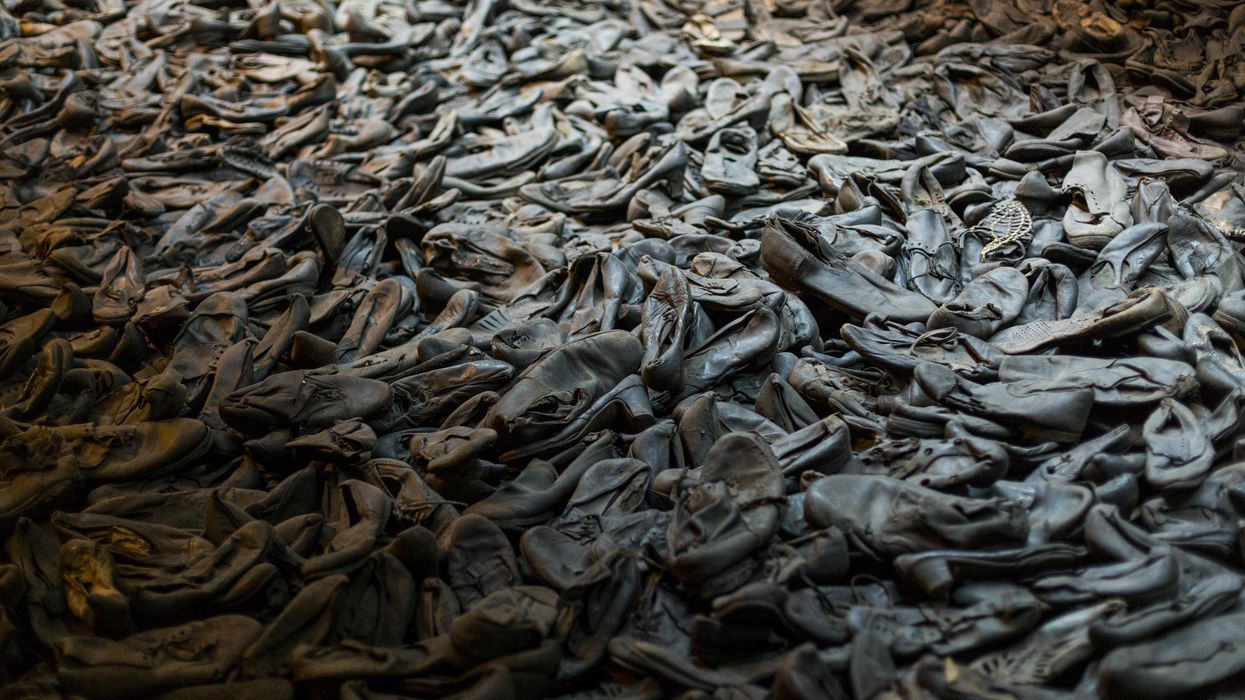
Such shoes are on display in Holocaust museums, piled high in containers, left behind by victims who were directed to disrobe. The shoes were then collected, summarily thrown into bins while the wearers either marched to their death or tripped on their way, their bare feet on frozen ground.
I see the shoes lined up as a sculpture, a memorial to the events along the Beautiful Blue Danube, where, in January 1945, Jews were hauled to the shores, forced to disrobe and leave their shoes along the banks. Then, as if that was not bestial enough, they were tied two by two with a rope, standing there in the frozen air, as one of each pair was shot. The bundled pair were kicked into the frozen river, the dead victim pulling the live one under the frozen water to drown in the most inhumane way.
These are the visions of shoes for me.
Try as I might to think of all the shoes I stood in, the view in my mind’s eye quickly changes to the shoes hastily gathered today, in 2022, by fellow human beings once more running for their lives, grabbing their terror-stricken children. To run away from their homes, their lives, their traditions, their homeland. Running on their shoes. Running with their children in their arms, leaving their lives, possibly forever … again. Didn't we say, “Never again?” But once again some tyrant is turning the world order upside down. When is enough finally going to be enough?
I go into my closet to see the shoes that I haven’t been able to throw out, and I ask myself, “Why?” They are not used anymore, the leather is cracked, the color is faded. Yet, I still have those shoes. My mother’s silver dancing shoes that she probably had in the 1920s, a wonderful time in Europe. She brought them with her, packed them when she ran from persecution, packed them as we escaped from country to country, tucked them in the back of how many closets in places we lived? But she always brought them with her. Shoes — a reminder of a past, a reminder of joy, of celebration, of laughter without concern, of a life with already dark shadows lurking, ready to change her world without her even having a clue. I have those shoes.
As I’m trying to downsize, I look at those shoes, but I can’t put them in the Goodwill bin. How many people in Ukraine took a special memento with them as they ran toward the trains and buses to get them out of there, to take them out of harm's way? How many took a memento of their lives, as a reminder of a different time, a place they called home?
The scenes of the people running, with absolutely no control over their lives, is terrifying.
We have to tell the story because even more terrifying is the misinformation that has spread like a dark cloud over certain parts of the world. The denial of reality that has prevailed in our land clears the path to tyranny, discrimination and intolerance. I have a heavy heart. It is hard for me to see the rays of sunshine pouring through the dark clouds of chaos. It is hard for me to turn to celebration amidst frenzy. These are the shoes I wear today, and I can’t remove them. They are tied tight to my feet. I can’t budge them. I can’t.
But don’t think I’m on the way down the well without an escape.
I was given shoes wherever my family went, some old, and musty, some tight and too short where we had to cut the leather off the top for my toes to stick out. But I did get the shoes, and because of the generosity of so many who helped our family, today we are able to have another generation … the next generation made possible by those who had shoes, those who ran hard and fast, those who were lucky, like myself.
I became a great grandmother in recent days, to a tiny little girl called Esther Ivy, named for Esther, of a long ago story, who was the hope, the strong resolute woman who rose up to save a people. Today, a guy named Zelensky rose from the ranks, a plain simple man, a young Moses of the 21st century, rising from nowhere, donning his battle-ready boots, to save his countrymen from a tyrant.
Now, as I watch world events with 85-year-old eyes, I feel like I don’t really know which pair of shoes to put on for this time. But, actually, I do know which shoes to wear: the shoes of action, of involvement, of voice, of speaking to anyone and everyone who will listen. I assert myself to do my part to save our democracy.
We are in trouble and everyone who holds choice, freedom, our system of justice, our Constitution in their hearts must put on the shoes of personal engagement by taking to the streets, galvanizing support, speaking out everywhere, donating, writing letters, making phone calls. Be a bystander, a silent watcher, and your rights will be snatched away by legislators, leaders, authoritarians who only want power to control, turning our country back to a time when some of our population didn’t have choices or rights or safeguards.
Vote! Write! Speak! Your voice counts. Your voice, along with all the others, will make a difference.