



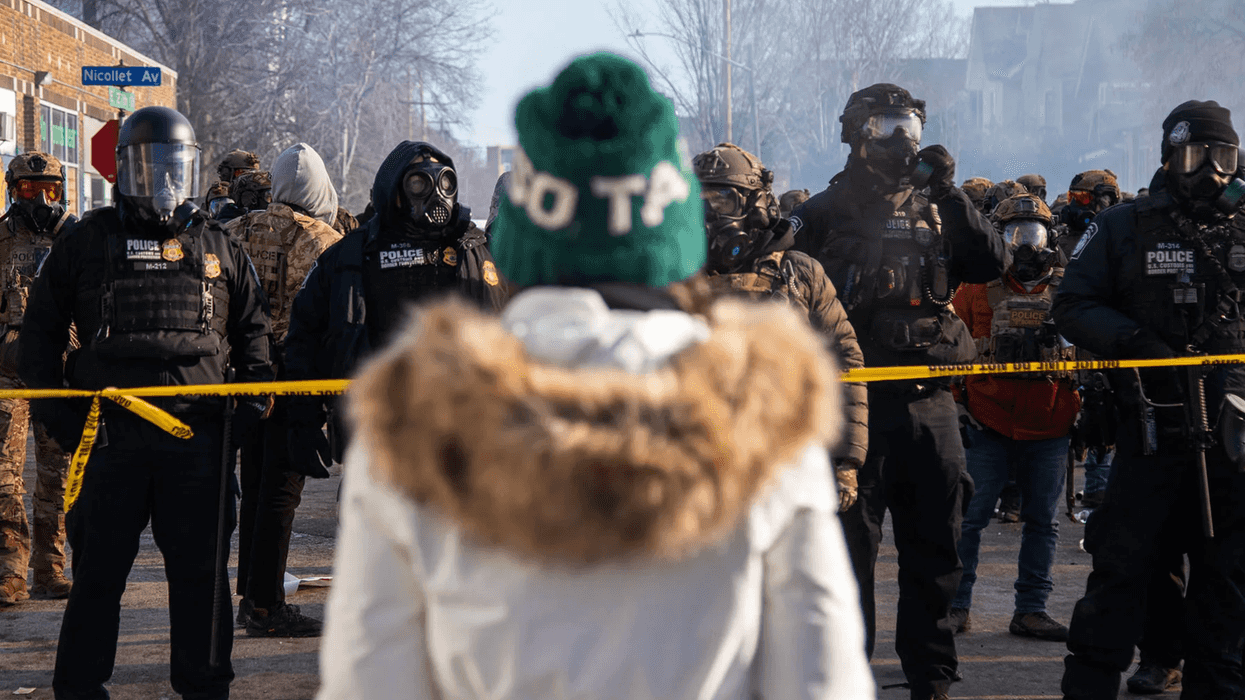

It was a frigid January morning in Minneapolis. Alexa quietly stepped outside her apartment to heat her car for her baby, who was waiting inside in her crib.
They immediately spotted her.
At the edge of the complex, the doors of a van carrying Immigration and Customs Enforcement agents swung open. They sprinted toward her.
She remembers the guns they held, and how the sight of them caused her to drop her lunchbox in the snow, turn on the spot and run as fast as she ever had back into the safety of her apartment, back to her daughter. When she shut the door, she didn’t leave again for nearly three months.
She couldn’t work. Those months drained every penny she had saved. When her own money ran out, she had no one to turn to. A year prior, her partner died in a car accident while she was eight months pregnant, leaving her with no other family in the United States. As she kept an eye on the ICE agents outside of her window, she turned to Minneapolis’ robust mutual aid networks run by volunteers who delivered groceries, formula and diapers to her door.
When ICE finally started to withdraw from the city in April, Alexa, whose name The 19th has changed to protect her privacy, finally ventured out. She started picking up odd jobs again and life returned to some sense of normalcy.
Until it came time to renew her Deferred Action for Childhood Arrivals (DACA) application about two months ago.
Alexa arrived alone in the United States from Honduras when she was 14 years old, which qualified her for DACA. For years, that policy has protected her from deportation and granted her permission to work. That work permit has been her lifeline over 12 years, and every two years she has faithfully renewed it.
With no savings, she had to decide between paying her rent to keep her baby and her 5-year-old housed, or paying the application fee — $555 — plus nearly $800 in attorneys fees she usually pays to ensure the application is done correctly. She chose rent.
But without her work authorization, Alexa can’t find a better job or regain any stability. She picks up any odd job that comes her way — cleaning hotel rooms, cooking and selling food — to gather up enough to renew her permit.
“I only work and work, and I can’t do anything else because I need to recover economically. I am the only one who is here with my daughter,” Alexa said in Spanish. “This is how many of us are.”
In the months since the end of ICE’s Operation Metro Surge in Minneapolis, which claimed the lives of two American citizens and saw hundreds of people with no criminal background detained, the immigrant families who hid in their homes are still reeling from the long-term effects of months of employment and income loss. One of the most pressing now: Interruptions in their immigration status or delays in paperwork that have kept them stuck in a cycle of uncertainty for nearly eight months.
Bri, a Minneapolis single mother who has single-handedly been running a mutual aid network for months, said about 52 people have contacted her seeking help covering their DACA fees. Nearly all of them are single mothers like Alexa.
“I have a lot of families, single moms, people from my community that are reaching out asking if I know who can get help,” said Bri, whose name The 19th changed for her safety. “A lot of families don’t have $500 lying around right now.”
At the start of the year, Bri amassed about $250,000 in donations to help get breastmilk donations to babies whose mothers had been detained, as well as other needs. That money helped 174 families with rent assistance and other bills. But “the need is just so high right now,” Bri said, and she’s now out of funds. Across the state, demand at food shelves and the number of eviction filings are set to hit all-time highs in 2026. In Minneapolis, the city estimates that immigrant workers with limited English proficiency lost $152 million in wages from December to March alone.
Bri has started a new GoFundMe, but no funds have trickled in yet. She’s been referring people to other local organizations, but those too are running out of money and having a harder time drawing donations or volunteers.
The support that flooded into Minneapolis at the start of the year has abated, but the problems have not.
Around town, people are on certain street corners with their tools waiting for someone to drive by and give them a job. Restaurants aren’t as full. Kids aren’t out at parks as much as they used to be. Church pews go unfilled on Sundays. Recently, two people were taken by ICE out of a front yard where they were cutting grass.
Single mothers, who work at higher rates than other mothers because they rely on the income to support their children, are already more likely to be low-income, facing higher rates of food and housing insecurity. Even three months of work disruption could put them in a precarious position, at risk of losing their housing and not having enough to feed their children.
Karen Clara, the social services director at the St. Louis Park Emergency Program, a local social services agency, said the organization has been using donations that came in at the start of the year to cover rent assistance for more than 200 families, and recently more people have been asking about aid with immigration paperwork filing fees. They’ve continued offering the rent assistance as a way to open people up to use other funds to cover filing fees, she said.
But the group is down to their last $5,000.
“I’ve been having mostly a lot of conversations with people to try to troubleshoot and think about letting them know our funding is running out. ‘How are things looking? Are you able to maybe join with another family member who is in the area to save money with rent? How are jobs working?’” Clara said.
Tracy Roy, the legal director at the Immigrant Law Center of Minnesota, said part of the problem for DACA families is there is almost no way to waive the filing fees, even for those with little to no income. On top of that, those who filed at the start of the year are seeing processing times as long as eight months in some cases, Roy said.
The Trump administration was sued last month for delays in processing DACA renewal applications, which are usually fulfilled within four to eight weeks but now can take three months or more.
For the single moms who are left to raise children after a male partner is deported, which is common among the people she sees, Clara said, there is now fear of deportation.
When they come in, Clara said, she “can see the hesitancy on their faces.”
“We’re a few months out from when things have kind of calmed down, but it’s a lot of trauma that’s gonna have to be worked through,” she said. “There’s going to be long-lasting financial effects. There are families who are torn apart.”
Ensuring they can maintain their immigrant status, she said, is “priority level number one.”
Jazmin, a single mother of two girls in Minneapolis, is preparing for her DACA to lapse in September. She was fired from her job at Target at the start of the year when she stopped going to work as ICE descended on the city. She’s back at work now, but was demoted, and her last day will be September 18 unless she can renew her DACA by September 20, when it’s set to lapse. In the meantime, she’s playing catch-up on an even slimmer budget and trying to squirrel away anything she can for her DACA renewal. With attorney fees, it will cost her about $1,300.
Jazmin has renewed the application numerous times since she got DACA in 2015 — she’s been in the United States since she was 5 years old — but this is the first time it may lapse.
“All of this is a nightmare that we all hope will end soon,” said Jazmin, who The 19th is identifying only by her first name.
As a precaution, she appointed someone to care for her girls should she get deported. With no family in the United States, she selected one of her daughters’ teachers.
“I felt like a horrible mother that day, because how could I sign my kids away to a teacher? But in that moment it was for their safety,” she said. “I felt like I failed them.”
Roy said the situation for many families exemplifies how ICE operations like Metro Surge could destabilize families’ lives for years — even for those who avoided deportation.
The attacks on immigrant families “haven’t stopped just because they’ve gotten quieter,” she said. ICE is still detaining people.
For now, her organization has been able to cover immigration paperwork filing fees for all the families who have come to them asking for help — about 100 this year — and the organization does not charge any legal fees to help with applications. But there is little legal recourse for those who are in limbo waiting to receive their permits as delays continue.
And eventually, their funds, which came in through donations largely at the start of the year, will dry up.
“It is something we are talking about internally, is how we can continue to do this if we don’t have a steady stream of donations,” Roy said.
Single Mothers Lost Months of Income Hiding From Ice — and Now Can’t Afford To Renew Immigration Papers was originally published by The 19th and is republished with permission.










Children watch a July Fourth Parade along the Walkway of Heroes and Independence Avenue on July 04, 2026 in Tappan, New York.
The Great American Grumpfest
Our nation’s 250th birthday party didn’t feel especially patriotic and wasn’t as much fun as the 200th anniversary was.
President Trump, who did his best to co-opt our holiday for his personal aggrandizement, was a major reason. The party he threw in Washington, D.C., was crankier than uplifting, and less about celebrating our shared past and a promising future than about reminding us how far we have strayed from our founders’ plan to create a republic that future Americans would keep in good working order.
Credit Trump this much. He has a singular gift for picking at scabs that other politicians would rather ignore and pushing us into reckonings we don’t need.
The thing is, Americans have seen all this before. Sometimes the makeover we were encouraged to undertake was more conservative, sometimes more liberal. Whatever direction we were pushing, however, the reckoning we had in mind this time had to be more forthright and the conclusion more definitive than it was the last time.
Our current discontents, the ones behind the reckoning President Trump has been trying to inspire, are not trivial. Included among them are immigration, birthright citizenship, exploding healthcare costs, election rigging, a gag-inducing national debt, how we educate our children, too many genders, racial differences we can’t move past, a lopsided economy that favors more well-off Americans, and historic levels of political corruption and graft. Add to these the several foreign adventures he has pushed us into or is anxious to undertake, and you have the makings of a national headache the likes of which we haven’t had in half a century.
All the elbow-throwing and overheated rhetoric we’re using today have begun to look almost normal in all the ways that bickering neighbors and feuding family members appear normal. But they have also made us look mean-spirited and have portrayed our differences as irreconcilable. To ourselves, of course, but also to many people outside the United States who might be forgiven for turning their heads and not looking at the national car wreck we Americans show no interest in avoiding.
The good news, as I suggested above, is that Americans have had a great deal of practice dealing with challenges and national car wrecks like these.
This essay begins to lay out the reasons why.
By way of illustration, we have our seemingly insatiable demand for more bad news about race in America.
Sixty years after being released from the legal constrictions that bedeviled both white and black Americans, many white people have come to believe the color that used to make them unassailable is now a sign of a moral inferiority born of a racial animus they can never wash off. Many black people, on the other hand, are insisting that America is as hopelessly stacked against them as the formerly unassailable white people’s ancestors used to tell their black ones.
The result is that many people today are buying into racist nightmares and mumbo jumbo that their black and white ancestors worked hard and effectively to put in each other’s heads.
This might be dismissed as crazy behavior if it weren’t so important to rituals Americans have long used to express their deepest fears about each other while figuring out what move they can make that won’t end with their world crashing down on everybody’s head.
Unfortunately, the kind of cultural sleight of hand we have used to ramp up our racial differences has been appropriated by people who have many other cultural fears and unresolved differences with each other. Their clumsy but culturally prescribed missteps are making all these other issues look as irremediable as our racial problems.
A good place to start an answer to how we back away from ledges is Alexis de Tocqueville’s writing on early-19th-century American democracy. He had an optimistic take on Americans’ unscripted displays of public bravado, recrimination, and payback.
For him, these were occasions when people tried to mitigate the effects of the unfair hand they were dealing someone else or had themselves been dealt by behaving in ways quite at odds with how they would otherwise be expected to act. These inversions of what Tocqueville called “the natural order of conscience” presented themselves as a loud but culturally muted challenge to the hypocrisies that people had built into the world they’d made together.
One of his favorite illustrations of early-American hypocrisy involved slave masters sleeping with their less-than-worthy slaves. To the best of my knowledge, he didn’t pick up on all the ways that slaves messed with their owners. Their well-chronicled and quiet resistance showed that even severely ill-treated people can exercise more control over their lives than outsiders appreciate.
Be that as it may, such inversions of a people’s “natural order of conscience” make a good public show of them wrestling with demons they can’t or may not want to shake off, but in any case, are nowhere close to figuring out how to cast out.
Implicit in these disruptions was the discomforting idea that people might flip the entire script and turn the world on its head in more permanent ways. That kind of flipping worked out better for us in our revolution against England than in our Civil War. These events taught us the value of stepping back from historically unprecedented ledges.
Americans of late have been giving loud expression to a long list of things they don’t like about each other and the last makeover they started but didn’t finish a half-century ago. The outcome of our fights today will be as revealing as they are embarrassing to everyone who imagined they could recast our country in a way that privileged their favorite kind of Americans.
Their disappointment with the accommodations they strike will be palpable, but the middling results they achieve with all their pushing and shoving won’t be anything they can’t live with.
Anthropologists who have written about such moments in other cultures less “advanced” than our own show that people find ways to work around their seemingly irreconcilable differences without ever fully resolving them. Indeed, the patches and repairs people make have the unheralded effect of reinforcing rather than undermining the legitimacy of the practices and values they thought were fundamentally flawed.
For example…
White guilt and black pessimism do more good than putting cash into the pockets of professional shamers and handwringers. They give the rest of us who don’t feel guilty or powerless more time to make the world less racially unequal. Good news.
Regarding illegal immigration, the entrance requirements for future immigrants will remain stringent. Americans will applaud the continued detention and deportation of the few illegal immigrants who commit serious crimes. Good news.
All the people who came to the United States without being legally vetted and were locked up for a time will be released in numbers small enough to avoid serious media attention. Along with the several million other good people who snuck in but avoided capture, the former detainees will go to school, find gainful employment, pay their taxes, and stay out of trouble. Many will eventually become citizens. Good news.
Investigations into election tampering and Donald Trump’s 2020 presidential loss will come to an unceremonious conclusion the day after his second term ends. Many Americans will grumble about this, but there will also be some quiet partying, too. Good and bad news.
Congressional hearings into all the grifting accomplished by people tied to the Trump administration will end without anyone having to pay a dime back to the American taxpayers. Bad news, we’ll learn to live with.
New laws and regulations will be created in the hope that the kind of corruption practiced by President Trump will not be repeated for another 250 years. Good news, I hope we’ll live long enough to enjoy.
Show trials for people who allegedly vandalized the Lincoln Memorial Reflecting Pool, if they happen, will get big television viewer ratings. Good news.
Trials for pardoned Capitol insurrectionists who committed serious crimes after their release should get more attention, but won’t. Bad news.
We will continue to hear nothing from most of the people who were pardoned for crimes they committed in the insurrection at the Capitol on January 6, 2021. They will keep their mouths shut and their heads down for the rest of their life. Good news.
The gold-gilded ornaments that Donald Trump had plastered all over the White House will be shipped to Mar-a-Lago, where the former president will sell them on eBay. Fun news.
American taxpayers end up paying for most of the new East Wing, the removal of the miniature gladiatorial arena that was built behind the White House, and the restoration of the White House rose garden. Bad news.
The Triumphal Arch was never built. Good news.
Trad wives and gay couples raise perfectly lovely children. Good but unsurprising news.
Trans men and women learn that most Americans can’t figure out who they used to be. No one gives a second thought to their use of “family bathrooms” or “unisex bathrooms” in public settings, businesses, and schools. Communities will sponsor athletic teams that have trans boys and girls just to show they can. Good news.
Budget deficits will be kicked down the road for someone else’s children to pay down. Bad news.
Federal agencies that had their budgets and employee ranks slashed during President Trump’s second term are getting some of the money and lost positions back. Good news.
Elite universities will buy their way out of DEI purgatory by competing for conservative scholars whose inflated salaries dwarf those of their liberal colleagues, who will think about suing their institutions for reverse discrimination but won’t be able to figure out who would pay for it or care. More fun news.
Okay. I’ve probably missed some ways that Americans will step back from the ledges they have been making noises about leaping off. But to the extent that my predictions pan out, the best and most important moral of the stories about us stepping away is this: everything we lost and took back, or had returned to us, will have happened without our government collapsing, civic traditions crumbling, or our people beating each other up.
The reason why is that the differences Americans have with each other really weren’t as irreconcilable as we made them out to be. The empty-sounding bromide that Americans have more that unites us than divides us turns out to be true, not just metaphorically but in fact.
Now that is really something to celebrate.
Daniel J. Monti (danieljmonti.com) is Professor of Sociology at Saint Louis University and the author of American Democracy and Disconsent: Liberalism and Illiberalism in Ferguson, Charlottesville, Black Lives Matter, and the Capitol Insurrection.