



The midterm elections for Congress won’t take place until November, but already a record number of members have declared their intention not to run – a total of 43 in the House, plus 10 senators. Perhaps the most high-profile person to depart, Republican Rep. Marjorie Taylor Greene of Georgia, announced her intention in November not just to retire but to resign from Congress entirely on Jan. 5 – a full year before her term was set to expire.
There are political dynamics that explain this rush to the exits, including frustrations with gridlock and President Donald Trump’s lackluster approval ratings, which could hurt Republicans at the ballot box.
Rather than get swept away by a prospective “blue wave” favoring Democrats – or possibly daunted by the monumental effort it would take to survive – many Republicans have decided to fold up the beach chair and head home before the wave crashes.
As of now, two dozen Republican House members have either resigned from the House or announced their intent to not run for reelection in 2026. With only two exceptions – Republicans in 2018 and 2020 – this is more departures from either party at this point in the election calendar than any other cycle over the past 20 years.
There is also growing concern within the House Republican caucus that Greene’s announcement is a canary in the coal mine and that multiple resignations will follow.
As a political scientist who studies Congress and politicians’ reelection strategies, I’m not surprised to see many House members leaving ahead of what’s shaping up to be a difficult midterm for the GOP. Still, the sheer numbers of people not running tells us something about broader dissatisfaction with Washington.
Why do members leave Congress?
Many planned departures are true retirements involving older and more experienced members.
For example, 78-year-old Democratic congressman Jerry Nadler is retiring after 34 years, following mounting pressure from upstart challengers and a growing consensus among Democrats that it’s time for older politicians to step aside. Nancy Pelosi, the former speaker who will turn 86 in March, is also retiring.
Sometimes, members of Congress depart for the same reasons other workers might leave any job. Like many Americans, members of Congress might find something more attractive elsewhere. Retiring members are attractive hires for lobbying firms and corporations, thanks to their insider knowledge and connections within the institution. These firms usually offer much higher salaries than members are used to in Congress, which may explain why more than half of all living former members are lobbyists of some kind.
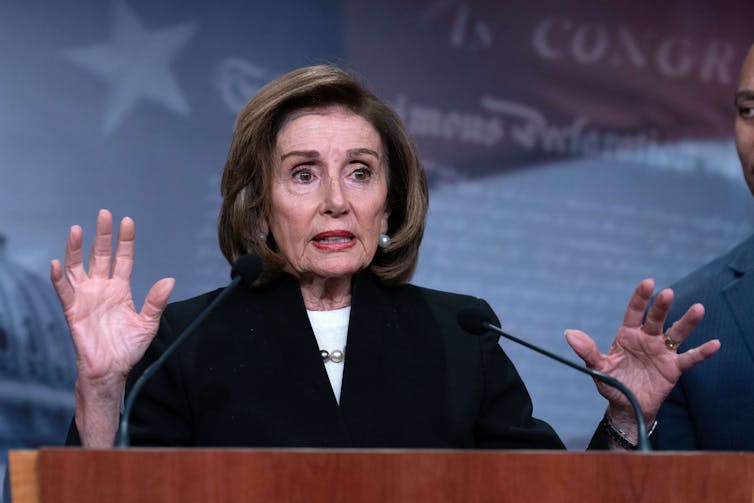 Democrat Nancy Pelosi, who was first elected in 1986, will step down at the end of this Congress. Jose Luis Magana/AP
Other members remain ambitious for elective office and decide to use their position in Congress as a springboard for another position. Members of the House regularly retire to run for a Senate seat, such as, in this cycle, Democratic Rep. Haley Stevens of Michigan. Others run for executive offices, including governor, such as Republican Rep. Nancy Mace of South Carolina.
But some are leaving Congress due to growing frustration with the job and an inability to get things done. Specifically, many retiring members cite growing dysfunction within their own party, or in Congress as a whole, as the reason they’re moving on.
In a statement announcing his departure in June, Sen. Thom Tillis, R-N.C., mused that “between spending another six years navigating the political theater and partisan gridlock in Washington or spending that time with my family,” it was “not a hard choice” to leave the Senate.
What’s unique about 2026?
In addition, there are a few other factors that can help explain why so many Republicans in particular are heading for the exits leading up to 2026.
The shifting of boundaries that has come with the mid-decade redistricting process in several states this year has scrambled members’ priorities. Unfamiliar districts can drive incumbents to early retirement by severing their connection with well-established constituencies.
In Texas, six Republicans and three Democrats – nearly a quarter of the state’s entire House delegation – are either retiring or running for other offices, due in part to that state’s new gerrymander for 2026.
All decisions about retirement and reelection are sifted through the filter of electoral and partisan considerations. A phenomenon called “thermostatic politics” predicts that parties currently in power, particularly in the White House, tend to face a backlash from voters in the following election. In other words, the president’s party nearly always loses seats in midterms.
In 2006 and 2018, for example, Republican members of Congress were weighed down by the reputations of unpopular Republican Presidents George W. Bush and Trump. Republicans had arguably even greater success in midterm elections during Barack Obama’s presidency.
Currently, 2026 looks like it will present a poor national environment for Republicans. Trump remains highly unpopular, according to polls, and Democrats are opening up a consistent lead in the “generic ballot” question, which asks respondents which party they intend to support in the 2026 midterms without reference to individual candidates.
Democrats have already been overperforming in special elections, as well as the general election in November in states such as New Jersey and Virginia, which held elections for governor. Democrats are on average running 13 points ahead of Kamala Harris’ performance in the 2024 election.
As a result, even Republicans in districts thought to be safe for their party may see themselves in enough potential danger to abandon the fight in advance.
Retirement vs. resignation
One final, unique aspect of this election cycle with major consequences is not an electoral but an institutional one.
House conservatives are quietly revolting against Speaker Mike Johnson’s leadership style. That members may be frustrated enough not just to retire but resign in advance, leaving their seats temporarily vacant, is a notable sign of dysfunction in the U.S. House.
This also could have a major impact on policy, given how slim the Republicans’ majority in the lower chamber is already. Whatever the outcome of the midterms in November, these departures clearly matter in Washington and offer important signals about the chaos in Congress.
Charlie Hunt is an Associate Professor of Political Science at Boise State University.