



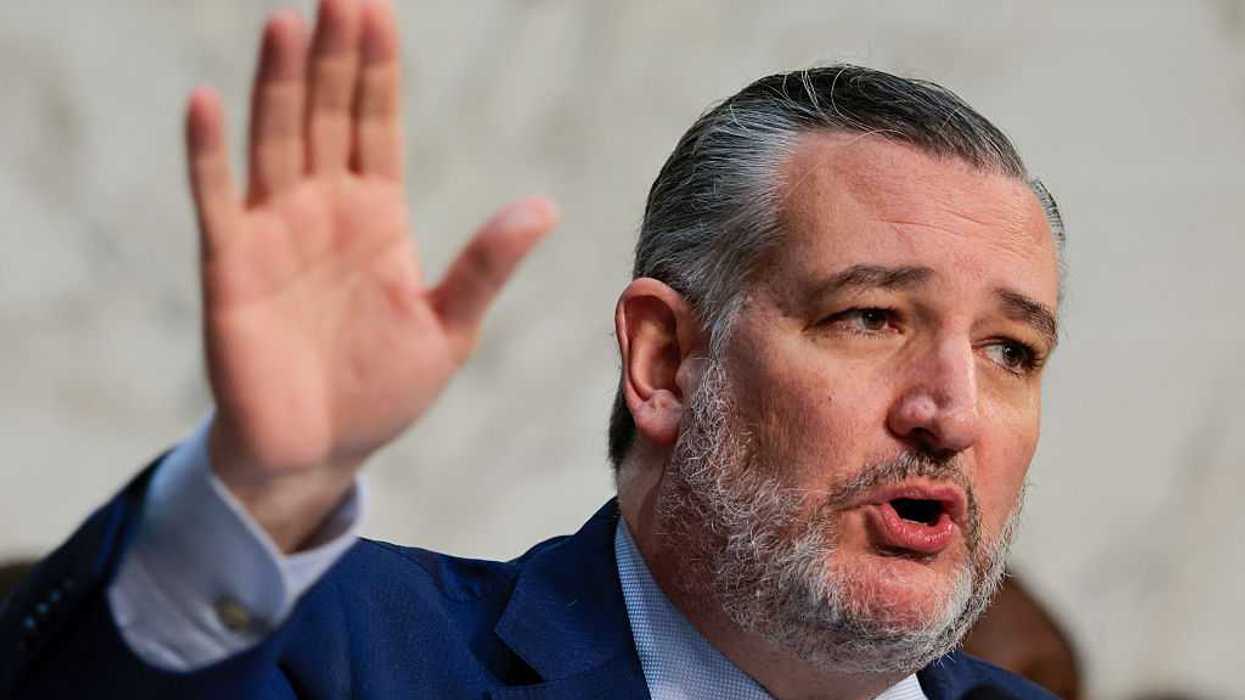
Sen. Ted Cruz (R-Texas), who built his political brand in part by arguing that politics had no place in sports during the Black Lives Matter protests, recently went on ESPN College GameDay to promote his bipartisan Protect College Sports Act, a bill that eventually cleared the Senate by a 77-22 vote and is headed to the House come November.
Cruz’ appearance didn’t go as planned, with the crowd greeting him with a chorus of boos and dealing him a devastating blow in his own home state. Beneath the surface, Cruz’s sting at College GameDay reflects a new trend in MAGA’s political playbook: using sport to advance legislation that hurts the constituents it claims to protect.
Ties to the political arena are not entirely new in sports broadcasts. For example, ESPN showed former President Barack Obama’s enthusiastic greeting of fans during a 2019 match of men’s basketball rivals Duke University and University of North Carolina.
On the other end of the political spectrum, 2012 Republican candidate for the U.S. Senate Craig James was a GameDay personality before (unsuccessfully) entering the political arena.
But what is so striking about Cruz’s appearance on GameDay ahead of the University of Texas at Austin’s show-off against Ohio State earlier this fall, however, is not the appearance of a political figure such as Cruz on the sports show.
It is the fact that his appearance on one of ESPN’s most prominent college sports platforms served the sole purpose of promoting a piece of federal legislation.
The timing of Cruz’s shameless lobbying attempt on ESPN is no coincidence. With the midterms looming on the horizon, the Texas Republican party is becoming increasingly vulnerable when it comes to holding onto power.
In the Texas primaries held earlier this year, Democratic turnout outpaced that of Republicans for the first time since 2020. In February, a Democratic candidate won a special election to serve in the Texas state senate by a margin of 14 percent – a double-digit win some have described as a “wake-up call” for Republicans.
Amid declining national approval ratings, the GOP held its national midterm convention in Dallas, a spectacle appearing to be a rescue mission for the party.
With Democratic momentum growing, it is not surprising that the party once fighting to the nail to keep politics out of sports for the sake of “unity” has now discovered that, perhaps, sport is not so apolitical after all.
Research by sport scholars has, of course, shown that there is no such thing as apolitical sport and that sport. Quite to the contrary, sport is often used to advance political goals.
In one of my research studies, my co-authors and I have shown how supposedly “neutral” policies prohibiting political protests in sport draw from the myth of neutrality to suppress athletes calling attention to social issues and challenging an unjust status quo.
In the MAGA world where hypocrisy runs as deep as the roots of Longhorn football in Austin, the spectacle of big-time sports now presents a fruitful arena for Republican opportunism.
President Donald Trump has spent years cultivating that arena to push his political agenda, from his appearances at UFC events, college football games, and the FIFA World Cup this past summer to turning the historic White House lawn into the hosting site for a UFC fight card. Now other MAGA Republicans like Cruz are taking notice.
Some may argue that a media platform like ESPN’s College GameDay is the perfect place to talk about legislation affecting college athletes. At first sight, that argument seems reasonable: GameDay reaches precisely the audience that has a stake in the future of college sports.
But Cruz’s appearance was not simply an effort to inform college sports fans about a piece of legislation. It was a calculated political pitch delivered on one of the most influential stages in college sports, using the emotional pull of a cultural institution to advance his political agenda.
But there is more that lurks beneath the surface when it comes to Cruz’s appearance on the ESPN broadcast. The piece of legislation he is promoting, the Protect College Sports Act of 2026, seeks to give greater regulatory power to the NCAA and its major conference, which could in turn limit college athletes’ power in advocating for more just labor relations.
Labor advocates such as the AFL-CIO, in particular, raised alarm bells that the Trump-backed bill can potentially weaken athletes’ bargaining power.
Similarly, the Congressional Black Caucus has issued a scathing statement opposing the act, describing it as falling short of “providing Black athletes with the rights, representation, economic opportunities, and meaningful safeguards they deserve, while also failing to adequately recognize the interests of Black coaches, Black agents, HBCUs, and other professionals whose futures will be shaped by this legislation.”
Given the legislation Cruz is advocating may ultimately be hurting the constituents it seeks to protect, voters seem to look right through the senator’s playbook. The crowd’s response in Austin was, perhaps, the clearest indicator that the audience recognized the political calculation behind Cruz’s stunt.
A striking parallel between college football and politics is that there must ultimately be winners and losers. Historically, athletes from marginalized communities, and Black athletes in particular, have scored important wins when it comes to social justice reform.
Their work has shown that politics, not politicians, belong in sport.
Come November, voters must ask themselves whether they want politicians like Cruz to exploit the power of sport to advance their own political agenda – or whether the political torch should once again be placed in the hands of those who most benefit from a shift in power: the athletes themselves.
Yannick Kluch, Ph.D., is an associate professor of sport management at the University of Illinois Urbana-Champaign. He is a Public Voices Fellow of The OpEd Project and the University of Illinois system.