
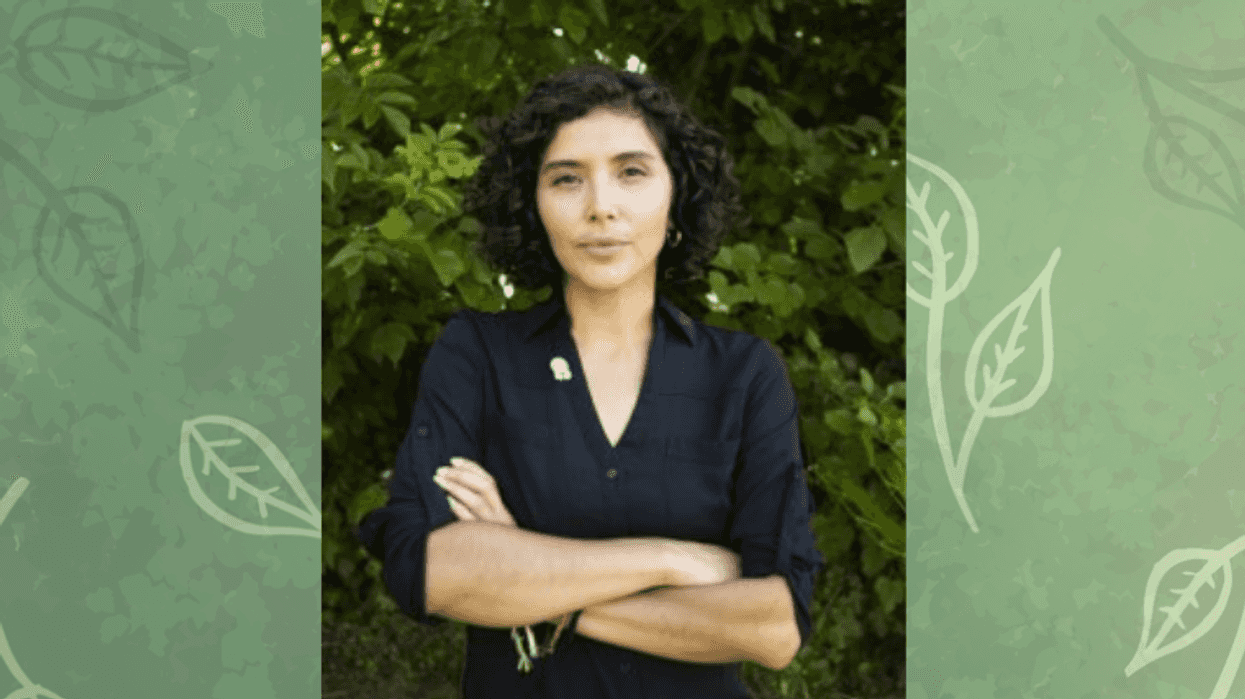

When Michelle Martinez talks about climate change, she does not begin with temperatures, emissions, or models and projections.
She begins with people. For Martinez, the inaugural director of the Tishman Center for Social Justice and the Environment at the University of Michigan (U-M), climate change is already being experienced through the housing, economic, and political crises confronting communities today. And that makes climate justice inseparable from a more basic civic question: Who has the power to decide what happens to a community?
The Tishman Center, established in 2021 at U-M’s School for Environment and Sustainability, was created around a particular idea of what a university can do in that struggle. Made possible through gifts from The NorthLight Foundation and Dan and Sheryl Tishman, the center connects students with environmental justice organizations and community leaders, supports community-led research, and prepares students to work on the problems communities are already facing.
That model grew partly from what Martinez felt was missing during her years working in environmental justice in Detroit.
“What I really needed from the university was a constant and steady support, with actionable research that could result in policy change,” she said.
Communities' needs, however, rarely follow the timetable of academic research. Environmental justice organizations may be responding to air pollution permits, legislative calendars, or the proposed siting of major developments while researchers are still developing a study.
“Communities like mine often need a more engaged and rapid response,” Martinez said, “but also a kind of scholarship that relies on relationship building.”
That distinction is central to how Martinez describes the Center's approach. The goal is not only to bring university expertise into communities, but to change how students and researchers understand their role.
“When we start to see ourselves as researchers, or as students in higher education, as participants in civic society, we can really start to change our orientation towards the expert,” she said.
The Center’s Climate Justice Movement Catalysts Fellowship reflects this idea by placing students in community organizations and supporting them with mentorship, financial assistance, and professional development. The Center describes the fellowship as a way to build leadership while contributing research and capacity to environmental justice organizations.
For Alexandrah Walker, a Catalyst Fellow working with the College of Menominee Nation’s Sustainable Development Institute, that relationship begins with listening. After first visiting the institute in January, she continued building relationships with its staff through summer visits and online meetings. Her work included mentoring undergraduate interns, helping them develop work plans, discussing their goals and troubleshooting challenges as they progressed.
“Working in/for/with community really requires you to cast your ego aside and what you think you know, and instead listen and strive to build healthy reciprocal relationships centered on trust and respect while being cognizant of cultural boundaries and customs,” Walker said.
Her experience illustrates the Center’s philosophy in practice. The work is not only about bringing knowledge acquired in a university into a community. It also requires students to build relationships, understand local contexts, and support people in pursuing their own goals.
In one example Martinez discussed, students worked with a Sikh community whose approach to sustainability was rooted in its cultural traditions. Practices such as energy efficiency and composting became more meaningful when they were connected to the community's existing values.
“Nobody was against those things, but by embedding it into cultural tradition, it had a place. It had a home,” Martinez said.
She described another project in northern Michigan involving tribal knowledge, land governance and technology. The work brought together efforts to reclaim Anishinaabe fire management practices with LiDAR technology and elders' knowledge. The point was not to replace community knowledge with technical expertise, but to bring different forms of knowledge into the same conversation.
That same approach is increasingly relevant as new pressures emerge.
Martinez is now working with roughly a dozen environmental justice organizations around the Great Lakes to understand how communities are thinking about the rapid growth of data centers. Many of these communities already live with the legacy of fossil-fuel infrastructure. Data centers introduce another major demand for energy and land, raising questions about who benefits from development and what communities want in return.
In Minnesota, Martinez recalled, organizers who had previously mobilized around protecting immigrant communities became involved in a fight over a proposed data center. When the city asked what the community wanted, the answer was not necessarily another technological solution. They wanted housing for people experiencing homelessness.
“The sort of intersectional approach, what civil society needs amidst climate chaos and political crises, is far more robust and responsive,” Martinez said.
For Martinez, this is part of what a just transition requires: communities having enough power to articulate what they actually want their future to look like.
“We really are trying to change the priorities of how people vision the future,” she said.
The Center's investment in students also extends beyond their time at Michigan.
Martinez pointed to Dr. Malu Castro, now a postdoctoral fellow at U-M’s School for Environment and Sustainability, as one example. Castro works with Kyle Whyte on Indigenous land restoration efforts and teaches courses on Indigenous sustainability and Indigenous rights. His scholarship grew from work on an ʻāina, or land, back initiative on Molokaʻi in Hawaiʻi, examining the theoretical and practical questions surrounding financing and pricing in Indigenous land restoration.
Martinez added that students with the resources, relationships, and space to pursue community-rooted work can carry those relationships into their scholarship and professional lives. The university becomes less of a place where knowledge is produced about communities and more of a place where people develop the capacity to work with them.
That is also how Martinez measures the Center's longer-term success.
“Over the next 30 years, what I would love to see is students building resiliency inside of communities that are most at risk,” she said.
The measure, she acknowledged, is difficult. Resilience might mean stronger housing institutions, greater capacity to resist criminalization or deportation, or the ability of a community to respond when the next crisis arrives. Those outcomes may take years or decades to become visible.
The difficulty is compounded by the barriers students themselves face. Martinez pointed to tuition, housing, caregiving responsibilities, and the distance many students must travel as obstacles that can prevent people from participating fully in this kind of work.
For her, those barriers raise a larger question about what society expects universities to do at a moment when communities are confronting overlapping environmental, economic and political crises.
That question becomes particularly urgent when climate change is discussed as something that will happen in the future.
For many communities, Martinez said, the crisis is already present.
“The disaster is already here,” she said.
Housing, education, domestic violence, drug use and economic and political instability are realities that are often discussed separately from climate change, according to Martinez. Yet, in her view, they are connected to how communities are equipped to respond to environmental disruption.
“It's not the weather itself; it's the divestment of the political system to respond to the weather,” Martinez said.
The response, then, strips away the idea of a single technological breakthrough and focuses more on investments in public transportation, walkable communities, housing, and local institutions.
It also raises difficult questions about the relationship between universities and the communities they study.
“When we have scholars who aren't taking social or political risks and leave communities to take those risks, that becomes a dual exploitation,” Martinez said.
Researchers can gain intellectual property, professional recognition and career advancement while communities bear the risks of the work, she argued. The Tishman Center is attempting to approach that relationship differently.
“We lock arms,” Martinez said, describing the Center's commitment to human rights, sovereignty and community agency.
The ambition is larger than producing better research. It is to create relationships through which communities can help determine what knowledge is produced, how it is used and what kinds of futures are considered possible.
That makes the Tishman Center an experiment in the civic role of a university. Its work asks whether higher education can become more than a place where students acquire expertise before entering public life. It can also be a place where students learn to participate in civic life while they are still there, alongside communities already doing the work.
For Martinez, the measure of that experiment may ultimately be found outside the university: in whether students leave with the relationships and skills to help communities build institutions, exercise greater control over their futures and withstand the crises ahead.
Val Amiel Vestil is a Graduate student at the University of Michigan and fall fellow with The Fulcrum.