




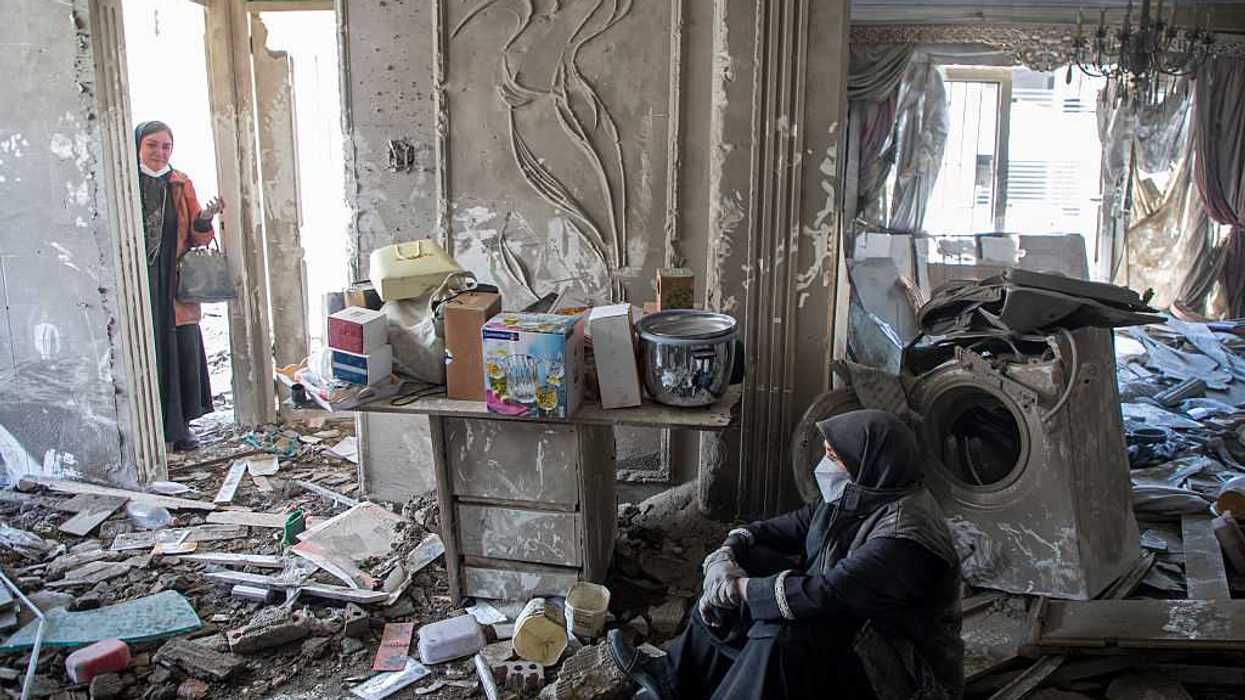

There has been much commentary on the dark side of President Trump’s character and the lack of leadership at other high levels of government. These events and the American president's statements should not go unchallenged. His efforts to dehumanize an opponent and trivialize bombing campaigns as they are part of a video game are unfathomable and inconsistent with most of American history. We must never forget that America is killing people, many innocent civilians, with apparently little remorse.
The war in Iran has brought back a memory from when my son was born nearly 20 years ago. A friend of my wife’s, an anthropologist and college professor, sent us a baby gift. It was a CD of music titled “Lullabies from the Axis of Evil.” The term “Axis of Evil” was first used in President George W. Bush’s 2002 State of the Union speech. He was referring to three countries that make up the axis: Iraq, Iran, and North Korea. Putting aside, for the moment, our complicated relationship with those three countries, the lullabies CD reminds us that, despite our geopolitical differences, these countries are home to human beings. They work, love, eat, drink, and practice religion as we do – and they sing lullabies to their babies.
One of the horrible aspects of the wars in the Middle East is the dehumanization of the victims. In a recent interview with the New York Times, scholar Marc Lynch described this as one of the consequences of the Israeli war in Gaza. “I think the fundamental problem is that we just have an extremely difficult time seeing these people as real human beings, and I think we just do not see them as people with families and lives and complicated motivations,” Lynch said.
Writing in The Fulcrum, David Nevins echoed this thought, criticizing President Trump, who said some weeks ago he might continue bombing Iran “just for fun.” “It reveals an appalling disregard for the human facts of war. A commander-in-chief speaking casually regarding striking a strategic oil hub “for fun” signals something deeper than excess language: a trivialization of war itself,” Nevins said.
It is incumbent on every American, indeed every citizen of the world, to decry this kind of attitude and language. And this is not just a moral argument to save innocent victims’ lives; it’s an argument to save ourselves. Research on the impact on societies committing attacks on others suggests that violence becomes normalized in public discourse, we become less reactive to atrocities, and media coverage loses its shock value.
Yet there are still dim lights in a dark world that give one reason to hope. I recently met Micah Hendler, the founder and musical director for the Jerusalem Youth Chorus, a musical group comprised of Israeli and Palestinian teenagers, spreading beautiful music and a message of reconciliation throughout the world. “Music is more permeable than spoken language in terms of being accessible across boundaries,” Hendler said in an interview. “I wouldn’t go so far as to say that music is a universal language. I think that’s an oversimplification, but that being said, it is much easier to bridge even between drastically different musical styles than it is between, say, Cantonese and Wolof (the language spoken in parts of Senegal, Gambia, and Mauritania). There’s not very much you can do if you don’t understand a spoken language,” he said.
Micah’s efforts and those of his youth chorus are reminders that bonds can be forged in unusual places, and there is more that unites us than divides us … like singing lullabies to our babies. One of the lullabies from the Axis of Evil is an Iranian song, “Sad Sol,” which translates to “You, My Destiny.” One lyric goes like this: “You’re my destiny / You’re my guiding light / You’re my soul and my treasure / Sleep, my child." I can picture an Iranian mother singing that lullaby to her daughter the night before an American bomb took the little girl’s life.
This argument should not be construed as a defense of Iran, and all the evil it has unleashed on its own people and the world. Yet, let us hope that when America looks back on this war, we cower from the atrocities that we as a nation inflicted on others, and pledge to return to the values we once embraced.
Bradford Fitch is the former CEO of the Congressional Management Foundation, a former congressional staffer, and author of “The Citizen’s Handbook for Influencing Elected Officials."














The President Invited Iran to Bomb My Home