



Skip to content
Search

Latest Stories

Follow Us:
Top Stories

America’s Data Crisis: Restoring Trust in the Facts That Unite Us

How strengthening federal data can rebuild shared reality and restore trust across the political spectrum

News

America’s Data Crisis: Restoring Trust in the Facts That Unite Us
a close up of a window with a building in the background

At a moment when Americans can’t even agree on the basic facts that mold our public life, the nation faces a deeper crisis than polarization alone. We are living through a collapse of shared reality. When people lose confidence in the numbers, surveys, and official information that once anchored civic debate, democracy itself begins to drift. Trustworthy government data isn’t a technical issue — it is core infrastructure that holds a self‑governing society together. And right now, that infrastructure is under strain.

The public has lost trust in government information on many levels and across the political spectrum. To restore that trust, we need to address the challenges facing government data — including low survey response rates, data protection concerns, and outdated or flawed statistical methods.


The Bridge Alliance and the National Academy of Public Administration are meeting this challenge through their Fellows for Democracy and Public Service partnership, a cross‑sector fellowship intended to elevate distributed leadership and advance actionable reform and renewal.

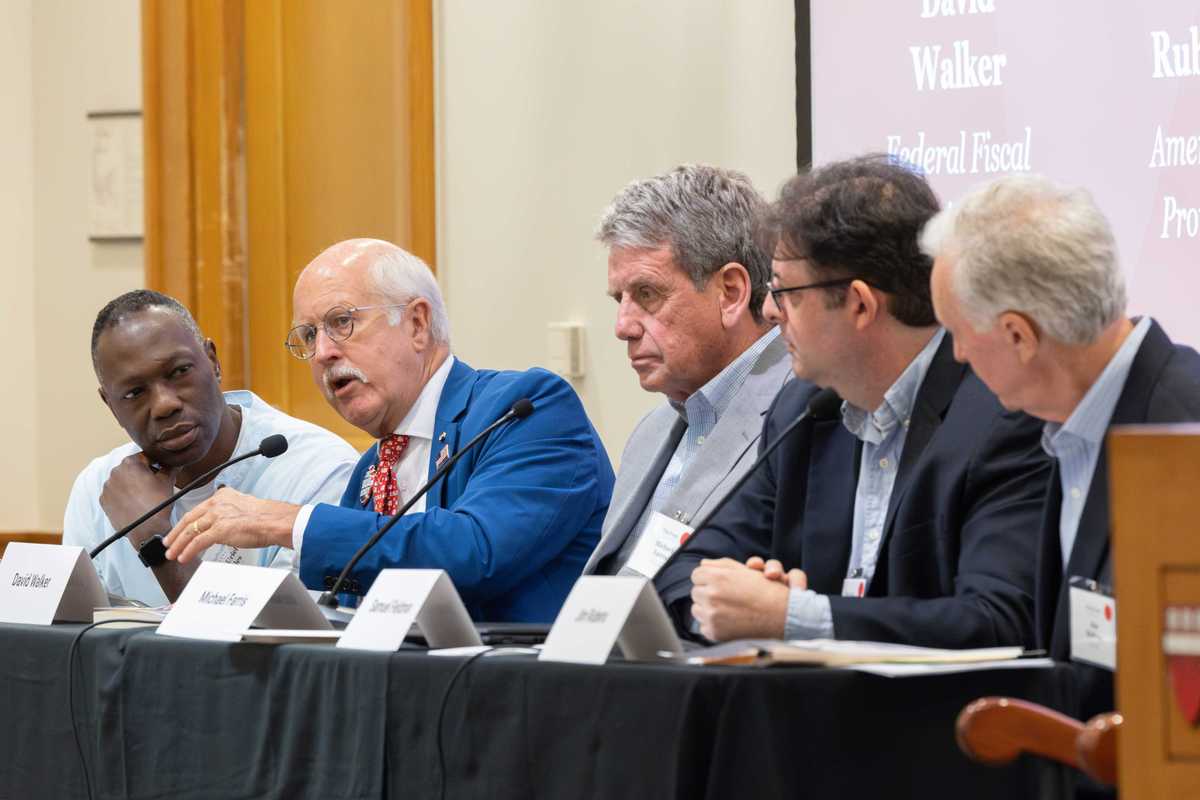
Join the webinar on June 30th to hear the fellows discuss issues in federal data, possible government solutions, and the role of supplementary data from nongovernment research, citizen‑generated projects, and “nontraditional” sources.

The Panelists

Joel Gurin (moderator)

President and Founder of the Center for Open Data Enterprise (CODE) and author of Open Data Now. Before launching CODE in 2015, he conceptualized and led the development team for the GovLab’s Open Data 500 project, the first comprehensive study of how the private sector uses open government data.

Chris Jackson

Senior Vice President and Civil Society Research Lead at SSRS. His work integrates politics, governance, media, information, commerce, and the economy to illuminate the full picture of American public life. Chris is an expert on electoral and public polling with deep experience in the American political system.

Beth Jarosz

Senior Fellow at the Massive Data Institute at Georgetown University and Vice President of the Association of Public Data Users. With more than 25 years of experience across government, academia, nonprofits, and research organizations, she specializes in helping decision‑makers examine complex data responsibly and effectively.

Francesca Perucci

Director of Policy and Partnerships at Open Data Watch. A global expert in development data and statistical capacity, she previously served for decades at the United Nations, most recently as Assistant Director of the UN Statistics Division. She is a leading voice in using data to inform policy, monitor progress, and strengthen institutions.

Stefaan Verhulst

Co‑Founder of The GovLab (New York) and The Data Tank (Brussels), Research Professor at NYU’s Tandon School of Engineering, Editor‑in‑Chief of Data & Policy (Cambridge University Press), and Co‑Chair of the Data for Policy Conference. Dr. Verhulst is a global expert on using data and technology for social impact.

Renewing trust in government information is not optional — it is foundational. A democracy cannot function when citizens doubt the integrity of the data that guide public decisions, shape policy, and inform civic debate. Restoring that trust requires transparency, modernized methods, along with a commitment to meeting people where they are — but it also requires leadership.

The Fellows for Democracy and Public Service are helping chart that route forward. By strengthening the nation’s data ecosystem and elevating trustworthy information, they are working to rebuild the shared civic reality on which a healthy democracy depends.

Register Here

David Nevins is the publisher of The Fulcrum and co-founder and board chairman of the Bridge Alliance Education Fund.


Read More

Keeping Kids Safe Online?: Understanding the Debate Over AI Age Verification
boy in gray shirt using black laptop computer
Photo by Thomas Park on Unsplash

Keeping Kids Safe Online?: Understanding the Debate Over AI Age Verification

This nonpartisan policy brief, written by an ACE fellow, is republished by The Fulcrum as part of our partnership with the Alliance for Civic Engagement and our NextGen initiative — elevating student voices, strengthening civic education, and helping readers better understand democracy and public policy.

Key Takeaways

Keep Reading Show less
Global leaders sitting around a circular table at the G7 Summit on June 18, 2026.

G7 leaders, G7 outreach partners and global tech CEOs attend a working lunch on innovation and AI at the G7 Summit on June 17, 2026 in Evian-les-Bains, France.

Anna Moneymaker / Getty Images

At G7 Meeting, AI Titans Showed Themselves to Be the World’s New “Power Elite”

Seventy years ago, in 1956, the sociologist C. Wright Mills published a startling exposé of the hidden forces controlling the government in the United States. What Mills labeled “the power elite” occupied leading roles in corporations, the military, and political institutions.

Mills’ book was designed to explore the shadowy world in which the power elite operated and to expose the enormous behind-the-scenes influence of a group whose decisions had great consequences for “the underlying populations of the world.” At the time it appeared, commentators credited Mills with “developing a theory of where the decisive power lies in American society, how it got there, and how it is exercised.”

Keep Reading Show less
The U.S. Pentagon.

Buried in the 2027 NDAA, Section 224 could fundamentally reshape U.S.-Israel defense ties. Is Congress creating an irreversible military partnership?

Getty Images, Westend61

America Should Stay Single

As we wait to see what comes of ceasefire negotiations between the United States and Iran, the House just released its 2027 National Defense Authorization Act (NDAA). Buried within it lies Section 224, titled the “United States-Israel Defense Technology Cooperation Initiative,” a provision representing what would be a radical departure from how we work with even our strongest allies, turning America’s relationship with a close collaborator into a permanent military-industrial integration. The U.S. has worked with NATO partners on co-production and shared supply chains in the past, but never like this. Many are calling it a merger. We should all be calling it off.

Section 224 could inextricably link the fate of our country’s defense to another’s. The Secretary of Defense would be directed to designate an executive agent to fuse ventures with Israel so significantly that it would touch almost every area of defense tech: AI, autonomous systems, energy, cyber, biotech, and beyond. It also proposes “network” and “data fusion,” which means, as the director of the Democratizing Foreign Policy program at the Quincy Institute warned, “the U.S. military’s data could soon be the Israeli military’s data.America First may soon sound more like a sarcastic punchline than a platform.

Keep Reading Show less
AI Could Save Thousands—So Why Is Healthcare Still Hitting the Brakes?

Discover how generative AI in healthcare could reduce misdiagnoses, improve chronic disease management, and save hundreds of thousands of lives—if policymakers accelerate adoption instead of waiting for risk-free perfection.

Getty Images / Pakorn Supajitsoontorn

AI Could Save Thousands—So Why Is Healthcare Still Hitting the Brakes?

Imagine that the only way Americans traveled was on foot or on horseback. And assume that 100,000 people died each year because they couldn’t reach a hospital in time or firefighters arrived too late.

Suddenly, they learned that thanks to a technological breakthrough, cars and trucks will become widely available within three years.

Keep Reading Show less