


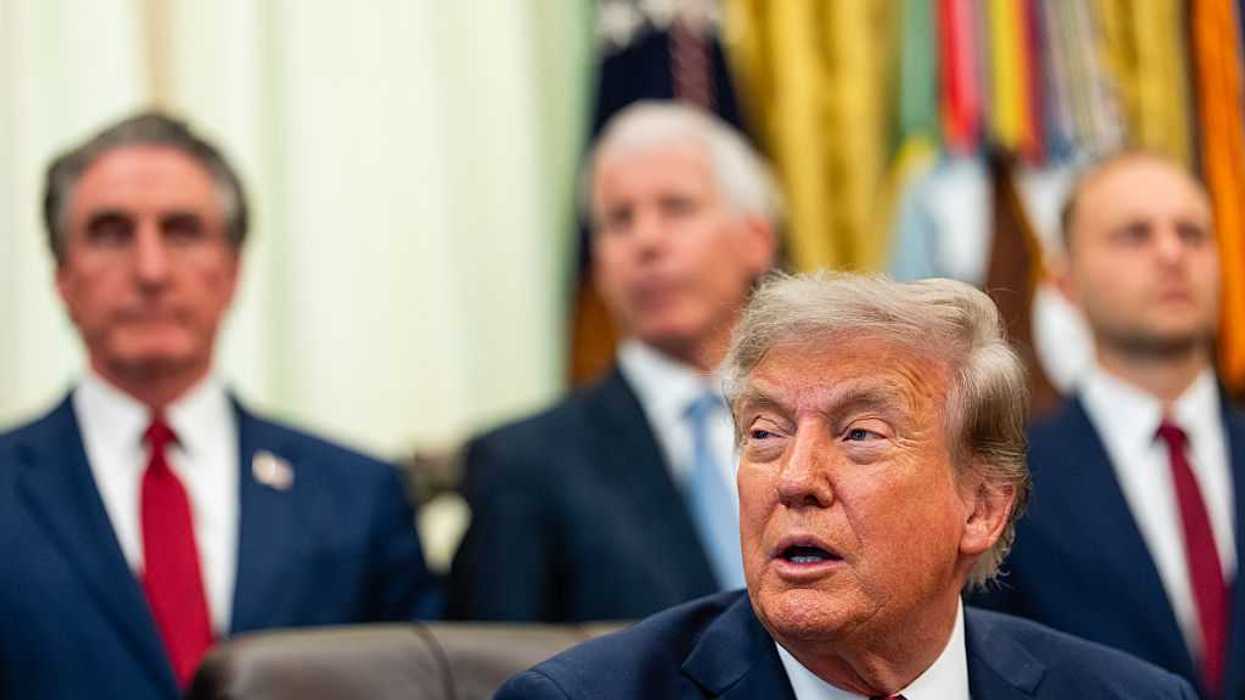

President Donald Trump’s recent address repeating his claim that he won the 2020 election was widely portrayed as a dramatic escalation of his attacks on our election system. It wasn’t.
It is nothing new!
Rather, it is only one element of a broader coordinated multiyear strategy that has combined litigation, executive action, personnel decisions, and state-level legislation to make voting harder and increase the likelihood that valid ballots will be challenged after they are cast.
Supporters argue these efforts are intended to prevent fraud and restore confidence in elections, and proposals such as voter ID requirements and prohibitions of noncitizen voting have appeal beyond Trump’s base. But critics contend that these policies target relatively minor problems while making voting more difficult, inviting more challenges to valid ballots, and further weakening confidence in the electoral system. When paired with repeated claims that elections are “rigged,” these proposals deepen public distrust in election administration and heighten the fear that Trump will contest the midterm results if they do not go his way.
Consider the evidence. In the 18 months since he returned to office, Trump has:
1. Appointed persons to key positions who will not acknowledge that Biden won the 2020 election, including Pam Bondi as Attorney General, Todd Blanche as her successor, Kash Patel as head of the FBI, and Markwayne Mullin, who has frequently called for a federal investigation into the 2020 election, as Secretary of Homeland Security. Bill Pulte, who Trump proclaimed would use the Office of National Intelligence to investigate “rigged elections” from 2020, now serves as the office’s Acting Director.
2. Undermined agencies responsible for election integrity and protection against foreign interference. He gutted the Cybersecurity and Infrastructure Security Agency and referred its former director, Christopher Krebs, who had earlier declared the 2020 election to be secure, to the Justice Department for investigation. Last month, Trump fired two members of the U.S Election Assistance Commission, leaving the body created by Congress in 2002 with no members.
3. Held up an important bipartisan housing bill to force the Senate to adopt the SAVE America Act, perhaps the most dramatic effort to undermine the ability of states to operate elections in history. So far, the U.S. Senate has called his bluff; the housing bill became law without Trump’s signature and SAVE seems to be going nowhere.
4. Attempted to acquire unredacted voting lists from each state in the nation. This is perhaps Trump’s most audacious power grab to date. If he can gain control of state voter lists, traditionally the province of state governments, he can use data to question whether votes were proper and throw election results into chaos.
While 23 mostly-Republican led states provided the data, 30 and the District of Columbia have not. Fortunately, Trump is losing legal challenges to this strategy. On March 31, Trump issued an executive order seeking to create a national voter list, which was promptly blocked by a federal judge. Trump sued states that refused to turn over their voter files. But private attorneys and state attorneys general fought back, and to date, Trump is 0 for 17 in these cases, losing every one that has come before a judge.
Federal control of voter lists is perhaps the greatest danger for the midterms and beyond. Centralized access to state voter files could allow the federal government to challenge voter eligibility on an unprecedented scale, potentially delaying certification of close contests and inviting extensive post-election litigation. The seizure of the Fulton County, Georgia files gives concern that this was a dry run for other confiscations this fall. Federal seizure of ballots or machines could delay final results and there are even scenarios where these delays could be used by the present republican-controlled House to deny seats to Democrats who win this November by small margins in hopes of preventing a Democratic takeover of the body.
5. Attacked mail-in voting. Trump has continually assailed mail-in voting, which is used by 30 percent of all voters and almost exclusively in several states. But when Trump tried to enlist the U.S. Postal Service in his scheme to make it more difficult, issuing an executive order requiring the agency to deliver a voter’s mail ballot only if their name is on a federally created list of enrolled voters, he was slapped down by federal Judge, whose 37-page ruling concluded that the president did not have the constitutional authority to regulate state elections. And the U.S. Supreme Court recent holding that federal law does not preempt states from setting their own deadlines for counting mail ballots only hurts Trump’s efforts.
These court rulings have not stopped the President; he appealed the postal service ruling and on July 17, the Court of Appeals for the D.C. Circuit stayed the lower court’s injunction, allowing USPS to move forward in implementing President Trump’s order in the states that have provided the files.
6. Warned states that officials could face criminal liability if they count ballots cast by noncitizens. The Justice Department recently sent letters to all 50 states and the District of Columbia threatening criminal prosecution if election officials counted any ballots cast by noncitizens in upcoming elections. Utah’s Republican lieutenant governor, called the tactic “bizarre,” and described the communication as “another love letter … from the DOJ … with threats of criminal prosecution…. for… resisting DOJ’s demands for private voter data that have thus far been ruled illegal by at least a dozen courts.” Homeland Security Secretary Markwayne Mullin then threatened to strip states of federal election-related aid, and to seek criminal penalties against election officials if they don’t comply with Trump’s demands.
6. Promised to send midterm election monitors to states, including Virginia, Arizona, Michigan, Massachusetts, Minnesota, and New Hampshire. Federal and state laws largely bar the deployment of federal law enforcement agents to polling places, but neither Trump nor Acting Attorney General Todd Blanche have ruled out the use of ICE for this purpose.
These initiatives, standing alone, do not guaranty that the 2026 elections will be disrupted. But taken together, they represent an unprecedented effort to expand federal influence over election administration—an area long managed primarily by the states. Whether these efforts ultimately succeed or fail, they have already intensified public distrust in the nation’s electoral process.
States Fight Back
This story is far from over. Courts have repeatedly rebuffed the President. After Trump issued an executive order requiring proof of citizenship, for example, a federal judge blocked the effort, saying that only states and Congress had that authority.
And state leaders continue to push back. While the Trump administration has received voter files from 23 mostly-Republican led states, many states resist. In addition, they are enacting measures to prevent federal intervention in elections. California, for example, made it a felony to seize ballots from county election officials, a law Governor Newsom signed on May 27 after the Riverside County sheriff seized more than 600,000 cast ballots.
Thirty-five states have criminalized intimidation and/or interference with election workers. States like Colorado, Nevada, and Virginia now allow election workers to keep their personal information confidential to avoid harassment. Connecticut passed a measure to bar law enforcement from being within 250 feet of a polling location, ballot Dropbox or vote-counting site without the permission of election officials. Washington state made it a felony to disclose personal information contained in the voter registration file to people other than state and local election officials without the permission of the secretary of state.
Eleven states—including New York, New Jersey, Virginia, and Minnesota—have enacted their own state-level Voting Rights Acts to establish state-level protections against voter suppression and ensuring independent state courts can protect ballot access regardless of federal action.
State attorneys general, local election officials, and private attorneys have become the front line of election defense, developing contingency plans if the federal government attempts to confiscate ballots or voting machines, disrupts the delivery of mail ballots, or sends troops or immigration agents to polling places. Hopefully, the concern is misplaced, and these defenses will not be needed.
It Ends With Us
The strength of American elections has never rested solely on laws or courts. It relies on citizens who participate, election officials who administer the process fairly, and institutions willing to enforce constitutional limits. Whatever one’s political views, confidence in elections ultimately depends on broad participation, respect for lawful outcomes, and vigilance against efforts that undermine public trust. Cast your vote as early as you can and encourage your friends and neighbors to do the same.
Trump’s Elections Speech Was Not the Opening Shot; It was the Latest Salvo was originally published by Fights of Our Lives on Substack and is republished with permission.









The President Invited Iran to Bomb My Home