



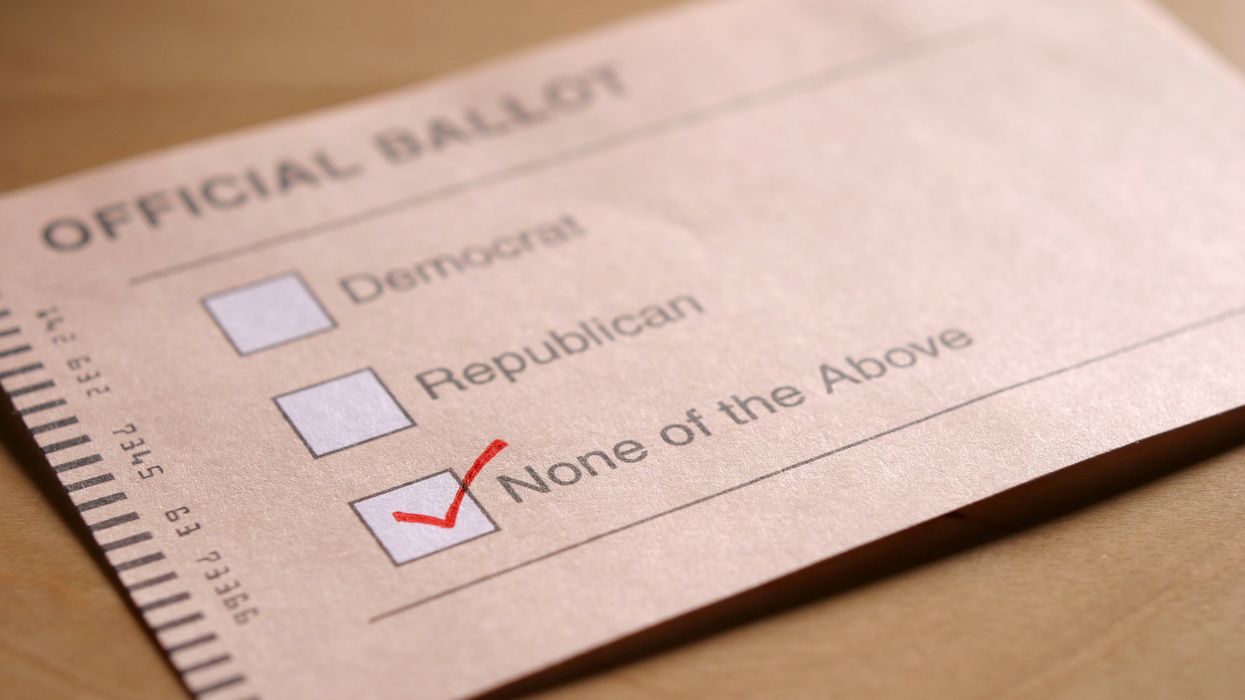

The evidence continues to come in -- lately from USA Facts and the Unpopulist-- that the majority of American voters don't like our two-party political system. Yet there is no consensus on what we want to replace it with.
There does seem to be an assumption that if you don't like the two-party system, then you want a political system which supports more than two parties, namely a multi-party system.
New America's Lee Drutman, the author of Breaking the Two-Party Doom Loop, has made the best case yet for a multi-party system. For those who want a multi-party political system, read his very engaging, well-argued book.
Still, the assumption that the alternative to the two-party system, at least the democratic alternative, is the multi-party system needs to be challenged.
It may be true that most Americans would prefer a multi-party system to our two-party system. So, turn us into a multi-party democracy like Europe, Japan, South Korea, Canada, and Australia, but leave out the parliamentary structure. Thus, a presidential/legislative structure, but multi-party rather than two-party.
The problem with this way of framing the situation is that many Americans probably do not understand that there is an alternative to a two-party system that is not about having more political parties (and having them in a system that welcomes them), even with ranked-choice voting, impartial redistricting committees, fusion voting, and proportional representation.
No, there is an alternative to the two-party system, which has nothing to do with political parties.
So how can this be?
Well, very simply. There is an alternative I have been defending for three years, namely a system that seeks tripartisanship and not bipartisanship, one which does so by developing an Independent Caucus of 5-6 U.S. Senators. An Independent Caucus can be developed in the House also, but an IC is less needed in the House.
In the Senate, an IC could have enormous leverage, where votes could be needed not only to reach 51 votes but to reach 60 votes on major policy bills.
The IC, as I conceive it, would be made up of senators from diverse political perspectives. They would not all be centrists.
They can be elected as independents, convert from a major party to independent, or remain independent if they are elected as independents (like Sanders and King) rather than caucus with either major party.
The IC is not a political party. It would be much smaller; it would have no central organizing committee, and it would not be a fundraising machine for a platform. No, the IC would be a group of senators who are driven by their own values, beliefs, and interests. But they would realize that they will only have power if, at times, some or most or all of them vote together to support a bill up for consideration.
Why the IC could hang together is a very complicated question. It is just as complicated as the question multi-party system advocates must answer about how they expect to get laws passed state by state or nationally that would create the election reforms that their system would need to support many political parties.
Suffice to say that no one in politics or life gets everything they want. But hanging together would enable the IC to get some of their favorite bills passed, and those times when they had to hold their nose would be for the good of the country.
The two-party system can be fundamentally changed without creating a multi-party system and without election reform measures that pose monumental obstacles as a matter of state or federal politics.
There is, thus, a false dichotomy in many political circles between a two-party system vs. a multi-party system. It is assumed that there are two alternatives to structuring American politics, one which has two parties that have power and one which has three, four, five, or more parties that have power.
There is a middle position, a way to empower over 60 million Americans who do not identify with either major party. The middle position promotes tripartisanship, not bipartisanship or systems that empower four parties or five parties or more.
We can fix the two-party system without trying to empower other political parties. We can fix the system by empowering a group of 5-6 U.S. Senators from diverse perspectives.
Dave Anderson edited "Leveraging: A Political, Economic and Societal Framework," has taught at five universities and ran for the Democratic nomination for a Maryland congressional seat in 2016.