



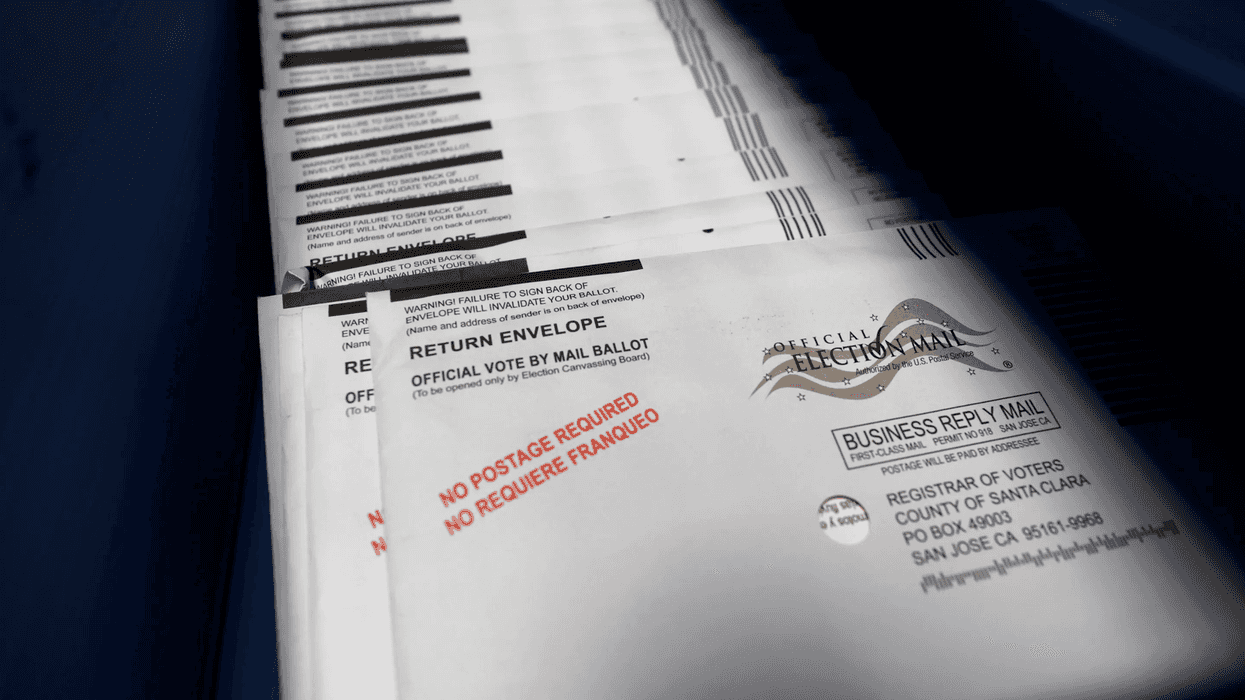

Some U.S. Postal Service facilities failed to properly handle ballots during this year’s primary elections, according to a new audit from the agency’s Office of Inspector General. Election experts say the findings call into question the agency’s ability to meet even greater demands for the November election that are under consideration by the U.S. Supreme Court.
The audit, which is dated Sept. 4 but has not been previously reported, found a lack of training for post office staff on how to properly and expeditiously handle mail ballots, deficiencies in how ballots were tracked and errors leading to delays, all of which risked ballots having incorrect postmarks or otherwise arriving late to election officials, which could lead to their rejection.
The identified failures increase “the risk that Election and Political Mail is not handled, documented, monitored, and reported in accordance with Postal Service policy,” the audit said, though it noted that “most facilities we visited generally adhered to Postal Service’s election-related policies and procedures” and that nearly 99% of ballots reached election officials in a timely manner.
“While instances of non-compliance were low relative to overall volume, the presence of similar procedural gaps across multiple facilities indicates a need for improved understanding and increased enforcement of Postal Service policies among its employees,” it said.
The findings come as the Supreme Court weighs whether to allow the Postal Service to move ahead with new rules that would allow the agency to regulate mail voting, under a March executive order signed by President Donald Trump. The order requires states to give USPS a list of all voters eligible to receive a ballot in the mail and requires USPS to use those lists to determine which ballots get sent to voters.
Top Postal Service employees, along with a whistleblower who filed a disclosure with U.S. Sen. Richard Blumenthal, D-Conn., have expressed concern that the new system stands to disenfranchise large swaths of eligible voters, both by its design and lack of testing, ProPublica reported last week.
Election experts told ProPublica the new audit findings should be considered by the Supreme Court, as they make even clearer what election officials already know.
David Becker, executive director of the Center for Election Innovation and Research and a former Justice Department civil rights lawyer, said the audit confirms that USPS has “a long way to go to meet its core obligations of delivering election mail in a timely manner.”
“The administration and USPS are simply incapable of successfully meeting vast and radical new responsibilities under the president’s executive order,” Becker said.
Postal workers, through the American Postal Workers Union, also said Wednesday in a brief filed with the Supreme Court that it is not practical to implement the rules, which pose a “significant risk of wide swaths of Americans not being able to vote by mail.”
Even if the Supreme Court allows the new rule to move forward, some state election officials say the requirements would be impossible to meet for the November election, with mail ballots starting to go out this month.
Chelsey Wininger, executive director of the Democratic Association of Secretaries of State, said the audit shows the Postal Service “struggles to implement even basic changes to postal process consistently” and reinforces the organization’s opposition to any new rules this close to an election.
In a response included with the findings of the audit, the Postal Service wrote that “while we acknowledge that we can always reinforce and amplify our internal processes and procedures (and will continue to do so between now and November) — overall ballot mail performance is strong.” The agency acknowledged that there are some instances in which employees didn’t follow policies and procedures, but called other errors “isolated incidents,” such as when some New Jersey ballots were delivered to Tennessee before being sent back.
The Postal Service agreed with all recommendations on how to protect against future problems, except for one that suggested promptly notifying customers impacted by new regional transportation plans.
The Postal Service did not immediately respond to a request for further comment Wednesday evening.
The Postal Service typically goes to great lengths to handle election mail in an expedited and careful manner. And overall, it delivered in this year’s primaries: Completed ballots from voters to election officials were processed “on time” nearly 99% of the time during the primaries, up from about 98% in 2024, for the about 6.3 million ballots that the Postal Service was able to track, according to the report. The definition of “on time” is not provided in the report. It refers to how quickly the ballot was handled by the Postal Service, not whether the ballot reached the election officials on time.
But when observing election mail at 14 processing facilities and 73 delivery units across eight states, the auditors found significant flaws in the handling of mail ballots.
There were no election-related training materials posted at 22 of 73 delivery units, or about 30%. In some locations, local management and employees weren’t familiar with requirements on how to process election mail, the report said.
In 14 states and Washington, D.C., election officials count ballots only when they are postmarked by the Postal Service by Election Day, making the correct postmark crucial for understanding which ballots to count and which to reject.
But the audit found that in 10 of 82 facilities, or about 12%, management wasn’t aware of the proper way to postmark a ballot. Some thought ballots should be postmarked at that time they go out to election offices instead of earlier on when they reach a processing facility or retail counter.
Also, at five of nine mail processing facilities studied, retail clerks who were postmarking ballots by hand sometimes used stamps with inaccurate dates, according to the report. That included a facility in Pennsylvania on the state’s primary election day, which caused 56 ballots to be postmarked with the wrong date.
In 13 of 82 facilities, Postal Service workers didn’t complete proper procedures to make sure election mail had been sent out from the delivery units each day. In one instance at a Harrisburg, Pennsylvania, processing plant, 108 ballots were grouped with other mail and had to be expedited to Pittsburgh on the morning of the election so they would count.
U.S. Postal Service Failed to Properly Handle Some Ballots During This Year’s Primary Elections, Audit Finds was originally published by ProPublica and is republished with permission










The President Invited Iran to Bomb My Home