Skip to content
Search

Latest Stories

Follow Us:
Top Stories

Video: The State of Global Democracy

Panel: The State of Global Democracy

This week, we are excited to share a video series featuring panel discussions from the Global Democracy Champions Summit co-hosted by Keseb and the SNF Agora Institute at Johns Hopkins University. We hope this series will spur dialogue and action to advance inclusive democracy in the US and globally.

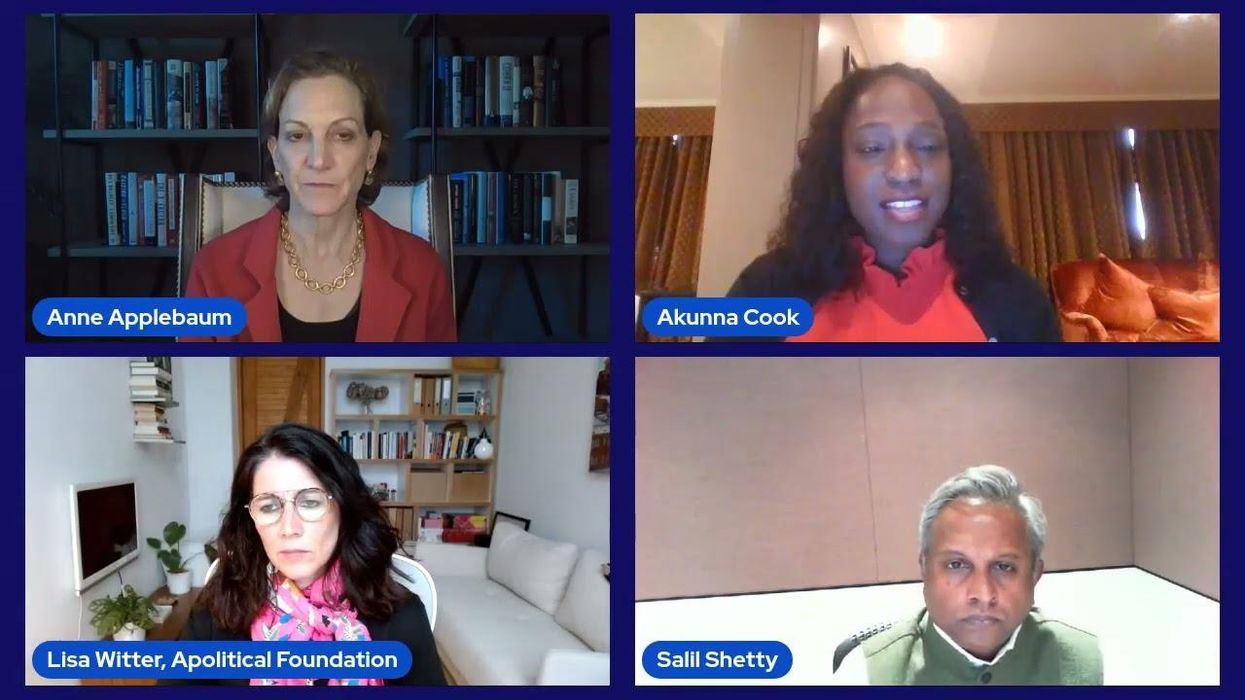
Today’s feature is a panel discussion on the state of global democracy. Panelists discussed the trend towards nationalist authoritarianism and highlighted strategies for how to build thriving, inclusive democracies in the 21st century.


Moderator: Anne Applebaum, Senior Fellow, School of Advanced International Studies and the SNF Agora Institute, Johns Hopkins University; Staff Writer, The Atlantic

Panelists:

●Akunna Cook, Deputy Assistant Secretary, Bureau of African Affairs, US Department of State

●Salil Shetty, Vice President, Global Programs, Open Society Foundations

●Lisa Witter, Co-Founder of Apolitical and CEO of Apolitical Foundation

Check out the discussion: The State of Global Democracy

We will share one panel discussion from the Summit each day of this week. Come back tomorrow to view “Battling the Effects of Conspiracy Theories and Disinformation.”

Please visit Keseb and the SNF Agora Institute at Johns Hopkins University to subscribe and receive news of future Democracy Champions opportunities.

Read More

Empty Bravado: Trump’s Hollow Swagger Behind  Iran War

U.S. President Donald Trump on March 11, 2026.

(Photo by Andrew Harnik/Getty Images)

Empty Bravado: Trump’s Hollow Swagger Behind Iran War

In moments of war, a president’s words carry enormous weight. They can steady markets, reassure allies, and signal strategic clarity — or they can do the opposite. President Donald Trump’s handling of the 2026 conflict with Iran has been a case study in the latter: a torrent of contradictions, self‑justifications, and evasions that leave the public less informed and the world less stable.

Across the political spectrum, reporting paints a consistent picture. Even as U.S. and Iranian negotiators scrambled to establish a cease-fire framework, Trump continued to insist the conflict was “limited,” “short,” or “nearly wrapped up,” despite ongoing strikes and regional spillover. Diplomats described the situation as “fragile” and “volatile,” yet the president publicly framed it as a minor dust‑up rather than a major regional crisis. Minimizing a war’s scope doesn’t make it smaller — it simply obscures its costs.

Keep ReadingShow less
Cancel Cesar Chavez: Continue The Fight For Justice
man in gray hoodie and blue denim jeans kneeling on green grass field during daytime

Cancel Cesar Chavez: Continue The Fight For Justice

As a young journalist, I covered the funeral of Cesar Chavez in 1993 and have interviewed Dolores Huerta several times over the past 30 years.

They were heroes to me and my family, icons of the Chicano civil rights movement.

Keep ReadingShow less
President Trump Demonstrates Why Euphemisms Damage Democracy

U.S. President Donald Trump speaks to reporters as he and Secretary of State Marco Rubio (L) depart the White House on their way to Florida on March 20, 2026 in Washington, DC.

(Photo by Chip Somodevilla/Getty Images)

President Trump Demonstrates Why Euphemisms Damage Democracy

In politics, words matter. In democratic politics, they matter even more.

Great political leaders have long recognized that fact.

Keep ReadingShow less
A President in Sheep’s Clothing and a Democracy in Decline

President Donald Trump speaks to members of the media traveling on Air Force One while heading to Miami on March 7, 2026.

(Photo by Roberto Schmidt/Getty Images)

A President in Sheep’s Clothing and a Democracy in Decline

Like a wolf in sheep’s clothing, America’s president is undermining the Republic by evading checks, consolidating power, and attacking democratic norms. He disguises his malicious intentions as innocence while dismantling policies and programs that would help citizens.

In earlier opinions, I wrote about three forces that corrode democracy: hypocrisy, corruption, and confusion. Hypocrisy creates a false image of leadership; corruption erodes public trust and suppresses voter participation; confusion keeps the public from seeing the truth. Together, they weaken the Republic.

Keep ReadingShow less