





They got an early start; the morning light came on fast. The Ring siblings were headed to the Joliet depot with young Angela in tow — the same depot where Lincoln’s funeral train had passed in silence thirty years earlier. Now they were bound for the White City, forty miles northeast. The Columbian Exposition was a turning point for both Angela and America. Buffalo Bill’s Wild West Show, pitched just outside the fairgrounds, rivaled the Exhibition itself.
One photograph captured it all. Taken in a fairground photo booth, the Ring siblings stood in their summer clothes, huddled around eleven-year-old Angela. Their faces were bright and open — a single moment preserved in time. Determined to outshine the 1889 Paris Exhibition and its Eiffel Tower, Chicago answered with George Ferris’s great wheel. At night, the city glowed, outlined in electric white light.
Angela felt the moment more deeply than she expected. She loved being with her aunt and uncles, but something larger stirred in her. The White City and the Wild West Show made the world feel bigger, possible, open. They were no longer simply Irish immigrants. Angela felt her American roots for the first time — a sense of belonging to a country that was rising. From that day forward, nothing felt the same.
Her life changed abruptly when her mother, Julia, died at forty-one. Angela had already lost her father, Peter, at the moment of her birth. Now, she lost her mother too. She wasn’t technically an orphan — she was surrounded by a loving aunt and uncles — but she felt like one. She missed her mother quietly, deeply. She was the only next-generation Ring living on the land, raised by her bachelor uncles and her aunt Belle, who kept the household steady. Together, they formed the quiet, sturdy world that shaped her.
James “Jim” Fitzgerald and Angela likely met in the early years of the new century, when Angela was in her late teens, and Jim was a rising young farmer in the Fitzgerald clan. Their families overlapped in parish life, farm labor, and social gatherings. In a township where everyone knew everyone, their meeting was less an event than an inevitability.
Manhattan was shaped by three Irish clans: two Delaney lines and the Fitzgeralds. Jim’s sister, Susanne “Susie” Fitzgerald, began seeing William Delaney — a union that joined two of the largest families in the township. When my own parents, Red and Eleanor, married, they united all three. The Fitzgeralds, Delaneys, and Rings became the central force in Manhattan’s civic and social life.
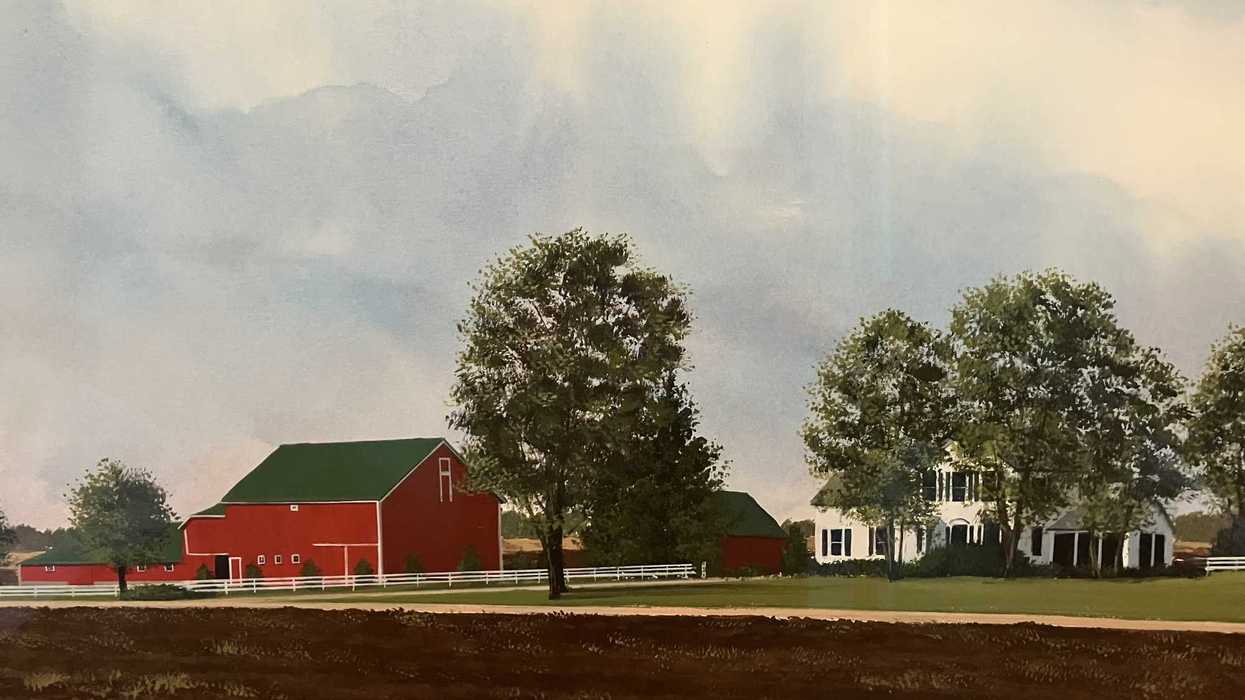
My father was born in the Ring homestead, the old house that had carried the family from the immigrant era into the new century. But shortly after his birth, Angela and Jim moved to a new farm less than a mile east. The land was almost certainly financed by the Rings, as was the new house that followed. It wasn’t a break from the old homestead — it was an elevation.
As Angela left the Ring homestead with Jim and three children in April of that year, she left behind the pewter coffee pot with her initial carved into the metal. No one knows exactly where it ended up. It may have been set on a shelf or tucked into a corner as cousins rented the old place, but it endured — a quiet emblem of faith in family, the Union, and the promise of America. Years later, my mother, Eleanor, found it and restored it, placing it on her dining room bookshelves. After more than a century, it was back in a place of honor in the Rings’ ancestral home.
Jim and Angela went on to have seven sons and one daughter; their first child died in infancy. With two farms to run, Jim needed help. Having sons was a boon. He bought each boy a new car on his sixteenth birthday — not as an indulgence, but as recognition for the hard work he demanded of them. It was their reward. The boys now had wheels.
At the same time, Susie Fitzgerald and William Delaney were raising their own family — three boys and one girl. Through Jim and Susie, the Fitzgerald siblings came to lead two of the three dominant Irish clans in Manhattan Township — the Fitzgerald–Mackin line and the Fitzgerald–Delaney line.
And here, in the tight quarter mile between the two households, something remarkable happened. Between them there were nine boys, and when the hard work hit, they closed ranks and did it together. But they didn’t do it alone. Belle kept the Ring homestead steady, Susie anchored the Delaney side, and Mary and Loretta fueled the boys with the kind of muscle it takes to keep an army moving. Angela wasn’t a bystander — she was in the middle of it, helping set the pace, carrying her share, and absorbing the purpose of two households that operated as one. The boys brought the force; the women kept the force moving. Together, they turned that quarter mile into a launchpad.
The third great development of that era was the Rings’ construction of their Manhattan home. Not just any home — the grandest in town, built of coal-glazed brick, set on a rise, and surrounded by newly purchased land on the east side of town. They knew those lots would be subdivided someday, and securing that ground early was a savvy move — classic Rings. It was a time of expansion and confidence, when the United States itself was feeling its strength. The Rings did too.
America’s promise was being realized. The children of immigrants were free to think big, find common ground, and build something larger than themselves. Their parents had endured hardship and broken promises, but they never lost faith in the Union. Now, their children were reaping the benefits of that faith.
A moment captured the Rings’ highest aspirations: their gift of a stained-glass window to the parish church. America was realizing its promise, and the Rings, Fitzgeralds, and Delaneys were realizing theirs — just like Chicago, a city known throughout the world.
But proximity to such a dynamic city came with a price. Chicago’s glamour and danger reached into Manhattan, and not all of it passed harmlessly. Prohibition — and the wild years that followed its repeal — touched the next generation in ways no one foresaw. Some of the children were harmed by it. But even in that, the family’s principles held. Angela and Jim steadied themselves with the values they were raised on. They endured the era’s excesses without letting it define them.
For all the upheaval of modern times, they stayed steady. When the stock market crashed and the Great Depression began, they held their ground. They even expanded — buying a third farm as the nation slid into darkness. That was their instinct: when America faltered, they built. When times fractured, they looked for common ground. When the country struggled to keep its promise, they kept theirs.
By the time the Depression lifted, the Rings, Fitzgeralds, and Delaneys had become more than families — they had become a lineage with weight, memory, and purpose. What began with immigrants holding fast to the Union had grown into a dynasty that shaped the life of a small town and carried its values forward through every upheaval. They built when times were good, and they built when times were dark. They steadied themselves when the world around them swayed. Their story — Angela and Jim’s story — is the American story at its best: a belief that the future is worth building, that common ground can be found, and that a family’s principles can outlast the storms of any age.
Patrick Fitzgerald contributes to The Fulcrum, a nonpartisan publication dedicated to strengthening democracy through informed civic engagement and diverse perspectives. Raised in the Midwest and shaped by farm communities, he later spent 29 years in San Francisco, where the city’s civic diversity and neighborhood culture influences his writing. He focuses on rebuilding trust in one another and environmental stewardship. He now lives in Buffalo, New York, where he continues to write essays grounded in personal experience.










The President Invited Iran to Bomb My Home