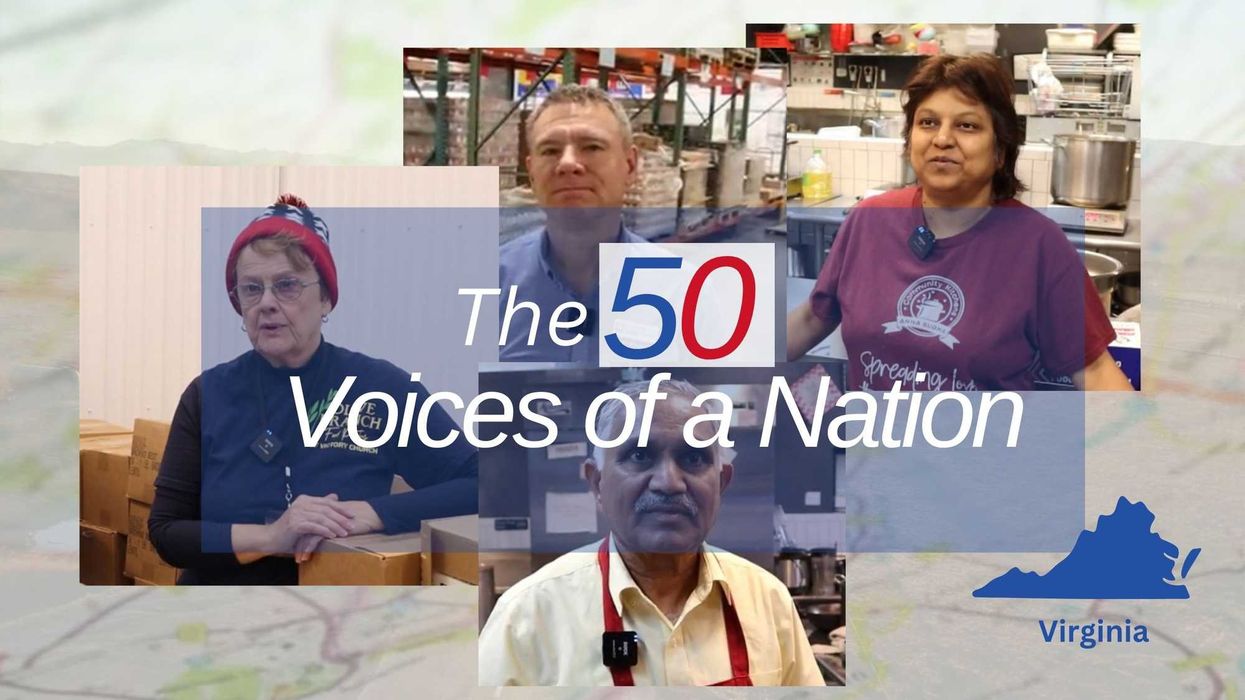
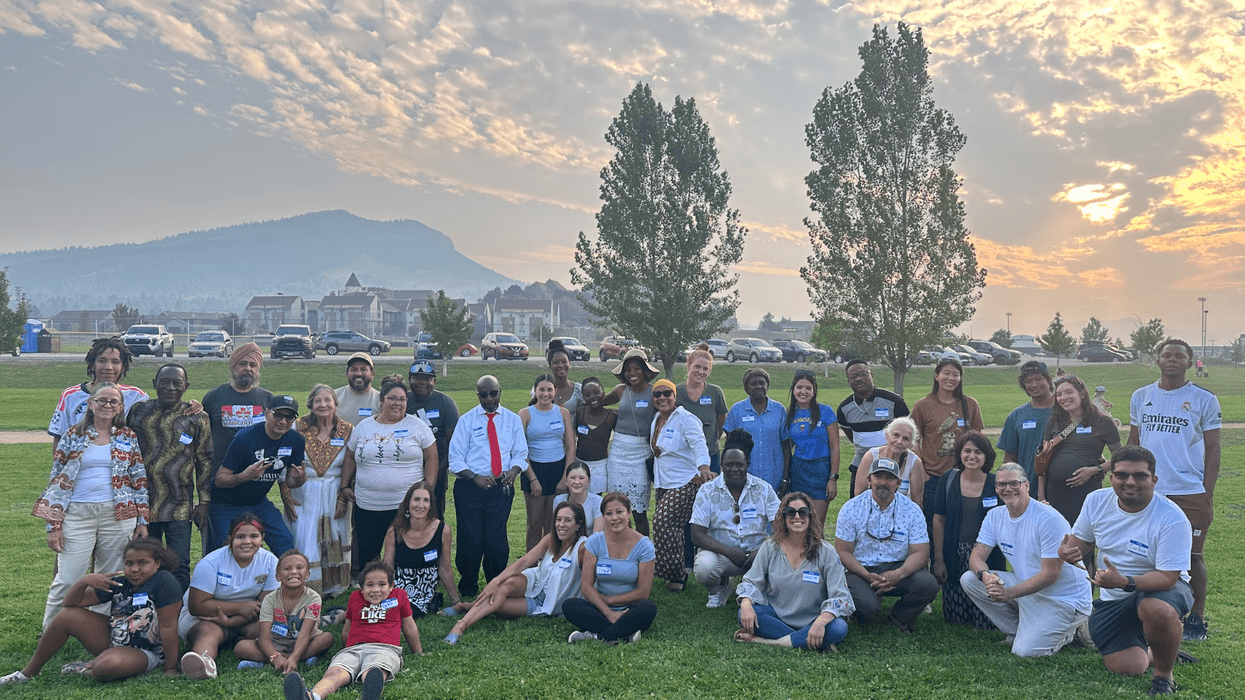
As the United States marks its 250th anniversary, the Declarations of Interdependence Relay is traveling across all 50 states with a simple message that rebuilding American civic life starts with rebuilding our relationships with one another. Organized by The Barnraisers Project, the year-long initiative brings people together through locally hosted gatherings centered on connection and care. Since kicking off in Seattle in April, the Relay has taken many forms, from a back-to-school community event in Casper, Wyoming, and a volunteer playground build in Viroqua, Wisconsin, to an Indigenous-led punk rock festival in Minot, North Dakota, and a post-election gathering in Minneapolis. Next up is a community supper in Indianapolis on November 14, with additional stops planned as the Relay continues across the country.
For community organizer and Barnraisers Project co-founder Garrett Bucks, these gatherings offer a different approach to addressing the loneliness, distrust, and political polarization shaping American society. Rather than asking people to find common ground on divisive issues, the Relay encourages them to build relationships by spending time together and working toward shared goals.
In this conversation with The Fulcrum, Bucks reflects on what he's learned from communities across the country, why strengthening democracy takes more than political agreement, and how everyday acts of connection can help restore belonging and collective responsibility
The Declarations of Interdependence Relay is traveling across all 50 states during the country’s 250th anniversary year. Why did you want to use this moment to focus on interdependence rather than independence?
When I think about this country’s best moments, it’s always been when Americans have extended the table and pulled their neighbors closer – either politically, socially or creatively. It’s the conductors on the underground railroad, the musicians who created jazz and country music, barnraisers who banded together to fulfill community needs on the prairie. It’s mariachi bands performing at quinceneras, and frybread stands in powwow parking lots. It’s union halls and church basements and bat mitzvahs.
When our country has truly shined, it hasn’t been the moments when we’ve declared our separation, but when we’ve realized that we’re bound up with one another – that we eat together, laugh together, celebrate and mourn together and survive together. That, to me, is interdependence.
The Relay brings people together through local gatherings rather than asking them to agree on a political platform or set of beliefs. What have you learned so far about the role that simply spending time together, working together, or caring for something together can play in rebuilding civic life?
I realize that I can suffer from “when you only have a hammer, everything looks like a nail” syndrome, but this relay has truly reinforced my belief that, in this moment in particular, there is no more urgent work than gathering local communities together. Whether you’re concerned about the loneliness epidemic, political polarization, economic precarity or climate and meteorological crises, every possible solution has the same starting point: we need to know more of our neighbors. And more than that, we need to build trust, to re-build the muscles of turning to each other for help, and to get over the hump of self-consciously worrying that, if we put ourselves out there, it won’t be reciprocated.
We often talk about polarization as a problem of politics or information. Based on what you are seeing through the Relay, how much of the problem is actually about relationships — people not knowing, depending on, or feeling responsible for one another?
That’s absolutely it, but I’ll add one more wrinkle. I talked about building back atrophied muscles just a second ago – I think that’s a huge piece of it. Not only do we not know our neighbors (which makes us less likely to trust them), we’ve now spent twenty years building our muscles of public outrage and online pugilism. On both sides of the political spectrum, that’s what it’s meant to be “political”- you scroll and scream, basically. What the relay is trying to get people to do isn’t just to know their neighbors (though that’s important), but to get used to asking each other for help.
You’ve described community-building as a form of civic infrastructure. What does that mean to you, and what happens when communities lack the spaces, habits, and institutions that allow people to build trust over time?
When civic infrastructure erodes, we all become both more passive and more nihilistic. Because we don’t have experience coming together with our neighbors to make sure every kid in town has a backpack (like happened at our Wyoming relay stop) or to build a playground (that one was Wisconsin), we internalize the idea that we can’t make collective change. And if you believe that, then you’re more likely to outsource all the things that we should expect from a neighbor – when you’re hungry and your cupboard’s empty, you don’t ask your neighbor for an egg, you doordash. When you need to make a flyer, you don’t ask a graphic designer friend, you just prompt Chat GPT. And I know this sounds dramatic, but when those become our default responses, we lose opportunities to build the relationships that make communities stronger in the first place.
The gatherings taking place through the Relay look very different from one another and are being shaped by people in very different parts of the country. What common threads are you seeing across communities that might otherwise appear to have very little in common?
So many, but one that I want to highlight is the everyday bravery of the invitation. All of our gatherings – from circles with 10 people to mass community events with hundreds of participants – began basically the same way. A regular person, not a big name or well-known activist, has a dream about some sort of convening that they themselves need. And then, because they can really focus on that need for themselves, it gets them over that scary hump of putting yourself out there and making an invitation. And if you do that persistently enough, it’s not as simple as “if you build it, they will come,” but eventually you do, in fact, find your people.
I think our Seattle host, Nicole, is a really perfect example of this. She lives in the Columbia City neighborhood of Seattle– a pretty dense, walkable place where she’d see her neighbors quite a bit. But ironically, it was exactly that– seeing the same face, but realizing that she didn’t know them- that made Nicole feel the most lonely. So one day she just set up a table at the neighborhood farmer’s market with a simple sign. “Do you want to meet a Columbia City neighbor?” Within a few weeks, she had hundreds of sign ups, and her Neighbor Club was off to the races.
Have there been any moments during the Relay that have challenged your own assumptions about what people are looking for from their communities or from one another?
More than challenging my assumptions, the Relay has reinforced them in ways I didn’t entirely expect. It’s been so gratifying to hear, from just about every host, how much participants felt like they needed a particular gathering.There’s something about sitting in a circle and being seen and heard– be that at a reunion of community organizers from across Kansas, or a group of neighbors who make breakfast burritos together in New Mexico– that is really speaking to a pretty deep, existential craving that people have right now. On one hand, I get it. I too need spaces that welcome me unconditionally, that really listen to me, that want to have me back. But hearing that depth of meaning from so many voices has been striking.
One of the ideas you’ve written about recently is that people are shaped by the places where they spend their time and by the things they repeatedly do together. How does that idea connect to the Relay and to the larger work of strengthening a culture of care, cooperation, and belonging?
When I say that human beings are social creatures, I mean both that we crave spaces with one another, but also that we’re extremely dialed into (and take our cues from) our social surroundings. It’s a key part of human evolution – learning the rules of a space so that we don’t get kicked out of it. You can spend years yelling at people about how there is a loneliness epidemic, or too much polarization, but that’s not how you learn how to be connected to your neighbors. You learn by being invited to a set of events that is clearly focused on care, and then you come back again, and eventually you start taking on more responsibility for keeping that community going.
So far, every host has said the exact same thing about the relay. At its core, it was an excuse to either hold an event that they wouldn’t have otherwise, or make one of their regularly scheduled events more intentional and special. And then, at the end, they’ve all heard the same thing from participants– whether they’re knitting together or organizing clothing or sharing food. “So when are we going to do this again?” I’ve loved that each of the relay events have been successful, and that we’re building a story as we go, but I’m even more proud of all the ways that the seeds the relay has scattered across the country keep blooming and growing.
Much of American mythology celebrates self-reliance and rugged individualism. What do you think that story gets wrong or leaves out about how communities and democracies actually function?
I mean, just about everything! We’ve never succeeded alone. And there’s a historical answer to that question– about how, behind every great story of a self-made American there’s both a network of support and government investment. Right now, though, the version of that story that hits me most viscerally is the claim, both implicit and explicit, that we’re living in an era where we need each other the least. I’m a millennial, and every tech promise of my lifetime has been, in essence, “you can have it all, without actually building community with the people closest to you geographically.” Even the supposedly connective technologies (like social media) have been warped so that they don’t encourage actually building community– they’re just spaces to mindlessly watch short form videos of strangers. And I think people are realizing that, even if the promise was true, even if we could get all our food through contact-less delivery and all our answers from Chat GPT, that there’d still be a big, gaping hole in our lives that is supposed to be filled with other people.
“Bridging differences” can sometimes sound like asking people to debate their way toward agreement. Is there another way to think about connection across difference — one rooted less in changing someone’s mind and more in building shared experience?
Great question. The great fallacy of most “conversations across the divide” is that the goal is to hone in on ideological common ground. You know, “what is the policy statement that lives in the Venn Diagram between your beliefs and mine.” I don’t find that at all helpful. Usually, the “common ground” that two parties land on is something that still obscures a great deal of pain and angst on both sides.
For me, that angst is actually the most interesting offering we have for one another. What I’m most curious about, when really going deep with another person (regardless of their politics), is what scares them the most right now, in what ways it feels hard to live their values in practice, what makes them feel most isolated and hopeless.
What I discover, when I have those conversations, is that there is a much deeper Venn Diagram to be found in our emotions than our stump speeches. And also, that the next step isn’t, “so what is it we both believe differently now?” but “what’s a project that we could both work on that would make us feel less alone?”
You know, I just saw this at the relay event we had in Viroqua, Wisconsin. Their old playground needed replacing, but the path forward to replace it was hitting a lot of dead ends and really wasn’t inspiring anybody. It was only when they started talking about what was meaningful about their last playground (namely, the fact that they built it together), that the conversation really flipped. And so of course, on the actual build days, you had people working next to each other, not just who were on multiple sides of the playground debate, but also much deeper political debates. In that moment, the thing they all needed was the feeling of building a playground together.
The Relay is still underway, so its lessons are continuing to evolve. At this stage, what is giving you the most hope about the possibility of rebuilding belonging and trust in American civic life?
Everywhere you look these days, somebody is bemoaning that we’re in a loneliness epidemic, or suffering through the antisocial century. And they’re probably not wrong. It does appear that the data on connection is pretty bleak. But amongst the million lessons of the relay, here’s one that feels particularly vivid: If all that IS true, there has never been a more fruitful time to actually invite your neighbors to an event than right now. We’re hungry for it! We want that invite! We need that invite! And yes, muscles are atrophied, so it may take three or four or ten invites to really click, but the old movie cliche is true. “If you build it, they will come.” Especially now.
If people reading this want to strengthen the civic life of their own communities, where should they start? What can individuals, local organizations, or institutions do to create more opportunities for people to practice interdependence in everyday life?
Where should people go to learn more about how to get involved?
Well I definitely hope they’ll check out the relay– both because we’re still making our way through half the country, so odds are there might be an opportunity for you to either attend an event and/or host. And beyond that, as soon as the relay is over, I’ll be offering free classes on community building through The Barnraisers Project.
But more broadly, here’s the advice I often give people. If you’re wondering what kind of community initiative your neighbors need, start with asking what you’re craving right now. What kind of group do you wish that you were invited to? What help do you wish you could ask your neighbors for? Then, once you’ve named that, make that your invitation. Send it out to a few people you know, explaining, “hey, I’m craving this, and wondering if you are as well.” Across the country, I’ve gotten to watch hundreds of initiatives– childcare collectives and pickleball leagues and movie nights – come from just asking those simple questions.
I get it, being a gatherer is scary. There’s always the risk of rejection. But if you need your neighbors, I can guarantee that they need you too.