


Skip to content
Search

Latest Stories

Follow Us:
Top Stories

Progressives press Senate to make quick work of new election aid

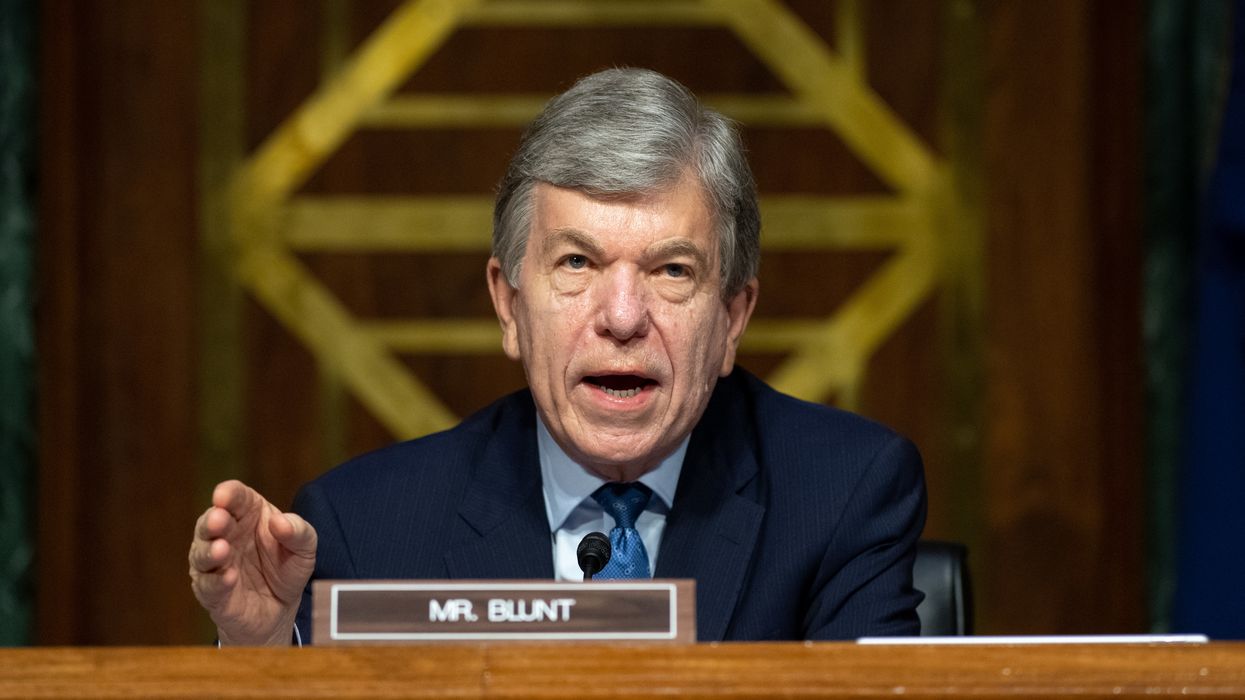
Sen. Roy Blunt

Sen. Roy Blunt will convene a hearing in two weeks that might make clear how much more to smooth the election Republicans are willing to spend.

Saul Loeb-Pool/Getty Images

Progressive groups pressed the Senate on Friday to reconvene "immediately" and approve more aid for states struggling to prepare for a presidential contest in the middle of a pandemic.

A letter from 31 left-leaning organizations to the Republican majority leadership is highly unlikely to alter the calendar, which has senators in recess next week. Instead, it highlights that election funding will be a high-profile, intensely lobbied and potentially partisan issue when Congress does negotiate its next coronavirus recovery package.

Congress allocated $400 million in March to help states conduct elections this year, an amount labeled wholly insufficient not only by voting rights groups but also by state and local election officials from both parties.


Congress is gone from the Capitol until July 20, but its leaders are in the early stages of negotiating what would be the fifth measure designed to prop up the economy and control the Covid-19 pandemic. But top House Democrats and Senate Republicans seem deeply divided over the size and scope of the new package — casting doubt it can get done before another recess now set to start in early August.

The House voted along party lines eight weeks ago to pass a $3 trillion bill that included $3.6 billion in additional election subsidies to accommodate a virtually guaranteed surge in mail-in voting, make in-person voting safer and bolster online voter registration.

The Senate GOP has made no specific counter-offer beyond an opening bid of $1 trillion as the bottom line. And the party's leaders have been vague about how much more it's willing to provide state election administrators, in part because of President Trump's blistering if false claims that easy and expansive absentee voting assures a wave of election fraud.

That could soon change. Roy Blunt of Missouri, a member of the leadership and its top negotiator on election policy as chairman of the Rules and Administration Committee, announced Friday he would hold a hearing July 22 to consider how much more funding is necessary.

But the groups who penned the letter say Congress shouldn't wait that long — and that GOP senators have already delayed too much.

"With less than four months until the November election, time is of the essence," the letter says, adding:

"It should be clear to senators of both parties that the cost of ensuring that every eligible voter can safely cast their ballot amid this pandemic is a small price to pay to preserve our democracy — but given your efforts to block this funding over the past two months, it bears repeating that this pandemic continues to threaten the very foundation of our democracy."

The missive was sent to Blunt, Majority Leader Mitch McConnell and Appropriation Chairman Richard Shelby of Alabama. It was originated by Stand Up America and was signed by groups that similarly align with the left — including Move On, Common Cause, Fair Fight Action, Let America Vote, Public Citizen and Voto Latino.

The haggling over election money will take place amid a welter of other deliberations — including the scope of a new round of direct cash payments, how to extend enhanced unemployment benefits and whether the bill should settle the new battle between Trump and many Democrats over how the nation's schools should safely reopen.


Read More

Has Donald Trump lost his golden touch?

President Donald Trump delivers remarks during a meeting with cryptocurrency executives in the Roosevelt Room of the White House in Washington, D.C., on Aug. 19, 2026.

(Jim Watson/AFP via Getty Images/TCA)

Has Donald Trump lost his golden touch?

On Tuesday night, Darline Graham, sister of the late Sen. Lindsey Graham, revealed somewhat awkwardly that she is entirely unprepared to be a U.S. senator.

At a South Carolina debate, she was asked a perfectly reasonable and straightforward question: “Are Taiwan and the South China Sea national security issues for the United States?” And, “If so, why?”

Keep ReadingShow less
Walling In, Walling Out
A person holding a smart phone with social media on the screen
Photo by Berke Citak on Unsplash

Walling In, Walling Out

In the 1980s, comedian Steven Wright had a bit about Smokey the Bear. When we were kids, we must’ve seen the old PSA a thousand times. “Only you can prevent forest fires.” As Wright recalls Smokey’s warning, he points at himself with a questioning look as if to say, “Me?”

That bit came to mind the other day when I saw the post of a friend from high school that started out by saying, “If you weren’t sure, this is censorship. You know, what you like to accuse President DJT of…”

Keep ReadingShow less
Person voting in a voting booth.

Why are so many American elections uncontested? Richard Neal’s long tenure in Congress highlights a broader problem involving money, ballot access, parties and candidate recruitment.

Hill Street Studios/Getty Images

America Has an Uncontested Elections Problem

Richard Neal, the congressman representing Massachusetts’ 1st district, is concluding his 19th congressional term this year. In many ways, Neal is a typical long-tenured congressperson. However, Congressman Neal is distinguished by having been elected to Congress uncontested more times than anyone in post-civil rights American history.

Neal owes his long tenure in part to the uncompetitive elections in western Massachusetts where so-called “silent elections” are common. Some would be challengers may be put off by the fact that he has won seven of his eight contested congressional races by more than 20 points. More often than not, Neal has been uncontested in the Democratic primary as well, however, this year he has competition in both the primary and general election.

Keep ReadingShow less
  Creative Images & Video Creative Images & Video Images Creative Editorial Video Creative Editorial  Search by image or video Electrician working at a construction site during home or apartment renovation, repair or reconstruction.

America’s housing affordability crisis is rooted in a severe shortage of homes, restrictive zoning and rising costs. Can Congress’s new housing law fix the foundation?

ArtMarie/Getty Images

America’s Housing Crisis Needs More Than Simple Repairs

My wife and I recently moved into a charming Victorian house built in 1879, when Rutherford B. Hayes was president. Despite nearly a century and a half of wear, it remains a beautiful home. But living in it has taught me an important lesson: there’s a world of difference between a house that looks sound and one that is structurally sound.

The floors slope noticeably from room to room. Windows stick on humid days. Doors don’t always close quite right. None of these problems is catastrophic. They are reminders that beneath the attractive exterior, a house this old carries structural issues that no amount of fresh paint can conceal.

Keep ReadingShow less