


Welcome to the latest edition of The Expand Democracy 5 from Rob Richie and Eveline Dowling. This week they delve into: (1) how better elections could empower legislatures; (2) the 2025 World Press Freedom on disturbing trends; (3) better RCV polling in NYC; (4) Bright Line Watch survey on declining democratic health; and (5) the week’s timely links, including to a new free documentary Majority Rules 101.
In keeping with The Fulcrum’s mission to share ideas that help to repair our democracy and make it live and work in our everyday lives, we intend to publish The Expand Democracy 5 in The Fulcrum each Friday.
If you want to suggest a pro-democracy idea for coverage in The Expand Democracy 5, please use the contact form at Expand Democracy.

Deep Dive - Empowering legislatures through better elections 💡
Last week, The Five spotlighted the growing breakdown of our constitutional system of checks and balances. Fundamentally, legislatures, not presidents or courts, should be the core of democracy. That means not having “mandates” from a single election to justify action on a full range of subjects, but creating policy through elected representatives who reflect the diversity of their constituents, deliberate in public view, and compromise to govern inclusively.
Fearful of Donald Trump and Elon Musk backing primary challengers, this Congress has largely turned its governing keys over to the president, but the problem runs more deeply. The shift to presidential power has gone on for decades. In states, while few governors act with the authoritarian zeal of the Trump administration, legislatures often have entrenched leadership with a stranglehold on the legislative process. Defenders of the two-party system may highlight the alleged virtues of winner-take-all elections that “throw the bums out,” but few legislative chambers in fact have even a slight chance of changing party control. In many states, that chance of turnover is best measured not in years, but in generations, if not centuries.
To have Congress and state legislatures play a central, vibrant role in our system, their leadership needs to be at least as accountable to the voters as the executive branch, and more of their members need to be electorally rewarded for pursuing collaborative, deliberative approaches to policymaking. Those goals may seem in conflict, but here’s an example of how to bring them together.
Accountability seats: Years ago FairVote proposed “Districts Plus”, a modification of Germany’s “mixed member” system designed to achieve proportional representation for parties (based on the principle that a quarter of the vote earns a quarter of the seats, and half the vote earns half the seats) while also still electing local representatives. A state legislature would have a share of its overall seats – perhaps 20% – be “accountability seats” that are added to those directly elected locally to ensure the legislative chamber reflects the partisan preferences of the voters. In Districts Plus, if the legislative majority party did not earn more than half the vote, it would not earn a majority of seats – and as a result would lose control or at least have to negotiate with independents and minor parties. ( As an important aside, the details matter with such a system – one recommended best practice is to allow voters to vote for their local representatives as well as cast a separate “party accountability vote.”)
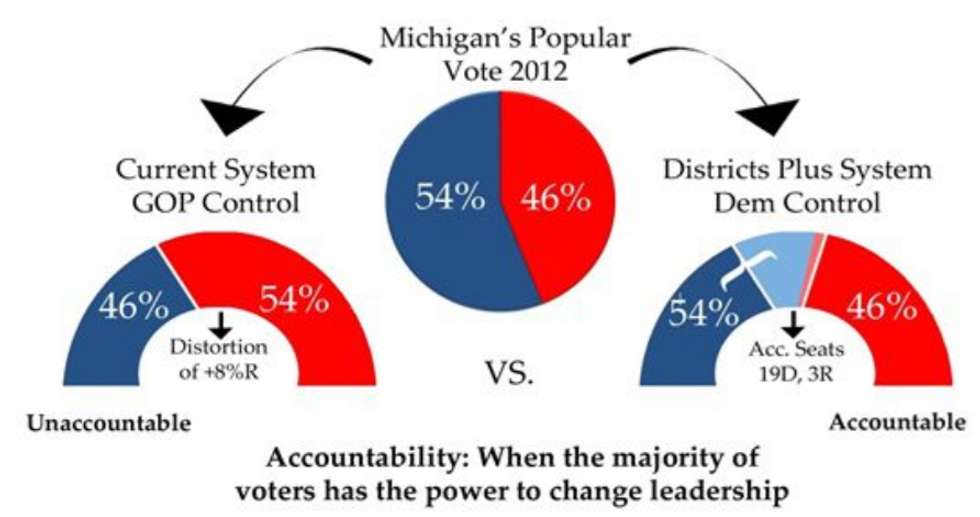
Three-member districts with RCV: Rather than have just one representative who rarely faces real competition except for possibly a primary challenger, voters would have three representatives, all elected with the proportional form of ranked choice voting, with just over 25% of voters having the power to elect a like-minded candidate. As proposed federally in the Fair Representation Act and as used comparably for Illinois house elections for 110 years, this would ensure our major parties truly are “big tents” that allow differences within their party to have a voice -- be it rural Democrats, urban Republicans and cross-cutting members on various issues. Given that they would usually share constituents with representatives who are independent or from another party and given the chance for the district’s less partisan voters to typically elect a seat, more members would be rewarded electorally for collaborative policymaking and almost always share district constituents with candidates from other parties.Together, these reforms aim to thread the needle of both aligning legislative outcomes with voter preferences while empowering individual lawmakers to represent their communities more independently and collaboratively. Nicely summarized by Devin McCarthy for FairVote back in 2013, this combination would increase accountability for how the chamber is run and increase rewards for representatives to embrace their legislative role. Congress could also have analogs for this approach, especially in tandem with increasing the number of U.S. House seats.
When the democratic legitimacy of legislatures is greater than that of the executive branch, power would likely swing back to where it belongs. If we want to restore balance to our democracy, we must retool the very rules of representation. These ideas, tested abroad and rooted in our own history, can empower legislatures to act as engines of consensus, not casualties of partisanship.

Economic Fragility Emerges as Leading Threat to Global Press Freedom
The 2025 World Press Freedom Index by Reporters Without Borders (RSF) reveals a historic decline in global press freedom, with economic fragility now identified as a primary threat. For the first time, the global environment for journalism is officially classified as “difficult,” with the average score dropping to 55 out of 100, a new low. Key factors contributing to this downturn include:
- Media ownership concentration is a major issue. In countries like France, a few wealthy owners control a significant share of the national press, restricting editorial diversity and increasing the risk of self-censorship.
- Economic pressures have led to the closure of news outlets in nearly one-third of countries globally, including nations with previously robust press freedom like New Zealand and South Africa.
- Opaque public funding and dominance by tech giants have rendered newsrooms susceptible to political and oligarchic sway in the advertising sector.
RSF emphasizes that without stable and transparent financial conditions, the independence and plurality of the media are at risk, threatening the very foundation of democratic societies. Here is a discussion of the United States, with a rating that does not factor changes in 2025 after Donald Trump became president:
“I n the United States (57th, down two places), where the economic indicator has dropped by more than 14 points in two years, vast regions are turning into news deserts. Local journalism is bearing the brunt of the economic downturn: over 60 per cent of journalists and media experts surveyed by RSF in Arizona, Florida, Nevada and Pennsylvania agree that it is ‘difficult to earn a living wage as a journalist,’ and 75 per cent believe that “the average media outlet struggles for economic viability.” The country’s 28-place drop in the social indicator reveals that the press operates in an increasingly hostile environment. President Donald Trump’s second term has already intensified this trend as false economic pretexts are used to bring the press into line.”

Getting RCV polling right in New York City💡
This year’s most prominent use of ranked choice voting likely will be in the Democratic primary for mayor in New York City, our nation’s largest city by far. RCV has had a remarkable impact up and down the ballot in New York City since its first use in 2021, but the mayoral race is the one contest that attracts national attention. Former governor Andrew Cuomo is seeking a comeback after his 2021 resignation, and has polled well ahead in first choices all years. But he’s also controversial, and given that he’s under 50% in first choices, there are questions of just what opponent might be able to build a majority coalition to overcome his lead.
While pollsters are busy in this race, they consistently are failing to make effective use of the data from asking for voter’s ranked preferences. Take this week’s Marist poll on the primary, which shows Cuomo leading state legislator Zohran Mamdani 44% to 22% in the first round, and ultimately winning head–to-head by 60% to 40% in the instant runoff. While pleased that Marist and other pollsters are showing that it’s straightforward for pollsters to simulate RCV contests, they could do much more.
Compare Marist’s reporting page with FairVote’s landing page on its mayoral poll in 2021. Not only does FairVote have visuals of how each candidate fares head-to-head against one another and how candidates’ depth of support might show a latently strong candidate, but it allows users to simulate any scenario they want. Polling shouldn’t just be about capturing the horse race, but revealing more deeply what voters think. RCV as a voting method does just that - and as a polling tool, it allows even more creativity and insights when presented creatively.
![NYC Likely Democratic Primary Voters [Excluding Undecided Voters ]](https://thefulcrum.us/media-library/nyc-likely-democratic-primary-voters-excluding-undecided-voters.png?id=60351993&width=980)

Plunging confidence in American democracy drops the US below Mexico and Poland
Bright Line Watch is an important initiative that brings together political scientists to monitor democratic practices, their resilience, and potential threats. Its detailed April 2025 survey report on the views of political scientists and voters is worth close reading. Here’s an excerpt on a disturbing trend that, sadly, is grounded in reality.
In the two months since our last survey, ratings of U.S. democracy declined among all groups — the public overall, Democrats, Republicans, and our academic experts. The shifts are statistically significant in every case. The mean public rating fell from 58 in December 2024 to 53 in February before reaching 49 in April — the first time it has fallen below 50 on the 0–100 scale since we began collecting public data on this question in 2018….
“The United States’ current democracy rating of 53 places it just above Israel (49) and below Mexico (60) and Poland (63). Canada (88) and Great Britain (83) are rated well above the United States by experts, while Hungary (30), Turkey (28), and Russia (11) are still rated well below. These findings also indicate that U.S. democracy has declined relative to other countries. We last asked experts to rate democracy elsewhere in July 2023. At the time, our rating of 70 trailed Great Britain (77) by much less, and we were well ahead of Israel (55), Poland (54), and Mexico (53).

Timely Links
We close The Expand Democracy 5 with notable links:
- Majority Rules unveiled at American Democracy Summit - and is free on Youtube: I’m with pro-democracy activists from around the country for the American Democracy Summit, with special appreciation for my wife Cynthia Richie Terrell of RepresentWomen ’s multiple speaking roles. My thanks to RepresentUs and scores of speakers for their role in bringing people together to learn, plan, and act. Last night I attended the premiere of AJ Schneck’s wonderful half-hour documentary Majority Rules 101, available free to support advocates of ranked choice voting and opening primaries - I’m one of the film’s speakers explaining reforms and the trajectory of changes.
- Republican Jefferson Griffin concedes N.C. Supreme Court race after months of legal battles: After disturbing levels of resistance to defeat, Jefferson Griffin has conceded the November 2024 election of Justice Allison Riggs to the North Carolina Supreme Court. Riggs told reporters: “After millions of dollars spent, more than 68,000 voters at risk of losing their votes, thousands of volunteers mobilized, hundreds of legal documents filed, and immeasurable damage done to our democracy, I’m glad the will of the voters was finally heard, six months and two days after Election Day.”
- Women soar in Australia election results - and trigger gender quota conversations among trailing conservatives: Australia is completing its tally of ranked choice voting elections for the house and proportional representation for the senate. The left-leaning Australian Labor Party (ALP) has won more than 60% of house seats, with independents securing close to 10% - with in both cases a large majority of those seats being won by women. The right-leaning Liberal-National party coalition has named a new woman leader and is having a soul-searching reflection on the election’s gender gap, with growing interest in following the ALP in establishing gender quotas.
- 8th Circuit ruling limits voting rights enforcement: The 8th US Circuit Court of Appeals has shockingly ruled that private individuals cannot use Section 1983 to enforce Section 2 of the Voting Rights Act, breaking all tradition and significantly restricting the ability of voters in seven Midwestern states to challenge racially discriminatory voting practices. This decision follows the 8th circuit’s 2023 ruling limiting Section 2 enforcement to government entities, raising concerns about the region's future of voting rights protections. Plaintiffs are debating whether to appeal this ruling to the Supreme Court.
- Colorado enacts state-level voting protections: Governor Jared Polis has signed the Colorado Voting Rights Act (SB25-001) into law. The act prohibits practices that result in racial or language-based voter suppression or dilution and allows individuals and civil rights groups to file lawsuits against such violations. Additionally, Polis signed the Freedom from Intimidation in Elections Act (HB25-1225), which criminalizes intimidation of voters and election workers.
- Over 200 Organizations: “House Tax Bill Threatens Tax Status for Charities, Churches, and Nonprofits ”: Over 200 organizations released a statement after the House Ways and Means Committee passed their tax bill granting the Secretary of Treasury the ability to accuse any nonprofit of being a ‘terrorist supporting organization’ without basic due process. From the statement: ““This will not keep Americans safe from terrorism. No President should have the power this bill provides to punish their political opponents.”