


Voting is the anchor of democracy, as we are reminded every two years. But this anchor rests on unstable ground today, signaling that our political roots need examining too.
In the United States, the Constitution itself becomes the focus when serious problems prompt such foundational civic dives. Our current challenges may not be as severe as the Civil War or the excesses of the Gilded Age, which produced waves of amendments, but today’s erosion of our system of checks and balances requires us to revisit our constitutional underpinnings.
The good news is that such work is underway. Amending the Constitution is the aim of numerous grassroots initiatives, from term limits and money in politics to fiscal responsibility. Influential books on constitutional change are multiplying. Law schools and universities are conducting model constitutional conventions and the like to supplement classroom activities and research.
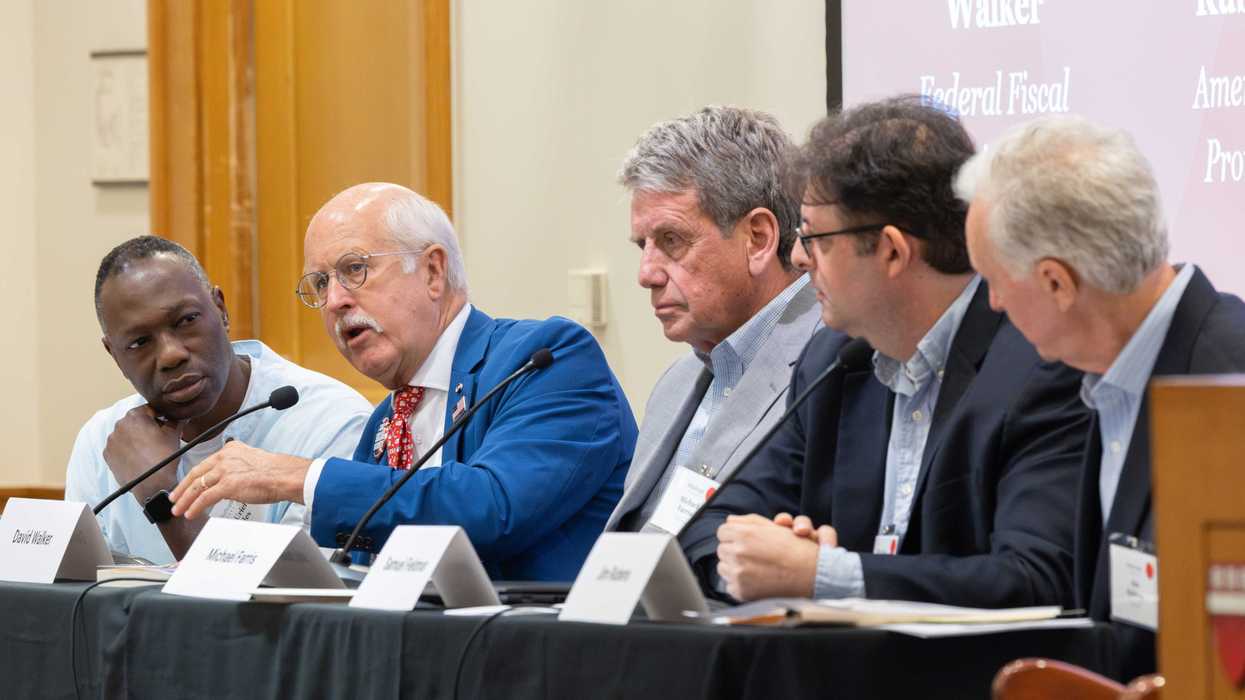
Over the first weekend in October, a one-of-a-kind gathering of scholars, activists, students, and citizens from across the political spectrum met at Harvard Law School to confer about constitutional change. Their priorities and positions differed widely, but they shared an interest in the never-used method of considering and proposing amendments—a convention called by 34 state legislatures.
Article V of the Constitution describes (too briefly for some) two methods for proposing amendments—congressional voting and a state-initiated convention. They are equally valid. The Framers explicitly included the latter method to give the people a way to change our foundational law when Congress could not or would not vote out such proposals.
Harvard Law Professor Lawrence Lessig co-convened the VthePeople conference, noting that there is “growing recognition about the need for constitutional reform,” but that a “broken” Congress can’t help. He added that we need to “go back to the founding ideal of engaging in a process of constitutional craftsmanship” that is not left to congressional action or Supreme Court interpretation.
Conference participants heard from proponents and opponents of such a convention, as well as advocates of various amendment proposals. They also heard from international leaders whose countries have used citizen assemblies and public deliberative processes to strengthen their democratic decision-making. Their use in U.S. constitutional reform could address concerns about how such a convention might work since the Constitution itself is silent on convention rules, processes, or constraints. Assemblies could help select convention delegates, set the convention agenda, and inform how delegates vote.
A key fact that can allay concerns about a convention “going rogue” is that, like Congress, it can only propose amendments, which then must be ratified by 75% of the states. Even proposals to make amending the Constitution easier, such as by lowering the supermajority thresholds for both proposing and ratifying amendments (as emerged from the National Constitution Center’s own Drafting Project earlier this decade), would still have to earn the support of 38 states before taking effect. This external brake after the convention could also serve as an internal brake during it, as occurred at the inaugural Model Constitutional Convention at ASU in 2024.
An Article V convention would also help foster debate and deliberation among the public, a necessary but lengthy and messy part of producing constitutional change. Given that our political branches are proving incapable of tackling issues such as representational integrity and fiscal integrity, is the prospect of a convention not far-fetched? Or, if it becomes more realistic, would it prompt Congress to take up amendment proposals?
Lessig, who organized such a conference 15 years ago, was heartened by the participation of the international and citizen assembly leaders. “There are a lot of new things to think about.”
All this takes time. And it takes people working together. The National Constitution Center has launched its “civic decade” program to connect citizens to the Declaration of Independence, the Constitution, and the Bill of Rights, all of which mark their 250th anniversaries this year, 2037, and 2041, respectively. Perhaps elevating repair of the Constitution can emerge during this window too.
VthePeople student organizer Billy Hasley summarized it well: “An Article V convention is another path to reforming our Constitution—maybe harder, but likely more durable, and certainly more democratic.” If enough of us do the work needed to make it happen or prompt Congress to fulfill its constitutional reform responsibility, he’ll be proven correct.
But start by voting. Then think about the ground we drop that anchor into.
Rick LaRue is a Fulcrum Contributor who writes about the Constitution, amendments, and electoral structure at structurematters.org. He served as deputy director of the Eisenhower Institute and of the American Society of International Law.