




Skip to content
Search

Latest Stories

Follow Us:
Top Stories

Gerrymandering is Dumb. Just Look at North Carolina.

Opinion

North Carolina flag

North Carolina flag

Ahead of the 2026 midterms, North Carolina Republicans redrew the state's congressional map in hopes of picking up another House seat. With every precinct reporting, the plan appears to have backfired.

By IVN's estimates, had Republicans kept the old map, they likely would have won one more seat than they did.
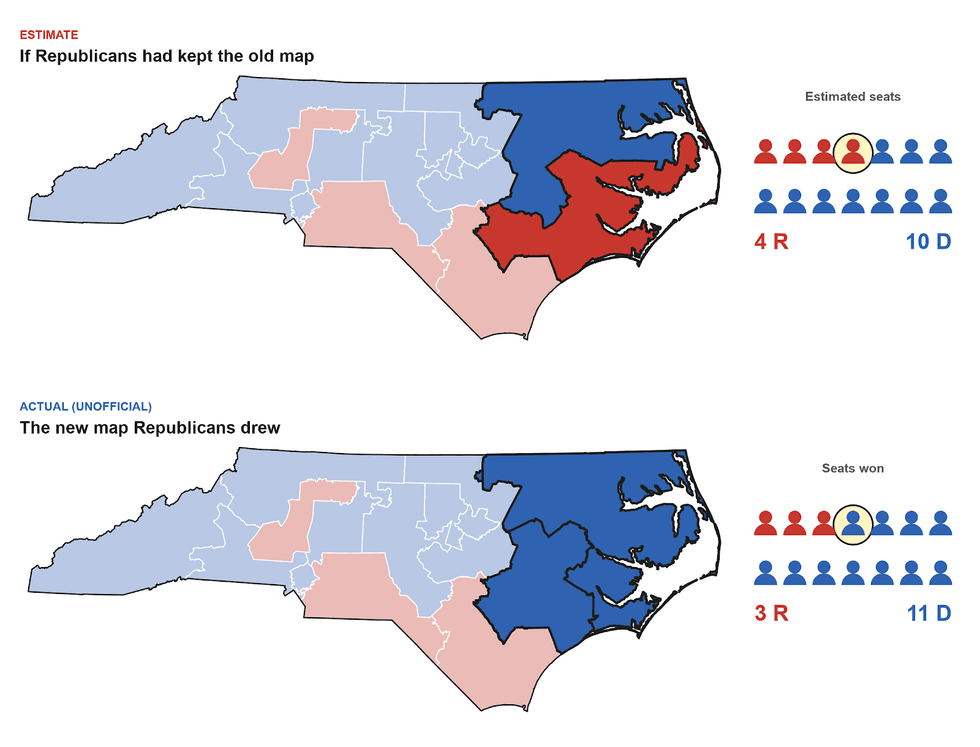

North Carolina’s latest round of redistricting was part of President Donald Trump's nationwide push to shore up the GOP's narrow majority in the US House. It was the thinnest majority either party held in modern history.

It is worth noting that Republicans had already redrawn the state’s congressional map in 2023, transforming an evenly split delegation into a 10-4 Republican majority after the 2024 elections.

However, Republican leaders saw an opportunity to pick up an 11th seat by targeting Democratic US Rep. Don Davis in the state’s 1st Congressional District.

In October 2025, North Carolina became the fourth state that year to move forward with a congressional redraw, joining Texas, California, and Missouri. The goal wasn't hidden from voters. It was a political calculation to protect the party.

"The motivation behind this redraw is simple and singular," state Sen. Ralph Hise said: "draw a new map that will bring an additional Republican seat to the North Carolina congressional delegation."

That is, by definition, a gerrymander.

Gerrymanders work by moving voters around so the other party's supporters are either packed together or spread too thin to win. In this case, six Republican-leaning coastal counties were moved from the 3rd District into the 1st.

They also shifted four inland counties the other way.

In a normal year, that trade might have worked. But 2026 is not a normal year. Democrats won about 58% of the two-party vote in North Carolina's House races, according to unofficial results.

In the targeted 1st District, Democratic Rep. Don Davis held on by 10,794 votes.

Meanwhile, the 3rd District (weakened by giving up those coastal counties) flipped: Democrat Raymond Smith Jr. leads Republican Rep. Greg Murphy by 258 votes.

Under the old lines, IVN estimates show Murphy would likely have won by about 8 percentage points, or roughly 21,000 votes.

That 258-vote margin is about 0.1% of the votes cast, close enough that North Carolina law lets the trailing candidate request a recount. But a recount is unlikely to change the outcome.

A FairVote study of statewide recounts from 2000 to 2023 found they shifted margins by about 0.03% on average, and the few that reversed a result began with margins of 0.06% or less. The results are not final until the state certifies them.

The redraw may still pay off for Republicans in a more ordinary year. By our estimate, it moved the 1st District about 8 points toward Republicans and the 3rd about 8 points toward Democrats, trading one safe Republican seat and one Democratic seat for two competitive ones.

That was a bet that Republicans would have a decent year. In 2026, they lost that bet.

Methods

We used unofficial county-level US House results from the North Carolina State Board of Elections as of Nov. 16, 2026. Using voter-file data from VoterCount.ai, we matched every registered voter to their district on both the old and new maps.

Within each part of a county, we spread the official vote totals across that area's voters, weighting by early voting, past turnout and party registration so that each area matches its official result exactly. We then added those votes back up under the old map to see who would have won.

The 2025 redraw changed only the 1st and 3rd Districts, so the other 12 districts have the same results under both maps. Because the redraw moved whole counties, about 95% of the old-map estimate for the 1st and 3rd is a direct sum of official county totals; the rest is modeled.

The estimate assumes people would have voted the same way under the old lines. It cannot account for how candidates, campaigns or turnout might have differed.

Gerrymandering is Dumb. Just Look at North Carolina. is republished as part of The Fulcrum’s partnership with IVN and the Latino News Network to expand voter‑first journalism and strengthen public‑centered coverage of democracy.



Read More

two cars on a highway
Cars drive on a highway next to a river

Why Your Town’s Roads Run Through Washington: Unpacking Transportation Infrastructure Funding

Introduction

Access to reliable transportation is a critical part of most Americans’ daily lives. In 2022, Americans took an average of 2.28 trips per day, traveling 28.55 miles on average — figures including every mode of transportation and every purpose, for the full population. However, little attention is paid to transportation infrastructure until there are obvious problems like potholes or broken sidewalks linked to sharp decreases in road safety and quality of life for nearby residents. Given widespread reliance on transportation infrastructure makes examination of the governance structures underpinning its funding an important area of consideration.

Process-Shaping Priorities and the Federal Level

At the federal level, transportation infrastructure is primarily governed by the United States Department of Transportation (USDOT), an executive branch agency split into nine main operating administrations overseeing a specific part of the national transit system. USDOT then uses this oversight to distribute federal funding and ensure that individual transit outlets comply with national policy and safety standards. Distributed federal funding is drawn from the Highway Trust Fund, a dedicated federal fund financed through taxes on gas and other transportation costs, and distributed to states through formula-based approaches or competitive grant programs based on spending caps established by Congress. While federal funding plays an important role in transportation infrastructure, it only represents one-quarter of all public spending on roads and highways. The remaining three-quarters of long-term financing and associated maintenance is provided by state and local governments.

Keep ReadingShow less
Capitol Building in Washington, DC
white concrete building under blue sky during daytime

The Public Is Demanding Ethics Reform. Will Congress Listen?

At the end of the 2026 midterm elections, “corruption” emerged as a central issue in the campaign. The public outrage had been building for years. In a September 2026 Gallup poll, 89 percent of Americans agreed that corruption is “widespread throughout the government,” an all-time high. Allegations that members of Congress use insider information for stock trading have become a common belief. Additionally, a raft of sexual harassment and sexual assault scandals has shed light on the inadequate protections in place for congressional employees. As the 120th Congress convenes in January, Congress must respond to this national cry for ethics reform in the legislative and executive branches.

Historically, Congress has always needed a scandal to act. The Honest Government and Open Leadership Act of 2007 – famously proclaimed by Speaker Nancy Pelosi as an act to “drain the swamp” – was passed as a result of the lobbyist Jack Abramoff scandal involving illegal gifts and favors to members of Congress. It appears the swamp was harder to drain than anticipated.

Keep ReadingShow less
a piece of paper cut out of the shape of a donkey
Photo by Kelly Sikkema on Unsplash

America Adrift—Our Future Depends on Returning to American Principles and Standards

The Democratic Party won the recent midterm elections overwhelmingly. But this was not because voters returned to the way people—whether Republican or Democrat— used to think about government and their relationship with it.

It was simply a matter of people being fed up with ever-increasing prices and with the Iran War. It was not a rejection of Trump's vicious, narcissistic, megalomaniac, mendacious personality nor his anti-democratic actions.

Keep ReadingShow less
Woman sleeping on the floor in a detention center

Woman sleeping on the floor in a detention center

Getty Images

Who Benefits When the Process Fails?

In my previous article, I wrote about TK, a lawful permanent resident who has lived in the US for 61 years and now faces possible deportation. I questioned whether immigration enforcement could coexist with fairness, compassion, and respect for the lives people have built in this country.

Since then, I have learned something equally troubling. The legal proceedings are only part of the ordeal. What happens outside the courtroom can be just as devastating.

Keep ReadingShow less