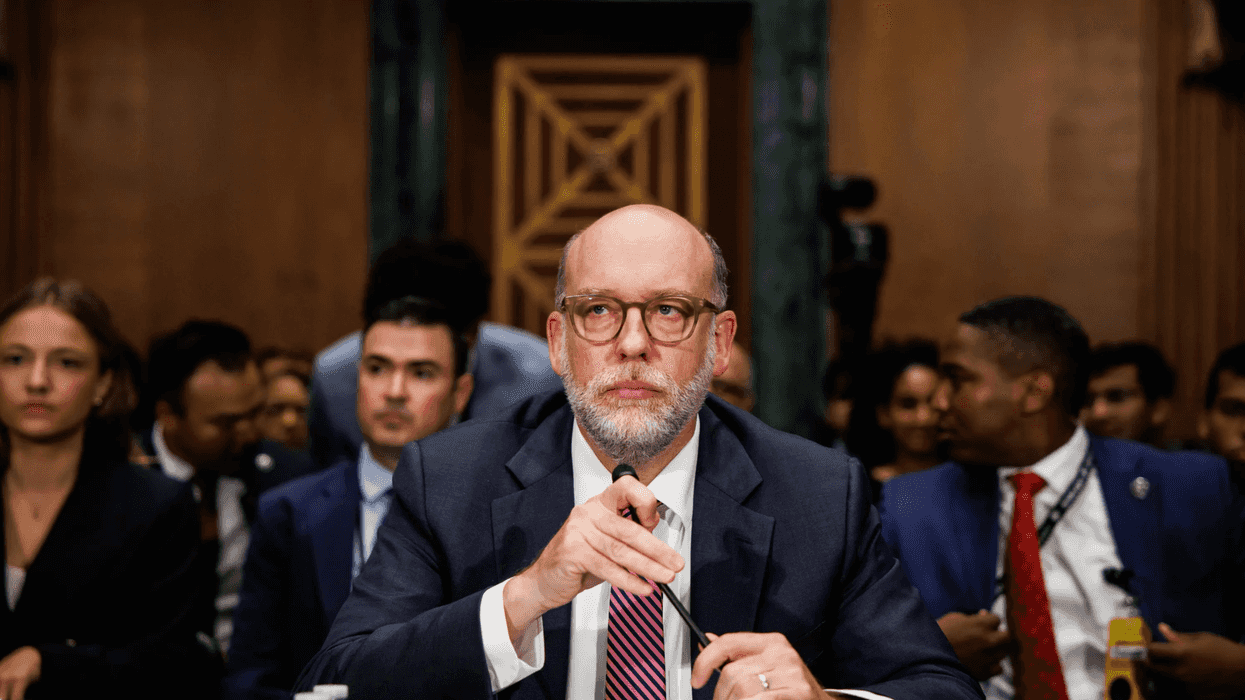





WASHINGTON- The acting director of ICE on Thursday told Congress that while the Trump administration pumped $75 billion extra into ICE over four years, many activities remain cash starved and the agency needs about $5.4 billion in additional funding for 2027.
There’s misinformation with the Big Beautiful Bill that ICE is fully funded,” said Todd Lyons, acting director of ICE, whose resignation was announced later that day.
He added that the recent influx of money funds adequately funds detaining and deporting immigrants. But everything from “putting gas in the vehicles” to special unit investigation teams remained underfunded. He cited growing needs, in particular, to fund their intelligence network and victim specialist teams.
“We just don’t have that [money],” he said.
With the passing of the One Big Beautiful Bill in July 2025, ICE had already become the largest law enforcement agency in the U.S.. The administration’s request for even more money came amid intense and continuing controversy over agents’ tactics, which have caused mass protests across the country.
“They [ICE] have been out of control,” said Sen. Bernie Sanders, D-Vt., to Medill News as he walked through the tunnels of the U.S. Capitol. “They have acted grossly, illegally and unconstitutionally.”
Democrats at the hearing argued that funding for law enforcement agencies like ICE should not increase without significant reform and oversight. These same demands from Democrats spurred a partial government shutdown that began in February - now the longest in U.S. history. The hearing, however, focused on next year’s funding.
Lyons argued that the agency needed more money to continue its efforts. He said that 451,000 people had been detained by ICE under the Trump administration. Including “281,000 with criminal histories, 8,400 gang members and 1,600 known and suspected terrorists,” he said.
Immigration advocacy groups and academic researchers challenged that data, finding that 71% of current ICE detainees have no criminal conviction.
Republicans at the hearing echoed Lyons, highlighting ICE’s role in national security, while some Democrats expressed their concerns about the prospect of additional funding. Among other things, Democrats pointed to the 44 detainees who have died in ICE custody during the Trump administration.
“That is a 20-year high for an agency that was only formed in 2003,” said Rep. Rosa DeLauro, D-Conn.
She spoke about ICE agents arresting US citizens without warrants, tear-gassing a family on their way home from a basketball game, sexual abuse in detention centers and one Cuban man who recently died while in detention due to excessive force. His death was ruled a homicide, according to an autopsy report.
“In January of this year, ICE violated nearly 100 federal court orders,” she said, “which the chief federal judge in the state of Minnesota estimated was more violations than some federal agencies have committed during their entire existence.”
Rep. Lauren Underwood, D-Ill., questioned the pattern of “reckless, incompetent, cruel, illegal, corrupt and unconstitutional behavior,” she has seen from ICE agents. “These are leadership problems, not funding problems,” she said, later declaring that she would not give the agency “another penny.”
Colleen Putzel, a spokesperson from the D.C. based think tank the Migration Policy Institute, expressed frustration with the potential of an increased ICE budget, describing what she sees as a “mismatch” in funding in the immigration system.
She explained that while the budget for immigration enforcement operations like ICE remains at “large and growing levels,” other immigration agencies, such as the U.S. Citizenship and Immigration Services and the Executive Office for Immigration Review, have seen drastic cuts.
For example, the office, which runs immigration courts, has seen a quarter of their immigration judges fired in the past year. This has helped create a back-log of 3.8 million cases.
Rep. Delia Ramirez, D-Ill., who held office during the height of Operation Midway Blitz at the end of last year, sees a country where family budgets decline while ICE budgets grow.
“It would be a travesty for taxpayers," she said to Medill News Service, and for many across the country asking “Why is my gas price so expensive? Why can’t I buy a home? Why is my life so hard?”
Jamie Gareh is a graduate student at Medill.