


As the United States celebrates the 250th anniversary of its Declaration of Independence, the global data we collect and analyze shows that the country is failing to “promote the general Welfare,” as the Constitution’s framers promised a little more than a decade later.
We are scholars of human rights. Alongside the Human Rights Measurement Initiative, a nonprofit that tracks how well more than 200 countries and territories are meeting the human rights commitments their governments have made, we annually update scores measuring whether people can actually get the basics of a decent life, such as healthcare, adequate food and a quality education.
The latest data our team has amassed shows that the U.S. is falling short compared with what it could achieve, given its US$32 trillion economy. This is not a one-year blip – the U.S. has been underperforming for the past 25 years.
Economic and social rights
Two foundational human rights agreements, the Universal Declaration of Human Rights and the International Covenant on Economic, Social and Cultural Rights, describe countries’ obligations to promote the welfare of their people. Countries should improve the health, education and occupational well-being of their people over time, as best they can, given their “resources.”
The United States co-authored and voted in favor of the universal declaration in 1948. Although President Jimmy Carter signed the International Covenant on Economic, Social and Cultural Rights in 1977, U.S. lawmakers never ratified it.
Resources in this context generally mean a government’s wealth and capacity. We measure resources by using per capita gross domestic product – the amount of money in a country evenly divided among its entire population. Because rich countries, like the U.S., can do more than lower-income countries, like Haiti, they are held to a higher standard.
So we don’t just ask how healthy, well-fed or educated the people of a country are. We ask how well a country is providing for its people compared with other countries with similar resources.
A 100% score means a country is doing all it can with what it has, and further improvements would require more resources. A lower score means there’s room for improvement.
Doing all you can with what you have doesn’t mean a government has to provide goods and services directly. Governments can rely on private businesses, employers, nonprofits, public programs or a combination. What we score is the result: Are people actually getting what they need?
We compared the scores of the U.S. over time against 37 other high-income free-market based countries in the Organization for Economic Cooperation and Development, a forum for industrialized economies to exchange information on the best policies and practices to support growth and development. Then we calculated how many Americans would be able to have these things if the U.S. adopted better policies.
Across all five areas we track – health, food, education, work and income – the U.S. has either stalled or lost ground, relative to its own history and to its peers.
Right to health
The U.S. ranks below its peer nations on health. Even Turkey and Hungary, less industrialized countries where the GDP per capita is a fraction of what it is in the U.S., have guaranteed better health outcomes for their people when compared to their resources.
Health scores indicate how well a country keeps its people alive and well, like whether children are born and stay healthy, whether adults live long lives and if the incidence of preventable diseases is kept low.
The U.S. scores about 80% of what it possibly could. By comparison, Canada scores 90%, Japan 88%, Mexico 86% and Australia 93%. Iceland scores the highest at 97%.
U.S. health scores have been relatively flat for a quarter century, rising from 79% in 2000 to a high of 82% in 2012. In 2023, it had receded to 80%. The rising scores were likely due to more Americans gaining health insurance following the Affordable Care Act’s rollout. The later decline was caused primarily by the COVID-19 pandemic.
We anticipate further declines. The Congressional Budget Office estimated that 11.8 million Americans would lose access to government-subsidized health insurance due to changes in the big tax and spending package President Donald Trump signed into law in the summer of 2025. By 2034, that number is projected to rise to 17 million people.
Right to food
People who have realized the right to food and adequate nutrition can reliably access affordable, healthy and nutritious food.
Our score measures the percentage of people who find themselves in that situation. The U.S. is only achieving about 81% of what it possibly could.
If the United States allocated its resources more efficiently, we estimate that roughly 14.8 million more women and 9.1 million more men would always have enough healthy food.
Among countries for which we have food security data, the U.S. ranks 30th out of 37.
Our data for the right to food in the U.S. spans 2015 to 2023. The U.S. food score fell slightly during that period, from 81.9% to 81.1%. This means that as the U.S. got wealthier, Americans got hungrier.
This score peaked in 2020, before the pandemic. Persistent inflation, rising housing costs and changes to the Supplemental Nutrition and Assistance Program led to declines.
Signs point to the share of Americans who have access to affordable and nutritious food declining further.
About 3.4 million people lost access to food assistance from September 2025 to June 2026, also due to cuts in Trump’s 2025 legislative package.
The effects are starker in some places. In Arizona, SNAP enrollment had fallen by about half as of April 2026, with more than 400,000 people losing benefits since July 2025. The Arizonans who were still getting SNAP benefits to help them buy groceries were receiving significantly lower benefits, ProPublica reported.
Right to dignified work and fair income
Can people find work? Do they earn enough to get by? That’s what we measured for this economic right.
We set the bar at half of what a typical American household earns. By that measure, the U.S. reaches just 27% of what a country this wealthy could achieve, which is the worst score for an Organization for Economic Cooperation and Development member country.
It does better at creating conditions where people can find a job, scoring about 75%, ranking 10th alongside countries like the Netherlands and Iceland. But it’s still far behind leaders like South Korea and Mexico.
If the U.S. changed some policies – such as increasing the federal minimum wage – 46 million people could earn enough to rise above that fair pay line. About 5 million more would escape extreme poverty, surviving on less than $4.20 per day.
The country has been losing ground on work and pay for 25 years. After accounting for how much richer the U.S. has grown, its score fell from about 62% in 2000 to 51% today. This reflects the growth in economic inequality, with the gains in wealth skewing toward the richest Americans.
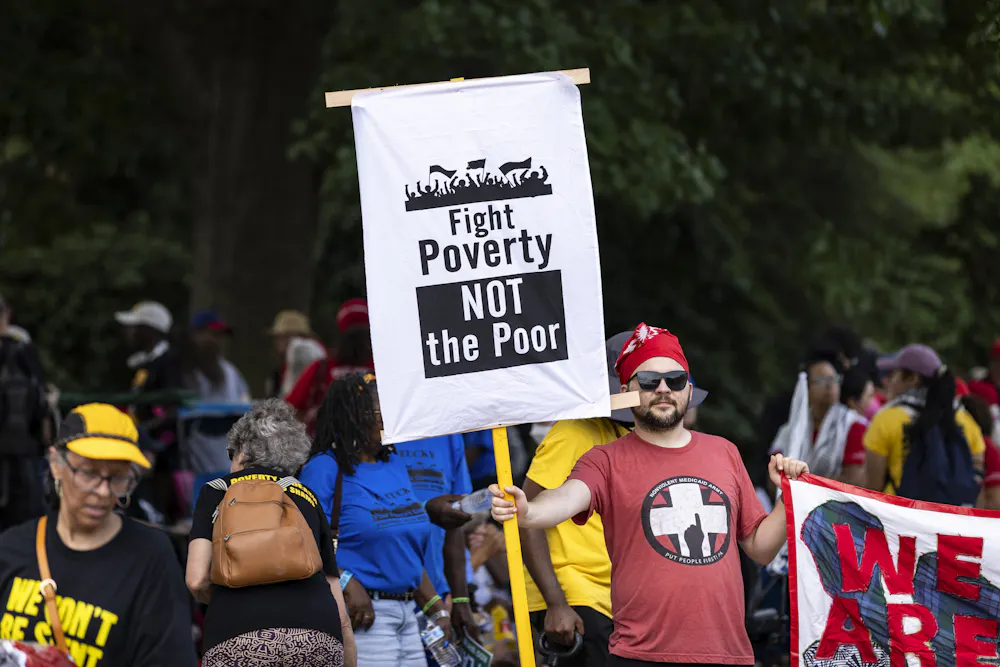 The Poor People’s Campaign holds a rally advocating for living wages, voting rights and other policies that would help poor and low-wage Americans in 2024 in Washington. Samuel Corum/Getty Images
Right to an education
The U.S. scores a 76% on the overall right to education, placing it 20th among 38 OECD countries. It’s behind Japan and the U.K. but ahead of some peers, including Canada and Norway.
We measure education through access – whether students are enrolled in school – and quality – how well they score on tests in science, math and reading.
The U.S. rates a score of 90.7% on access but only averages 61.3% on quality.
An unmet promise
The U.S. is among the wealthiest nations in human history, but it falls far short of what that national wealth makes possible for its people – in terms of health, food, pay and what its students learn.
The reason isn’t that the country can’t afford to do better; we’ve found it’s because the U.S. doesn’t turn that wealth into opportunities for everyone to have a decent life.
Recent cuts to health insurance coverage and food assistance are pushing much of what we measure in the wrong direction.
Promoting the general welfare was written into the country’s founding promise – 250 years later, our data shows how far there still is to go.
Americans Are Not As Well Off As People in Peer Nations – Us Safety Net’s Shortfalls Show Up in Global Data was originally published by The Conversation and is republished with permission.