




Skip to content
Search

Latest Stories

Follow Us:
Top Stories

For Imre Huss, Fixing Democracy Starts With Talking to a Stranger

News

For Imre Huss, Fixing Democracy Starts With Talking to a Stranger
a couple of people sitting at a table with cups of coffee

The Democracy Architects Council, presented by The Bridge Alliance Education Fund and Civics Unplugged, offers a paid, one-year fellowship for eight fellows ages 18 to 28, each selected for their work across a distinct sector of democratic life.

The youngest member of the Democracy Architects Council is building AI-powered civic tech, but he says the real work of democracy still happens face to face.


When Imre Huss talks about why he believes democracy is worth fighting for, he doesn't start with a civics textbook. He starts with his mother, who left Poland alone at 17, after helping distribute newspapers during a period of authoritarian rule there. Huss grew up in Cleveland, Ohio, hearing those stories, and he says they planted a seed: that pro-democracy organizing was something an ordinary person, even a teenager, could actually do.

That seed grew into Govvy, an AI-powered civic technology platform Huss co-founded to close the gap between residents and local government. It emerged from two experiences during his junior year of high school. The first was organizing a hyperlocal campaign (alongside neighbors in their 60s and 80s) to stop a development that threatened a green space in his city. Petitions, yard signs, and an op-ed in the local paper moved the needle some, Huss said, but what actually stopped the project was a single phone call from a retired judge in the neighborhood to a friend on the planning commission. The second was watching, as a youth advisor to his congresswoman, how constituent mail got triaged by interns before it ever reached her desk, even as her social media comments and DMs went unanswered.

"There was this intent to engage, but in practice, there weren't really the tools to do so," Huss said.

Imre Huss

Govvy started out ambitious. Huss said he originally tried to design for every gap he saw across local, state and federal government before narrowing to focus on local elections and day-to-day civic information. He's headed to the University of Virginia this fall on a full scholarship through the Jefferson and Echols Scholars Program, and he's bringing Govvy's mission with him, carefully. A team will keep building it back home in Cleveland, but Huss says he won't import the platform into Charlottesville before he understands what the community actually needs.

"They [tools] should be grounded in the needs of the community, in the interests of the community," he said. "If that doesn't match the needs of the community, then I wouldn't want to bring it there."

That instinct to start local, then scale carefully, shapes how Huss thinks about a contentious debate in the democracy reform space: whether the path forward runs through local organizing or national media. He's landed on both. National media moves faster, he said, but local conversations tend to leave partisan labels at the door. He pointed to a recent trip to the Indiana Civic Summit, in a state that's grown reliably red, where he found real energy for expanding civics education, not because it polled as partisan, but because nobody had attached a party to it yet.

"If you put a D or an R next to that, at the national level, you're all supposed to agree on those things," he said. "But there is a lot of nuance within a political party."

That caution carries into how Huss talks about the council's broader mission. He argues one of the group's first jobs is repairing the word "democracy" itself, which he says has become so politically coded that it shuts down conversation before it starts. His approach: find organizations that don't see themselves as democracy groups like corporations, civic associations, sports leagues, and build buy-in one shared value at a time, without forcing a partisan frame onto it.

"We need to figure out how we connect with organizations that hold power," he said, "and then, through those connections, try to communicate a vision of democracy that is greater than just the word democracy."

It's a theory that runs through how Huss responds to a generational refrain he hears often - that young people are "the future" of democracy, tasked with fixing what older generations broke. He calls the sentiment well-intentioned but incomplete. "It's easy to say this is your responsibility as a young person," he said. "But it's very easy to say something like that without actually putting in the effort to foster those young voices and turn them into young actions."

Asked what he wants people to do - not just feel - after encountering his story, Huss didn't point to an app or a campaign. He pointed to the grocery store line.

"Talk to somebody at the grocery store. Start up a conversation. Talk to your neighbors," he said. "We try to separate ourselves, we try to become so individual, and we lose those connections we have across our society."

Kristina Becvar is the executive director of the Bridge Alliance Education Fund.


Read More

Vote Badge with Rising Social Media Like Icons and Hearts – Digital Engagement and Online Voting
J Studios / Getty Images

Democratic Autopsy and AI

After every defeat, organizations conduct autopsies. The good ones are honest, like NASA’s Rogers Commission report after the Space Shuttle Challenger exploded shortly after takeoff. In addition to identifying the infamous O-rings as the proximal culprit, it looked at organizational culture, communication failures, normalization of risk, management pressures, and institutional blind spots. The best ones are uncomfortable, and make a serious effort to understand “why did we mess this up so badly?” I’ve personally seen both good “autopsies” and bad ones throughout my decades of experience in true life-or-death realms: the SEAL Teams and as an Emergency Medicine physician.

Following the 2024 election, the Democratic National Committee produced a lengthy report titled Build to Win. Build to Last. Yet it is not a serious document because it does nothing to prepare for the unstoppable and very near future staring us right in the face. It is nearly 200 pages long and attempts to explain what went wrong and how the party should prepare for the future. It discusses organizing, communications, coalition building, fundraising, digital strategy, and voter outreach. It is filled with references to data, analytics, and technology.

Keep Reading Show less
My Generation Can Spot the Deepfake. That’s Not Enough.
Smartphone with ai text in jeans pocket
Photo by Immo Wegmann on Unsplash

My Generation Can Spot the Deepfake. That’s Not Enough.

Thomas Massie, a seven-term Republican congressman from Kentucky, lost his primary on May 19. The race cost $32.6 million, making it the most expensive congressional primary in U.S. history. Among the weapons deployed against him: an AI-generated video showing him checking into a hotel room with Representatives Alexandria Ocasio-Cortez and Ilhan Omar, with their hands clasped. The narrator called it "worse than adultery." A disclaimer at the bottom of the screen, in small text, read: "This satirical ad was created with artificial intelligence."

I watched the ad. It looks ridiculous. The movements are slightly too smooth, the lighting is off, and the scenario is so cartoonish that I genuinely could not tell at first whether it was meant to be taken seriously. But I'm 17, and I've spent the last four years watching AI-generated content get better in real time. I know what the seams look like. Massie, in his post-loss interview on Meet the Press, was blunt about who the ad actually reached: "It was actually very effective on the boomers."

Keep Reading Show less
An illustration with the words, "AI," in the middle - Icons on a computer, robot, lock, and a car are around

AI is unpopular yet widely used. Explore how citizen-led “crackpot schemes” could shape AI policy, protect jobs, strengthen democracy, and maximize AI’s benefits while reducing its risks.

Andriy Onufriyenko / Getty Images

In Defense of “Crackpot Schemes” for AI Governance

AI is unpopular. And nearly a billion people use ChatGPT.

AI is destroying jobs. And fields predicted to have been eliminated by AI, like radiology, continue to grow and leverage the technology to improve their work.

Keep Reading Show less
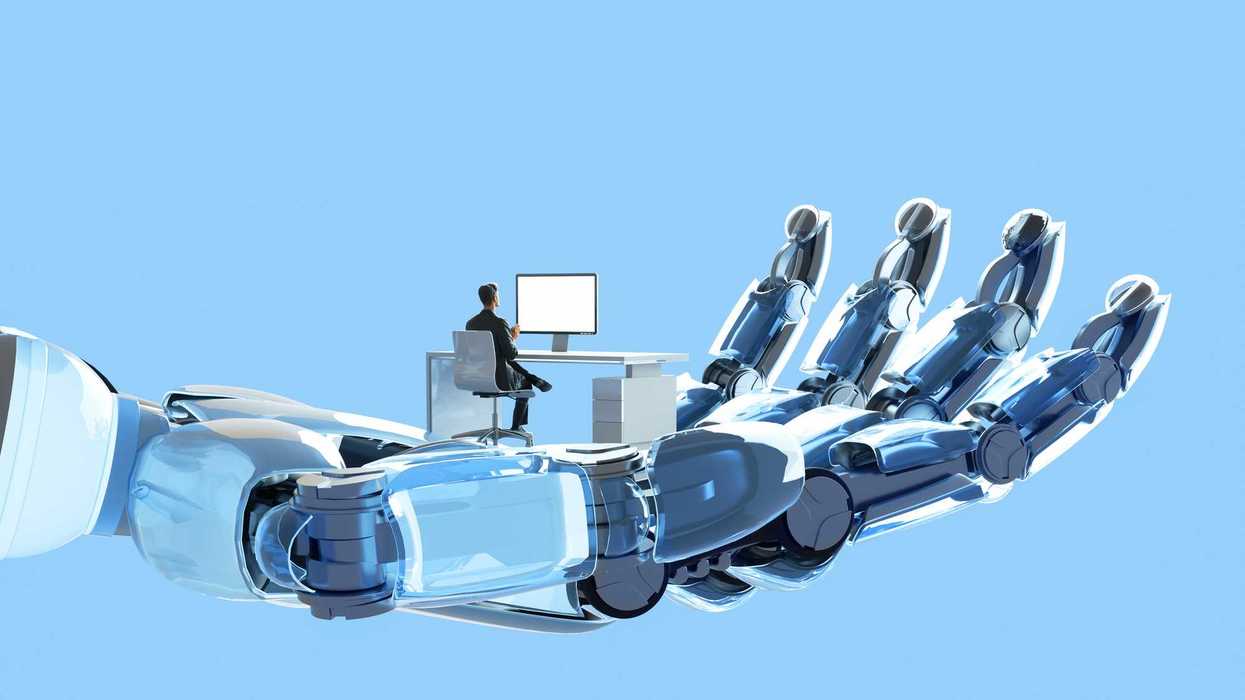
Digital illustration of robot's hand holding and supporting man who is working on his desk using computer, represent themes of artificial intelligence (AI), the future of work, and the intersection of humanity and technology.

A critique of Steven Rosenbaum's The Future of Truth and the irony of AI-generated errors in a book warning about AI, truth, trust, and democratic responsibility.

Andriy Onufriyenko / Getty Images

On Truth, Shame, and the Abuse of AI

A democracy is only as robust and vibrant as the citizens who sustain it. Self-government depends upon people willing to deliberate honestly, reason carefully, and exercise judgment responsibly. With the emergence of AI, this obligation becomes even more consequential because these powerful systems can either deepen human agency or quietly erode it. They can either help citizens think more clearly and participate more meaningfully, or they can encourage the outsourcing of judgment itself and the slow substitution of synthetic plausibility for human responsibility.

Imagine, then, publishing a book warning humanity about the epistemological collapse supposedly ushered in by artificial intelligence. Imagine assembling endorsements from solemn guardians of the humanities, critics of automation, custodians of truth, defenders of interpretation against probabilistic sludge. Imagine presenting yourself as a kind of intellectual fire marshal standing before a burning building, yelling that people must immediately stop playing with matches.

Keep Reading Show less