




This is the third in a four-part series examining possible outcomes of state legislative elections in 2022 and their potential impact on policy-making.
As Congress has become mired in gridlock, passing few meaningful bills each year, state governments have become home to most consequential legislative activity. That makes the 2022 midterm elections critical for anyone concerned about a myriad of issues, including reproductive rights and elections.
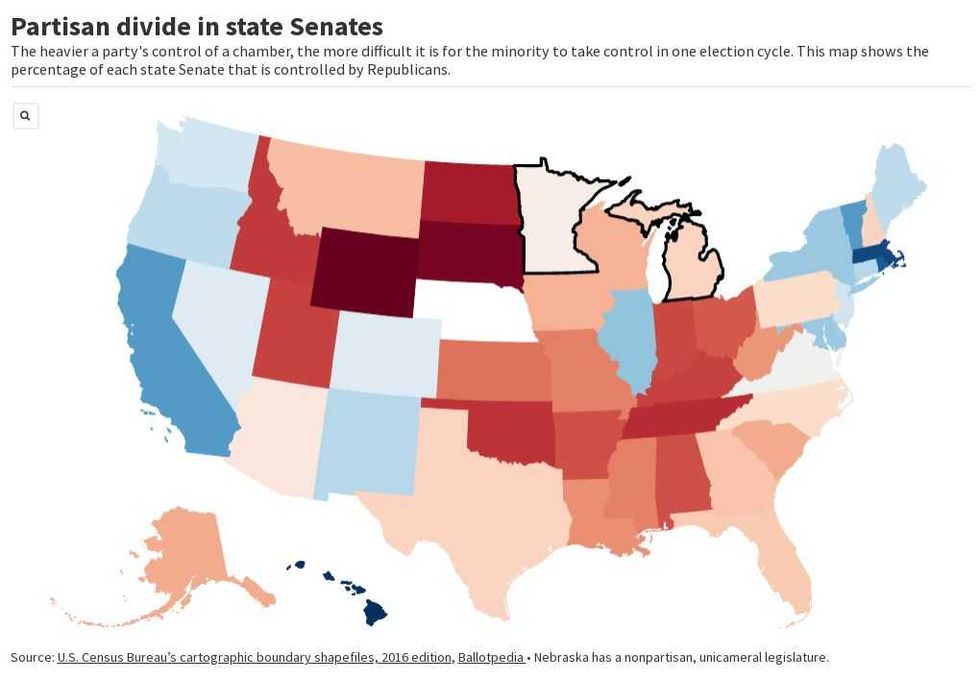
This installment examines likely outcomes in Michigan and Minnesota and what they mean for constituents and the country as a whole. In both chambers in Michigan, as well as the Minnesota Senate, Republicans currently have control and will likely maintain it, though Democrats still have a chance to flip. In the Minnesota House of Representatives, Democrats currently hold a majority that they will have to fight for, as Republicans are also favored to win this legislative body.
For this series, the Fulcrum utilized ratings from Cnalysis and Sabato’s Crystal Ball to identify the most competitive legislative bodies. Ballotpedia data on election trends addresses the historic tendency for the president’s party to lose state legislative seats in the midterms, while Campaign Legal Center redistricting data explores possible advantages one party may have over the other.
Michigan
State Senate Week 3
 State Senate Week 3
A Flourish data visualisation by Reya Kumar
State House Week 3
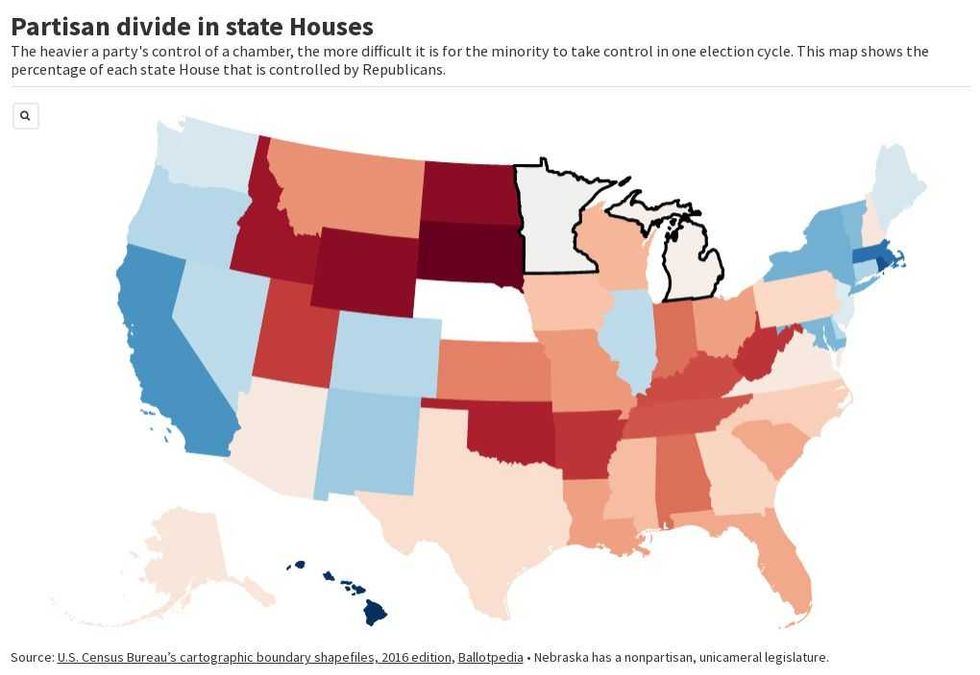 State House Week 3
A Flourish data visualisation by Reya Kumar
The Michigan Legislature is composed of the 38-member Michigan Senate and the 110-member Michigan House of Representatives. Michigan is one of the top battleground states. Currently, Republicans hold the majority of seats in both chambers. However, this control is complicated by the fact that Gov. Gretchen Whitmer, elected in 2018, is a Democrat.
Senate
Sabato’s Crystal Ball considers the Michigan Senate one of the few tossup chambers where it could be anyone’s game this November. They highlight new maps drawn by an independent redistricting commission as a reason why Democrats can expect to gain seats, if not win the legislature.
Cnalysis rates the Senate as Tilt R. Few seats are very competitive, with 44 percent of the seats safely Republican and 42 percent most likely going to Democrats. In order to flip this chamber, Democrats would have to win one district that leans towards them, the two districts rated tossup, and one of the two districts that lean towards Republicans.
The Michigan Senate has remained solidly in Republican hands for the past 40 years and has largely followed national midterm trends in recent elections. In both 2010 and 2014, Barack Obama’s Democratic party lost seats. In 2018, a Republican party headed by Donald Trump lost out. This means that Democrats may be fighting a red wave as constituents react to President Joe Biden’s leadership.
Where control of state legislatures is up for grabs
House of Representatives
Sabato’s Crystal Ball and Cnalysis both rate the Michigan House of Representatives Lean R. Sabato’s points out that while the GOP does have an edge in the House, they lost a traditionally Republican-leaning seat to a Democrat in a recent special election, which may bode well for Democrats this November.
However, Cnalysis data reveals that Democrats face an uphill battle in this chamber. Fifty-five percent of the House districts are solidly in the Republican camp, while 39 percent will almost certainly go to Democrats. To flip the House, Democrats would have to win not only the five districts that lean their way and the 6 tossup districts, but also five of the seven districts that lean Republican.
The Michigan House of Representatives has remained in Republican hands for most of the past 20 years, except in 2006 and 2008 when Democrats gained the majority. In recent midterms elections, the president’s party has reliably lost out. Democrats lost seats in 2010 and 2014, while the 2018 midterms saw them gaining a few back. Democrats may struggle to overcome this trend and gain seats with President Biden in the White House.
Key factors
The 2020 redistricting cycle will likely have a major impact on Michigan’s state legislative election this year. New maps were approved by the Michigan Independent Citizens Redistricting Commission for the first time last December, after decades of maps drawn by the Republican legislature. Data from the Campaign Legal Center indicates that the previous maps were skewed heavily in favor of the GOP. The Senate map skewed 15 percent and the House map skewed 8 percent. Though there is not yet any evidence of how these maps will perform, they will assuredly lessen the gerrymandered advantage the Michigan GOP has enjoyed for many years.
While the primary elections are set to occur on August 2, current polls show Whitmer still ahead of her prospective Republican challengers. This means that Michigan’s government will likely remain divided after the general election this fall. If Democrats win the Senate and/or House, they may be better able to further their legislative agenda with the support of a Democrat in the governor’s seat.
Impact
Michigan has passed little election-related legislation in recent years, with Whitmer at odds with the Republican legislature. In 2019, they launched an online voter registration system and implemented automatic voter registration. Additionally, the legislature passed a resolution urging national level politicians to oppose the For the People Act, a sweeping voting rights bill led by U.S. House Democrats. If Republicans retain control of the legislature, it is likely that this stalemate will continue. Democrats, however, would almost certainly work to pass legislation expanding voter access if they win the majority in one or both chambers.
Reproductive rights will be on the ballot in November, as Michiganders collected the most signatures in the state’s history for a ballot initiative to introduce a constitutional amendment protecting abortion. However, if this fails to pass, abortion rights in Michigan will be dependent on the votes of the state legislature. The GOP gubernatorial frontrunner has voiced support for a near-total abortion ban without exceptions for minors or victims of rape.
Minnesota
The 67-member Senate and the 134-member House of Representatives comprise the Minnesota Legislature. Republicans currently have control of the Senate, while Democrats control the House, making it one of the few divided state legislatures in the country. Democratic Gov. Tim Walz completes Minnesota’s state government. Minnesota will hold its primary election on August 9 ahead of November’s general election.
Senate
Cnalysis rates the Minnesota Senate Lean D. This Senate is much larger than many other state senates, and many districts could go either way. Cnalysis predicts that 35 percent of the districts will almost certainly go to Democrats, while 46 percent are solidly Republican. Of the remaining 12 districts, Democrats would need to win all five districts that lean their way, plus five of those that lean towards GOP candidates.
Sabato’s Crystal Ball also rates the Senate Lean D. Sabato points out the key role that districts in the Twin Cities’ suburbs will play. However, though both chambers are contentious, a GOP win in the House is more likely than the Democrats flipping the Senate.
Over the past 20 years, partisan control of the Minnesota Senate has fluctuated. Democrats held the majority from 2002 until the 2010 midterms when it switched to Republican hands. In 2012, it flipped back to Democratic control. Four years later, the GOP regained control of the majority and has held it since. This means that this chamber does not necessarily follow typical midterm trends.
House of Representatives
The Minnesota House of Representatives, currently held by Democrats, is very contentious. Cnalysis gives it a rating of Tilt R, while Sabato’s Crystal Ball considers it anyone’s game, rating it one of the few tossup chambers.
Solidly Democratic districts make up 40 percent of the seats, while 41 percent are solidly in the Republican camp. In this chamber, Democrats face an uphill battle to retain their tenuous majority. Unless they win all three districts that lean toward their party, all nine tossup districts and one of the Republican leaning districts, the GOP will be able to take control.
The House seems to follow nation midterm trends more reliably than the Senate. In 2010 and 2014, the chamber flipped from Democrat to Republican control during the two midterms while Obama was president. In 2018, it flipped back to Democratic control during Trump’s presidency. This suggests that Republicans are likely to gain at least some seats this November, as Biden faces backlash.
Key factors
Minnesota enacted new legislative maps this February, following the 2020 redistricting cycle. These maps were created by a special judicial redistricting panel, as the divided government could not agree on a plan. In 2010, the maps were also created by a judicial panel as the Democratic governor vetoed the maps drawn by the Republican legislature. Data from the Campaign Legal Center indicates that the 2010 map was slightly biased in favor of the GOP, particularly in the state House. The new maps will likely perform similarly, maintaining a slight edge for Republican candidates.
It is unlikely that Minnesota will become a trifecta for either party this November. Polls show that Gov. Walz is likely to be reelected, regardless of which GOP candidate he faces. Meanwhile the Senate appears likely to remain in Republican hands. Whether or not Republicans flip the House, both parties will remain at odds and unable to freely pass their legislative agendas.
Impact
Little changes in election law have been made in recent years due to Minnesota’s divided government. In fact, out of 166 bills introduced in the past two years, only one that enhanced security for absentee ballot dropboxes has been enacted, according to Voting Rights Lab. If the Democrats flip the Senate and maintain the House, they will most likely pass laws to expand voter access. However, the more likely scenario of Republicans retaining control of the Senate and flipping the House will likely result in GOP-backed bills intended to restrict voter access being blocked by Democrat Walz.
One other key area is abortion. Without Roe v. Wade, the current divided government has preserved Minnesota’s status quo, and if the government stays divided, it will almost certainly stay that way. Abortion is neither banned nor codified, though it is protected by the state constitution. With control of both houses, Republicans would probably attempt to pass legislation banning abortion, especially if Walz loses to his most likely opponent, Dr. Scott Jensen, who vehemently opposes abortion. Meanwhile, if Democrats manage to win out, they will presumably work to codify abortion access.