





Meyers is executive editor of The Fulcrum.
Democracy reformers may not always agree on the best ways to improve the American political system, but a survey of reform leaders shows some consensus on structural priorities that could make elections more competitive and result in more moderate elected officials: open primaries, ranked-choice voting and nonpartisan redistricting.
The Fulcrum asked representatives from dozens of organizations that focus on political change and engagement to identify the three most important reform proposals that should be pursued in 2024. While the 51 respondents offered nearly as many options, slightly more than half identified open primaries as one of their three biggest priorities.
“They allow the largest voting block in our country – Independent/nonpartisan/unaffiliated voters – to fully participate in all of our taxpayer-funded public elections,” said Eric Bonner, founder and chief operating officer of Veterans for All Voters.
In most states, at least one political party restricts who may vote in a primary, allowing candidates in those states to focus almost exclusively on the parties’ most devout members.
“Open primaries will lead to more bipartisanship as the legislators will have to consider/respond to all their constituents instead of only those who can get them through the primary,” said Dona Sauerburger, a member of the Independent Voters of Maryland executive committee.
Among the 27 respondents who picked open primaries as a top priority, 11 specifically suggested a system akin to Alaska's new “top four” elections in which all candidates run in one primary regardless of party. The four who receive the most votes then advance to a general election that uses ranked-choice voting.
Supporters of the Alaska model, or a variation with a “top five” general election, argue it gives more choices to more voters and results in less partisan representatives serving in government.
“The current system incentivizes candidates to tack to the right in red districts, and tack to the left in blue districts. Moderate centrist candidates are squeezed out,” said Michael Morrow, a member of the board of the Center for Free, Fair and Accountable Democracy. “Also, the current structure tends to have relatively small numbers of relatively extremist voters determining the outcome of partisan primaries.”
Morrow’s latter point echoes Unite America’s messaging about the “primary problem.” According to UA’s research, 83 percent of House members were effectively elected by 8 percent of Americans in 2022 because general election contests are overwhelmingly noncompetitive. Unite America found that states that hold nonpartisan primaries (not just Alaska but also California and Washington) have greater turnout and more voter participation than other states.
Unite America, among others, recommends pairing open primaries with ranked-choice voting to combat the primary problem. Twenty survey respondents included RCV in their top three priorities, making it the second most popular reform.
In an RCV election, voters rank the candidates in order of preference. If one candidate receives a majority of first-position votes, they win the election. If no one has a majority, the candidate with the fewest top votes is removed from the ballot and that person’s support is redistributed to voters’ second options. That process continues until someone has a majority.
Backers of RCV say that because candidates in that system need to attract second- and third-place votes, they must appeal to more than the traditional partisan base, leading to the election of more moderate officials. Advocates also argue that RCV leads to the election of more women and minorities compared to traditional elections. In 2021, women – and women of color – won a majority of seats on the New York City Council for the first time, in the city’s first modern election using RCV.
“RCV is both doable and highly impactful regarding representation and depolarization,” said Tom Charron, president of the California RCV Coalition. According to the group FairVote, which advocates for ranked-choice voting, the system is used in 50 cities, counties and states.
Some advocates want to go one step further and pair RCV with multi-member districts.
“Multi-winner RCV is the gold standard electoral reform for achieving gender balance in the U.S.; it kills multiple barriers with one stone,” said Katie Usalis, partnerships director for RepresentWomen.
Sixteen survey respondents mentioned nonpartisan redistricting or the creation of independent redistricting commissions as a top priority, placing it third on the list.
In two-thirds of states, the legislatures control the congressional and/or legislative redistricting process, which means elected officials determine the lines. In the other states, either a commission or a hybrid structure has responsibility for redistricting.
When a political party controls redistricting, it can use practices like “ packing ” and “ cracking ” to minimize the opposition party’s ability to win seats at either the federal or state level, virtually ensuring whichever candidate wins the primary is most often on an easy path to election in November.
“As long as the politicians control the redistricting process they will protect themselves regardless of party,” said James Maddox, a policy analyst who works on reform issues.
In 2019, the Supreme Court determined that such “partisan gerrymandering” is not unconstitutional and left the matter to the states, where advocates see the potential for change.
“Nonpartisan redistricting is achievable, proven to work at depolarization, and popularly supported,” said Kamy Akhavan, executive director of the USC Dornsife Center for the Political Future.
While most reform leaders have their preferred priorities, many agree that open primaries, RCV and nonpartisan redistricting should go forward hand-in-hand.
“These reforms have separate and synergistic impacts on representation, responsiveness and fostering deliberation,” said Sam Wang, director of the Electoral Innovation Lab. “They are all part of a larger picture and are likely to have more impacts than other reforms that may be pursued in 2024.”
Among the other reform proposal mentioned by multiple activists:
- Proportional representation.
- Campaign finance reforms, including counteracting the Citizens United ruling.
- Modifying or eliminating the Electoral College.
- Policies to make it easier to vote, such as voting by mail and same-day voting.
- Protecting election workers and increasing trust in elections.




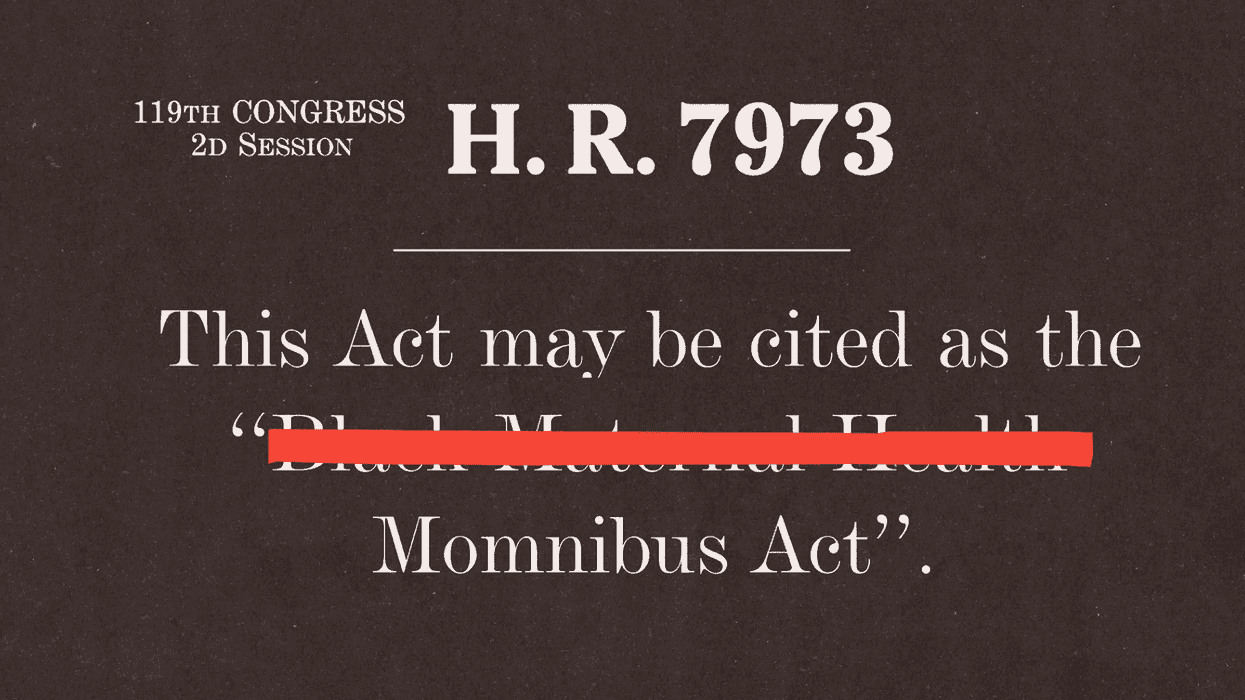
 Rep. Lauren Underwood, a lead sponsor of the Momnibus package, said the title change reflects how people commonly refer to the legislation and emphasized that the bill continues to help Black women. (Samuel Corum/Getty Images)
 At an April congressional hearing, Rep. Summer Lee questioned Health and Human Services Secretary Robert F. Kennedy Jr. about reports that organizations applying for federal dollars had been told to remove words including ‘Black’ from funding applications. (ALLISON BAILEY/NURPHOTO/AP)