



Skip to content
Search

Latest Stories

Follow Us:
Top Stories

Can he do that? Ga. governor, voting rights villain, cancels election.

Brian Kemp

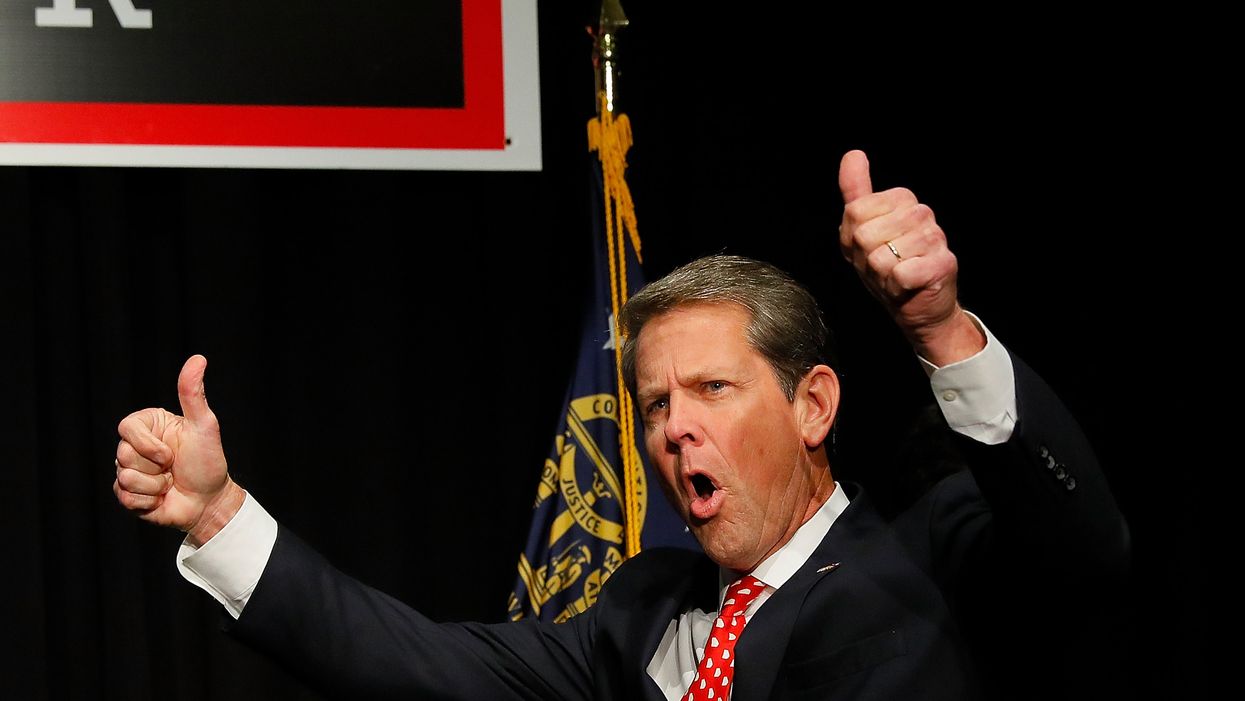
Georgia Gov. Brian Kemp called off a state Supreme Court election and plans to appoint a new justice to the bench.

Kevin C. Cox/Getty Images

It's a startlingly bold move, the legality of which is now being challenged in court: Republican Gov. Brian Kemp, already an enemy of voting rights groups nationwide, has canceled an election and says he'll fill a seat on the Georgia Supreme Court all by himself.

After he won an extremely narrow election in 2018, Kemp's critics said it was entirely because, as secretary of state at the time, he used his power to suppress the vote for Democrat Stacey Abrams by aggressively purging the registration rolls, closing or moving polling stations, rebuffing voters with missing middle initials on their ID cards, and tossing absentee ballots for similarly small bureaucratic mistakes.

Now, the governor has opened himself up to intense criticism that he'd rather stack the state's highest court with another fellow conservative than abide by the spirit (if not the letter) of the law.


When justices leave in the middle of a term, Georgia law permits the governor to fill the vacancy. In this case, however, Justice Keith Blackwell said two weeks ago he was no longer seeking re-election and would resign a few weeks early -- eight months from now, in November.

For a few days, it looked like the race for his spot on the becnch would feature the two remaining candidates: John Barrow of Athens, a former Democratic congressman, and former Republican state legislator Beth Beskin of Atlanta. But a week ago, Kemp's successor as secretary of state, Republican Brad Raffensperger, said he was deferring to the governor's wishes and calling off a contest that was to be decided in the May 19 nonpartisan judicial elections.

Since the governor plans "to fill the created vacancy by appointment," an attorney for the secretary of state wrote the two suddenly vanquished candidates, "our office determined that the most prudent course of action was to cancel."

In response, Barrow and Beskin have filed lawsuits in state court saying Raffensperger had no right to call off the election and Kemp has no right to name a new justice because Blackwell is still on the job.

Barrow said canceling the election amounts to "the ultimate act of voter suppression" by depriving voters of their rights to fill one of the state's top posts.

Blackwell, 44, was put on the high court in 2012 by GOP Gov. Nathan Deal and won election in his own right two years later. But with two children getting ready for college, he said when announcing his resignation, his $175,000 government salary is not enough and he needs to return to private practice.

Of the nine Supreme Court justices, eight were originally put on the bench by appointment. Two justices, Charlie Bethel and Sarah Warren, are still standing for new terms in two months — and, for now at least, Beskin has shifted her sights and is challenging Bethel. But the odds are stacked against her as incumbent judges in Georgia rarely lose elections.


Read More

An illustration of a paper that says "Ranked-Choice" with options listed below.
Image generated by IVN staff.

Why Mathematicians Love Ranked Choice Voting

The Institute for Mathematics and Democracy (IMD) has released what may be the most comprehensive empirical study of ranked choice voting ever conducted. The 66-page report analyzes nearly 4,000 real-world ranked ballot elections, including some 2,000 political elections, and more than 60 million simulated ones to test how different voting methods perform.

The study’s conclusion is clear. Ranked choice voting methods outperform traditional first-past-the-post elections on nearly every measure of democratic fairness.

Keep ReadingShow less
Three people looking at a gerrymandered map, with an hourglass in the foreground.
Image generated by IVN staff.

Missouri’s Gerrymander Faces a Citizen Veto, but State Officials Aren't Taking 'No' for an Answer

People Not Politicians (PNP) submitted over 305,000 signatures last week to freeze a congressional gerrymander passed by the Missouri Legislature in September. However, state officials are doing everything they can to pretend this citizen revolt isn’t happening.

“The citizens of Missouri have spoken loudly and clearly: they deserve fair maps, not partisan manipulation,” said PNP Executive Director Richard von Glahn.

Keep ReadingShow less
California’s Governor Race Is a Democratic Nightmare, But There’s One Easy Fix
Photo by Tim Mossholder on Unsplash.

California’s Governor Race Is a Democratic Nightmare, But There’s One Easy Fix

A new Emerson College poll of California’s 2026 governor’s race confirms what many election observers have suspected. California is entering a high stakes primary season with no clear front runners, a crowded field, and an election system where the outcome often depends less on voter preference and more on mathematical luck.

Emerson poll

Keep ReadingShow less
Let's End Felony Disenfranchisement. Virginia May Lead the Way

Virginia Governor-elect Abigail Spanberger promises major reforms to the state’s felony disenfranchisement system.

Getty Images, beast01

Let's End Felony Disenfranchisement. Virginia May Lead the Way

When Virginia’s Governor-Elect, Abigail Spanberger, takes office next month, she will have the chance to make good on her promise to do something about her state’s outdated system of felony disenfranchisement. Virginia is one of just three states where only the governor has the power to restore voting rights to felons who have completed their prison terms.

It is the only state that also permanently strips a person’s rights to be a public notary or run for public office for a felony conviction unless the governor restores them.

Keep ReadingShow less