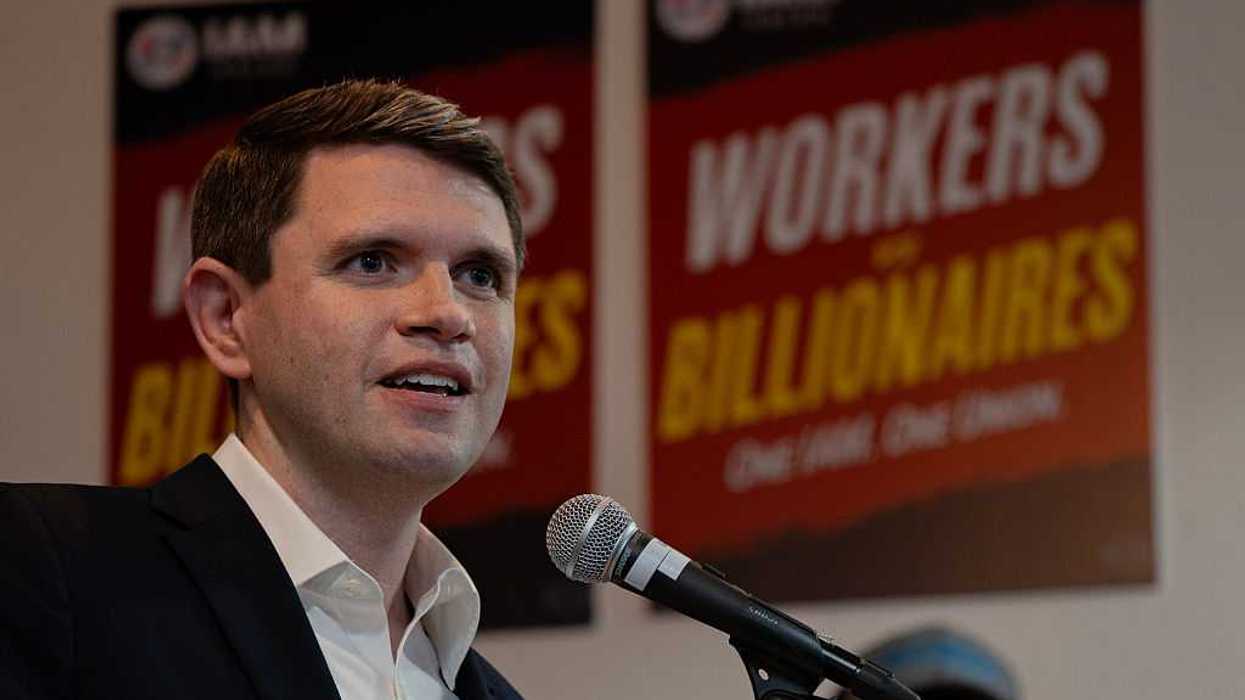
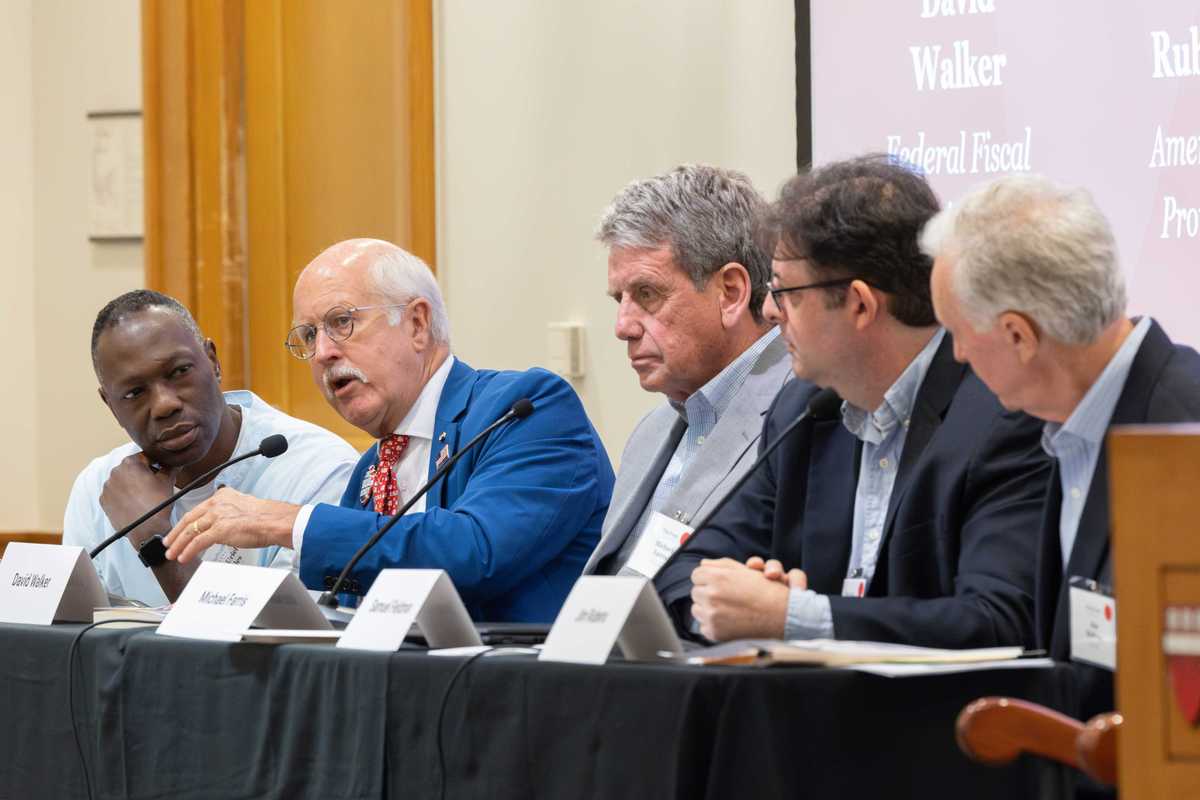

State Senator Brian Jones joins host T.J. O’Hara on Deconstructed to discuss California politics. Senator Jones represents the 38th District that covers the vast majority of San Diego County.
He previously served six years in the State Assembly before being term-limited under California law and also served as a member of the Santee City Council both before and after his term in the State Assembly. He currently is the Vice Chair of three Senate committees and sits on four other committees as well as five Select committees. Senator Jones is also in the minority in California as a registered Republican.
Site Navigation
Search
Latest Stories
Start your day right!
Get latest updates and insights delivered to your inbox.
Top Stories
Latest news
Read More
For the People, By the People
Dec 13, 2025
Democracy was once America’s proudest legacy — the last best hope on earth, a torch that lit the path for nations worldwide. Today, dysfunction grips all three branches of government: Congress abandons its duty to the people, the President exploits power for retribution, and the Supreme Court fails to enforce accountability. This betrayal of trust places our republic at risk. Americans must reclaim democracy from dysfunction and abuse of power.
The United States is both a participatory democracy — by the people, for the people — and a constitutional republic. Power lies with the people, and elected officials are entrusted to serve them. The President enforces the laws, Congress checks executive power, and the Supreme Court interprets the Constitution. These checks and balances are designed to prevent abuse of power, yet Congress and the Court have abandoned their duty (U.S. Constitution).
Instead of working for the people, Republicans in Congress pledge allegiance not to the Constitution but to the President. They ignore checks and balances, enabling his abuses. The Supreme Court, plagued by partisan politics and ethical lapses, shields him rather than checks him. The Trump v. United States decision grants immunity, paving the way for continued abuse (Supreme Court opinions). Justices fly upside‑down flags outside their homes, accept lavish gifts from wealthy donors (ProPublica), and allow spouses to support the January 6 insurrection openly. These actions erode public trust and reveal a failure of accountability.
The Court has also ignored the voices of the people on fundamental rights. In Dobbs v. Jackson Women’s Health Organization, it overturned Roe v. Wade, ending nearly 50 years of constitutional protections for reproductive freedom (Dobbs ruling PDF). Polls show that a majority of Americans opposed overturning Roe (Pew Research). Yet, the Court disregarded public will, silencing millions of voices and eroding trust in its role as guardian of liberty.
Meanwhile, dysfunction in Congress is on full display. Shutdowns, budget gridlocks, failure to pass bills for the good of the people, attempts to repeal the Affordable Care Act (KFF), and passage of the so‑called “Big Beautiful Bill” are glaring examples. Instead of helping citizens with healthcare, housing, and food, Congress ignores their cries. Sessions devolve into censures, profanity, and personal attacks on the House floor — total dysfunction. Together, these failures reveal a government unmoored from its constitutional duty.
At the same time, the President continues to disrespect the Constitution. He refuses to divest his interests, uses his office as a tool for retribution, and openly expresses his desire to be a dictator (Washington Post). Voters elected a man with a documented record of corruption and abuse: his charitable Trump Foundation was dissolved for misuse of funds (NY Attorney General), he was found liable for sexually abusing and defaming E. Jean Carroll (BBC), his Trump University defrauded students (FTC), and he manipulated tax laws to enrich himself (NY Times). Congress and the Supreme Court have given him a pass, enabling dysfunction instead of protecting the people.
Accountability has collapsed. Remember the attack on the Capitol, encouraged by the President (House Select Committee Report). Republicans ignored his wrongdoing and refused to check him. Leaders like Liz Cheney and Mitt Romney tried to do the right thing, but they were ostracized. Senator Susan Collins excused his abuse of power after the first impeachment, saying, “He learned his lesson and won’t do it again.” That remark betrayed the people. He abused power again, pardoned criminals from the January 6 insurrection, and victimized the victims yet again.
I was outraged when Representative Paul Gosar formally objected to Arizona’s certification on January 6, 2021, with support from Senator Ted Cruz of Texas. Cruz was not even from my state, yet he tried to silence my vote, my voice, and the voices of millions of Arizonans. Representative Andy Biggs also promoted efforts to overturn Arizona’s results (Arizona Republic). These leaders failed to honor Article II, Section 1, and the 12th, 20th, and 25th Amendments. How can Congress be functional when its Speaker ignores the Constitution?
Millions of voters lost respect for leaders who tried to silence the voices of Americans — our votes.
Yet history shows dysfunction is not destiny. Citizens have reclaimed democracy before. Abraham Lincoln’s Gettysburg Address defined democracy as government “of the people, by the people, for the people.” The civil rights movement proved that citizens, through courage and peaceful protest, could bend the arc of history toward justice (King Institute). The women’s suffrage movement showed that persistence at the ballot box could expand freedom (National Archives). These examples prove that dysfunction can be overcome when people act with courage.
Solutions must therefore focus on accountability and courage at every level of government. Members of Congress must enforce ethics rules and refuse to enable abuse. The Supreme Court must adopt binding ethics codes, recuse itself when conflicts arise, and respect the voices of the people rather than silence them. Presidents must be held to the same standards as ordinary citizens, with stronger conflict-of-interest laws, enforced divestment requirements, and a clear principle that no one is above the law. Citizens must reclaim their role as the ultimate guardians of democracy — registering and voting, speaking out, writing letters, signing petitions, attending town halls, and participating in peaceful protests.
Democracy requires vigilance every day, not just at election time.
Ultimately, there is power in the people, and we must not allow leaders to suppress it. Democracy cannot survive on silence or complacency; it demands vigilance, courage, and accountability. Congress must enforce its oath, the Supreme Court must respect the people’s voices, and the President must be held to the same laws as every citizen. History shows that when citizens act with courage — from Lincoln’s Gettysburg Address to the civil rights and suffrage movements — democracy can be reclaimed. The republic will endure only if the people insist that government once again serve for the people, by the people. That is our responsibility. That is our power. That is our promise.
C. Goode is a retired educational leader and advocate for ethical leadership and health care justice.
Keep Reading
Show less
Recommended

black and gray stethoscope
Photo by Hush Naidoo Jade Photography on Unsplash
The Health Care Debate & Feldstein’s Fix
Dec 13, 2025
Serving in Congress during the implementation of President Barack Obama’s Affordable Care Act, Republicans embraced the position of “repeal and replace.” Repeal the ACA, but replace it with what? The debate is front-and-center again, though the ground has shifted some. There is more support for the ACA. Even some Republicans are looking to temporarily extend COVID-era subsidies for ACA health plans. Other Republicans want Health Savings Accounts, so more money goes to individuals instead of insurance companies. Democratic leadership seeks an approach temporarily extending the expanded premium subsidies, during which the entire approach to health care can be rethought.
The late economist Martin Feldstein had the fix: Martin Feldstein proposed a voucher system in which everyone could purchase a health insurance plan covering health care expenses exceeding 15% of their income. This could be combined with HSAs if they prove popular with the public.
The variable prices for medical care across common geographic areas help illustrate that greater cost-consciousness in health care could have an impact. “In a well-functioning competitive market, prices for the same service will not vary widely within a given place,” the Brookings Institute summed it up. Brookings offers two examples: “Estimates from the Health Care Cost Institute show that the price for a blood test ranges from $22 (10th percentile) to $37 (90th percentile) in Baltimore, Maryland, but in El Paso, Texas, the same range is $144 to $952. For a C-section delivery, prices vary widely both across and within markets: the 10th to 90th percentile range is 9.3 times larger in the San Francisco, California, metro area than in the Knoxville, Tennessee, metropolitan area. Getting a well-functioning competitive marketplace will drive prices down while still incentivizing quality care.
So, rethinking the health care system has value, but any debate should also consider whether a little more free-market would be beneficial in our mixed-economy health care system. The advantage of the Feldstein proposal rests here: There would be greater price sensitivity in the health care sector, a sensitivity that encourages greater efficiency and cost-lowering, competitive innovation.
Physicians, hospitals, and other health care facilities would gain reputations as being more expensive or less expensive. A doctor might be willing to provide discounts to patients in need, especially if we also generously fund non-profit community health centers for the medically needy. There may be more conversations about the frequency of checkups or the duration of a long-term stay. Fewer tests that are not truly necessary. Lower administrative expenses. Less headaches with insurance in general.
If someone buys insurance to work in conjunction with Feldstein’s proposal, premiums would be lower due to several factors. The insurance policy would not have to cover as much. There would be greater predictability for each insurer about how much risk they are taking on with any one policyholder, and that predictability would encourage more competition within the consumer insurance market.
There was an interim version of the Affordable Care Act from 2014 to 2016, as the bill’s health insurance exchanges were coming into being. Specifically, the Transitional Reinsurance Program in the ACA was a government-provided reinsurance policy that supported insurance plans in the individual market by covering a portion of a plan’s costs, starting in 2014 at 100% of costs between $45,000 and $250,000. The cost of doing so was financed through a fee on plans in both the individual and group marketplaces. Something which reduced health insurance premiums for the individual market by 10-14%. That is the real-world experience of the benefit of reducing risk to any one insurance plan.
Income-related cost sharing, as proposed by Feldstein, could reduce health premiums even further. By one estimate, a whopping 22-34% of overall health expenses. All without jeopardizing patient care.
Feldstein’s article and its ideas never became a significant part of the health care debate. Six months after the publication of the Feldstein proposal, the Affordable Care Act was signed into law by President Obama. After the transition period, the bill created only a complicated set of taxes and subsidies, a kind of Rube Goldberg device – different pieces creating incentives for different directions, not certain to come together in the best way for the American people. The complexity of today's health care system under ACA continues to collide with the complexity of how we pay - or sometimes don't pay - for it. We should have a health care system as good as our current system, and then some. A health care system that can heal itself with the right incentives. All of which means not becoming Canada or Great Britain with their longer wait times; rather, creating a unique American system along the lines of the Feldstein model.
A couple more years of debate over health care could perhaps lead to this bolder approach if part of the political culture embraces it. Even if not, debate over cost-consciousness must occur. Taking care of the sick is a moral imperative for government; red tape, bureaucracy, high health care costs, and narrow provider networks are not.
Scott Miller is a graduate of Widener School of Law, a former chief of staff in Congress, and the author of 'Christianity & Your Neighbor's Liberty.
Keep Reading
Show less

people holding a signage during daytime
Photo by Liam Edwards on Unsplash
ENDING THE VICIOUS CYCLE OF NON-GOVERNING
Dec 13, 2025
“We the People” know our government is not working. For decades, Americans have said they want leaders who work together, confront problems honestly, and make decisions that push the country forward. Yet the officials we send to Washington keep repeating the same self-defeating patterns—polarization, gridlock, shutdowns, and an almost complete inability to address the nation’s biggest challenges.
The result is a governing culture that cannot resolve problems, allowing them instead to grow, intensify, and metastasize. Issues don’t disappear when ignored—they become harder, more expensive, and more politically explosive to solve.
In October, over seven million people took to the streets in the No Kings protest—the largest public demonstration in modern memory—expressing outrage at Trump’s attempts to control the levers of government and his disregard for the separation of powers. Weeks later, record-breaking special-election turnout in states such as Virginia and New Jersey made clear that voters were desperate for a new direction. Long lines in California reflected the same frustration with political manipulation and gamesmanship.
Yet as those demonstrations unfolded, Washington was shut down for 43 days. Congress once again failed to pass the annual budget bills—something it hasn’t done on time since 1997. Instead, lawmakers rely on a chain of short-term continuing resolutions (CRs), each one a manufactured crisis that becomes a leverage point for partisan brinkmanship. The latest CR funds the government only through January 31, 2026—barely two months of stability.
During the standoff, federal employees were furloughed or forced to work without pay. Air traffic safety was strained. Public services were disrupted. And on issue after issue—immigration, the economy, Social Security, climate, AI, healthcare, civil rights, Ukraine, reproductive rights, guns, housing—the country made no progress. Not even a beginning.
Some analysts framed the huge November turnout and the No Kings protest as a decisive victory for Democrats. But that interpretation misses the point. With only two parties to choose from, a vote against Republican leadership is not automatically a vote for Democratic leadership. More likely, it is a rejection of the current political trajectory, which could easily flip in the next election.
Even if Democrats take the House and perhaps the Senate in 2026, we will still have two polarized parties, the same rigid decision-making structures, and the same inability to govern. A change in congressional control cannot fix a broken system.
If the 2026 midterms simply repeat the “we win, you lose” cycle, the public will be no closer to solutions. We cannot keep perpetuating this vicious cycle of non-governing. The core problem is not political preference. It is a governing framework that has failed—and has been failing for years.
The Illusion of Mandates
After the recent election, Kamala Harris said, “We must harness the people’s power to come up with a blueprint for our government that truly works for the American people.” She is right. But listening to the public requires more than celebrating a partisan win. The “blueprint” cannot be a continuation of three decades of escalating hostility and governance by conflict.
The challenge starts with the psychology of partisanship. George Washington warned 229 years ago of “the baneful effects of the spirit of party,” rooted in “the strongest passions of the human mind.” That warning has never felt more relevant: political passion has overtaken national responsibility.
We must also avoid misreading the moment. Trump-era politics distorted the landscape so severely that many assume the public is shifting left. But recent polls show something different. Support for both major parties remains historically low. Nearly half of voters now identify as Independent–not wedded to either party. A few weeks ago, Republicans polled slightly ahead, but now it’s Democrats. Volatility and indecisiveness characterize the public mood on parties, while a poll of more than 20,000 people last summer found that 80% want leaders who compromise to get things done.
The public is not endorsing Democrats or Republicans. They are rejecting dysfunction. They are rejecting the chaos and extremism of recent decades—an era marked by wild swings of power, constitutional brinkmanship, weaponizing government authority, and rising threats to democracy itself.
For decades, Congress has misread the public, interpreting every narrow victory as a mandate. But a win by 1%, 2%, or 3% is not a mandate. It is a warning.
The Call for Something Different
A few organizations have been listening to the public. Swing Left’s Ground Truth initiative emphasizes trust-building by “showing up early, listening closely, and treating every voter as worth the conversation.” Future Caucus, No Labels, the Independent Center, the Sunwater Institute, the Bipartisan Policy Center, ModSquad PAC, and Blue Dog PAC are all seeking new pathways for cooperation.
Future Caucus’s major post-2024 study, Together or Torn, found that 84% of voters prefer leaders who “work together respectfully and with integrity toward solutions.” That number is astounding—and it has remained consistent across multiple polls.
Evan Bayh, recently named one of six No Labels’ National Leaders, warned, “Bad things will happen to our beloved country unless millions of good people step up to counter the dangerous extremism and political violence consuming our politics.” No Labels has also helped build the Problem Solvers Caucus—a bipartisan group of roughly 70 House and Senate members working to build trust and find cross-party agreements.
But while these efforts matter, none provide what America truly needs: a well-known, membership-based, coherent, sustained, national mechanism to influence the decision-making structures of Congress and the broader government. Fragmented efforts, however sincere, with little public identity cannot overcome structural incentives that reinforce division—large-scale public involvement and support are necessary.
Why Our Political System Cannot Fix Itself
The greatest obstacle to reform is structural. The Constitution states simply that each chamber of Congress “may determine the rules of its proceedings.” Those rules, written and controlled by party leadership, define: what bills get voted on; which amendments are allowed; how committees operate; how debate is structured; who holds procedural power; and whether bipartisan cooperation is possible.
No independent analysis would conclude that today’s rules serve the public. They serve the parties.
Consider just a few examples of how Congress’s rules now obstruct real legislating: closed rules in the House routinely prevent members from offering amendments, shutting out genuine debate; the so-called Hastert Rule blocks votes on bipartisan bills unless they have the support of a majority of the majority party; Senate holds allow a single senator to freeze nominations or legislation indefinitely; the mere threat of filibuster—once a tool for extended deliberation—has become a routine weapon of paralysis; and leadership’s tight control over committees suppresses the bipartisan policymaking those committees were designed to produce.
These are not quirks. They have been woven into the decision-making system over the years and are now considered rigid constraints. They deliberately frustrate cooperation and compromise and are designed to give power to the party in control, rather than facilitating constructive problem-solving.
While rule changes are technically easy—a majority in the House, a supermajority or nuclear majority in the Senate—the political incentives overwhelmingly discourage reform. Leaders, lobbyists, funders, influencers, and interest groups have various reasons to preserve systems that benefit them, even those systems that harm the nation. A simple matter of party over country.
The Need for an External Force
Some assume the solution is a third party. But third-party efforts routinely collapse under structural and financial pressures, ballot-access barriers, and the ever-present fear of becoming a spoiler.
The Forward Party has made a serious attempt to advance an alternative party based on bipartisanship and compromise. Their slogan, "Not Left, Not Right, but Forward," is inspiring and what many voters are asking for. Yet, after four years with prestigious backing and financial support, it has failed to gain even widespread name recognition.
The media landscape compounds the challenge. News outlets increasingly reflect partisan identities. Algorithms reinforce beliefs. Disinformation spreads. Even legitimate reporting is dismissed as biased when it challenges a party’s narrative.
Because neither party will voluntarily rethink the governing framework, because third parties remain structurally marginalized, and because information channels are fragmented and distrusted, we need a new force—external, respected, and powerful enough to pressure both sides and gain nationwide recognition.
A national forum… A civic mediator… A Third Point of View!
Not a third party… Not a loose protest movement… Not just another nonprofit…
Something fundamentally different!
Imagine an institution with millions of members, expert staff, public representation, credibility, and the ability to influence media narratives, congressional debate, and individual legislators. A forum grounded in constitutional principles, driven by evidence, and committed to bipartisan solutions rooted in documented public consensus.
A forum that does not dictate ideological positions but provides authoritative guidance—research, analysis, and public sentiment—to help both parties move toward balanced, practical solutions.
A place where moderates, independents, unaffiliated citizens, and exhausted majorities can unite around constructive governance.
What a National Third Point of View Could Do
A Third POV forum could fill systemic gaps by:
- Coalescing public sentiment into a unified national membership organization open to individuals and organizations alike, giving millions of citizens a direct connection and support for an instrument that advocates governance consistent with their beliefs.
- Coordinating policy expertise on congressional rules, legislation, AI-enabled transparency and information management, and institutional reform.
- Bringing together existing reform groups, strengthening them, and providing focus, rather than competing with them.
- Producing trusted analysis—research, scorecards, public opinion indexes—that media and lawmakers must take seriously.
- Influencing legislation by presenting compromise-oriented positions backed by millions.
- Providing nonpartisan framing for political events to reduce manipulation.
- Applying timely, targeted public pressure on congressional decision-making.
- Proposing specific rule changes to reduce polarization and restore constructive deliberation.
The goal is not to replace election campaigns or parties. It is to counterbalance them—providing a home for the widely documented and recognized public voice for cooperation and compromise. An ever-present influence on decisions beyond the campaign seasons and a respected counter to partisan extremes.
What Existing Efforts Teach Us
Groups like No Labels, the Independent Center, Future Caucus, the Bipartisan Policy Center, and others have demonstrated two important truths:
- Millions of Americans are hungry for post-partisan solutions.
- Congress’s outdated rules and procedures are the root cause of dysfunction.
The Hoover Institution and Sunwater Institute’s 2024 report, Revitalizing the House, put it plainly: “This is not a Republican or Democratic problem, but a problem with how the institution currently operates.”
These organizations have laid a solid foundation of infrastructure and concept for a much broader movement to fit the critical needs of our time. What is missing is scale—a membership organization large and visible enough to influence and shape national political incentives.
That is what a Third POV forum could provide.
Harnessing the Public’s Power
The largest gap in American politics today is between what the people want and what the political system delivers. The public wants respect, cooperation, responsibility, and results. They want decisions based on facts and the national interest, not party discipline or fear of primary challenges.
Millions support this vision. Thousands of groups, organizations, and staff resources are backing this idea. But they are scattered and uncoordinated—silos without a central structure capable of shaping congressional behavior.
To carry “the great experiment” beyond its 250-year epoch, we must reconnect public power to political decision-making in a durable, organized, and sustained way. That means more than voting every two years. It means building a civic architecture worthy of the country’s complexity and ambition.
A Blueprint for a New Mindset
The way forward requires a fundamental mindset shift—one that recognizes the political reality of a country divided nearly 50–50 and accepts that neither side can govern effectively without the other.
Bipartisanship is not a courtesy. It is a structural necessity.
A national Third POV forum could reinforce this reality by: Keeping public expectations visible and unavoidable; elevating compromise-oriented solutions; exposing manipulative partisanship; giving moderates and independents political cover and recognition; influencing committee agendas and legislative priorities; and demonstrating that the real mandate is for the government to function.
With enough members and credibility, such a forum would become impossible for Congress, the Executive Office, and the media to ignore.
The Time Is Now
We stand at a crossroads. The old model—win, lose, power, control—has given us paralysis, anger, instability, violence, and democratic decay. The public is demanding something better. The country is ready for a new mindset and a new civic infrastructure that gives voice to the exhausted majority.
The solution is not another party, another protest, or another think tank.
It is a Third Point of View—an organized, respected, nationwide forum with the legitimacy and scale to influence how decisions are made and how governing actually works.
We cannot continue the vicious cycle of non-governing. The survival of American democracy depends on rethinking how we solve problems, how we allocate power, and how we listen to the public.
It is time for the new mindset.
It is time for the next evolution of American self-government.
It is time to build the Third Point of View.
It is time for the groups, organizations, foundations, and powers already dedicated to the bipartisan government model to organize, coordinate, and expand this tenet of governance to give it the scale and influence the public is demanding.
Jeff Dauphin, aka J.P. McJefferson, is retired. Blogging on the "Underpinnings of a Broken Government." Founded and ran two environmental information & newsletter businesses for 36 years. Facilitated enactment of major environmental legislation in Michigan in the 70s. Community planning and engineering. BSCE, Michigan Technological University.
Keep Reading
Show less

person wearing gold wedding band
Photo by National Cancer Institute on Unsplash
When Medical Misinformation Costs Lives: Balancing Free Speech and Public Health
Dec 13, 2025
In my corner of the world, it feels like 2020 all over again, experiencing the push and pull between losing someone I love due to medical misinformation, all while holding respect for free speech.
The tension between combating medical misinformation and protecting free speech represents one of the most challenging dilemmas of our age. On one side lies the very real danger of false health claims that can literally cost lives. On the other side, there is a fundamental democratic principle that has historically protected unpopular truths from suppression.
The stakes of walking this tightrope are undeniably high. We have witnessed how vaccine misinformation can fuel disease outbreaks, how false cancer cure claims can lead desperate patients away from effective treatments, and how pandemic conspiracy theories can undermine public health responses. And yet, freedom of speech remains crucial to our democratic republic.
While upholding one of our country’s core rights can feel theoretical, the human cost of medical misinformation isn't that abstract. It is measured in concrete, preventable deaths and suffering.
One of those deaths was my friend. Out of respect for my friend’s grieving family, I will call him “John.”
John was diagnosed with prostate cancer just over a year ago. Instead of listening to his oncologist and following their treatment plan, John chose to take Ivermectin for his cancer and ended up succumbing to its side effects.
Ivermectin, a broad-spectrum anti-parasitic agent, was approved by the U.S. Food and Drug Administration (FDA) for humans to treat certain parasitic worm infections and specific skin conditions.
In addition to the conditions mentioned above, Ivermectin is not approved, authorized, or recommended by the FDA or the Centers for Disease Control and Prevention (CDC) for the treatment or prevention of COVID-19 or other conditions, such as cancer.
John fell down the dangerous path of medical misinformation five years ago during the pandemic. Unfortunately, medical experts, as well as family and friends like me, could not pull him back to safety.
Sitting at John’s memorial, I felt the weight of grief press into something sharper. It was resentment at the leaders and public figures who, with their platforms and bully pulpit, chose to amplify falsehoods instead of truth, and anger that their words carried more influence than the quiet counsel of doctors who had dedicated their lives to healing.
It is one thing to mourn the natural course of illness; it is another to grieve a death hastened by deliberate misinformation. This is not an abstract editorial on medical care in America; it is personal, raw, and a reminder that the stakes of this debate are not theoretical. They are measured by the real loss of people like John.
Of course, John had agency, and as an adult, he had the right to seek alternative therapies and treatments as prescribed by an alternative medicine provider, within the law. But John was swayed by thought leaders and elected officials whom he trusted, and this is where the discussion of misinformation and free speech gets mired in a morass.
We should also acknowledge that “misinformation” itself can be contested. The line between settled science, emerging evidence, and genuine uncertainty isn't always clear.
History offers sobering lessons about the risks of empowering authorities to determine truth. Medical consensus has been wrong before. Doctors once promoted cigarettes, dismissed the link between handwashing and infection, and resisted germ theory itself. Breakthrough discoveries often began as heretical ideas that challenged establishment thinking.
The challenge of balancing the two intensifies in our current information ecosystem. Social media algorithms amplify engagement, and health misinformation often generates intense emotional reactions that boost its spread. A false claim can circle the globe before accurate information can put on its shoes. The traditional marketplace-of-ideas theory assumed roughly equal access to platforms and audiences. Unfortunately, those assumptions no longer hold.
So, where does this leave us? Heavy-handed censorship risks creating martyrs, driving misinformation underground where it becomes harder to counter, and eroding public trust in institutions. But a completely hands-off approach allows falsehoods to proliferate with devastating consequences.
Perhaps the answer lies not in choosing between these extremes but in pursuing a more nuanced approach. This might include: prominent placement of accurate information from credible sources without outright censorship of alternative views; transparency about content moderation decisions and clear, consistently applied standards; investment in digital literacy education that helps people evaluate health claims critically; and, perhaps most importantly, holding leaders to a higher standard when it comes to the dissemination of incorrect medical information.
Ultimately, this isn't a problem we can solve once and for all with the right policy. It requires ongoing calibration, humility about our own certainty, and recognition that both unchecked misinformation and aggressive censorship carry serious risks. We must find ways to protect public health without sacrificing the open discourse that allows science and democracy to function.
Until we can do that, there will continue to be unnecessary goodbyes, like the one I had with John.
Lynn Schmidt is a columnist and Editorial Board member with the St. Louis Post-Dispatch. She holds a master's of science in political science as well as a bachelor's of science in nursing.
Keep Reading
Show less
Load More