

When I grew up in the 90s, as ever before, it was commonplace to talk about America as a young nation. America’s precise age relative to certain European or Asian nations was never really the point; it was to suggest that America had the qualities of youth—growth, dynamism, ambition, optimism.
We still have those qualities, but as we celebrate our 250th birthday, it’s worth reflecting on what it might mean to be a middle-aged nation. Even suggesting such a notion seems vaguely unpatriotic—America, middle-aged(!), how dare you? But as many of us can attest, while it comes with new aches and pains and perhaps a keener sense of limitation, middle age is not death. It’s just maturity.
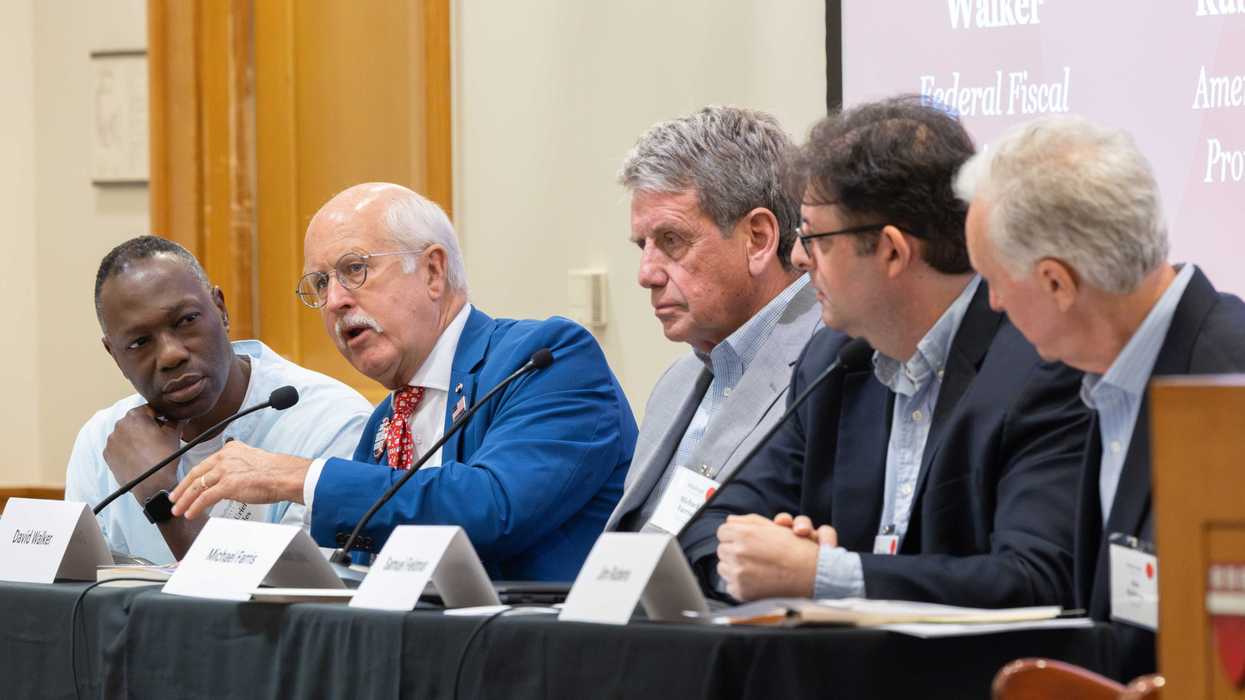
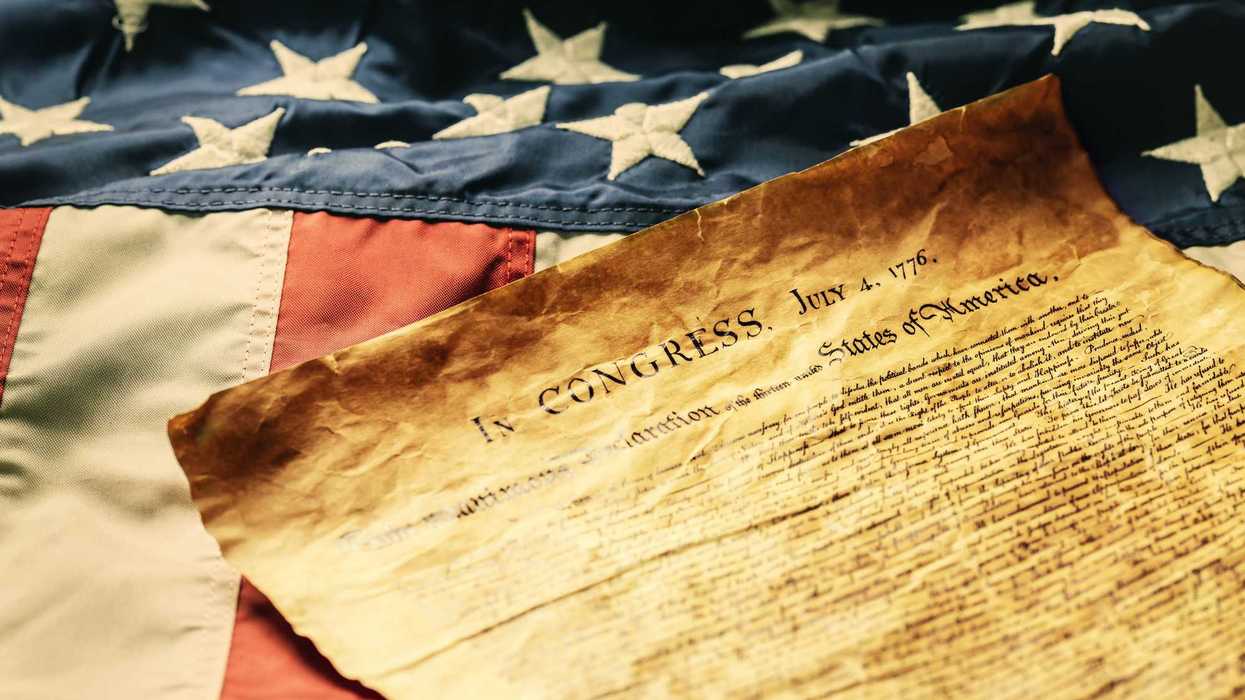
What a mature American identity might look like was a sub-theme of the Jack Miller Center’s (JMC) most recent National Summit on Civic Education. The official theme was “Words that Changed the World: America at 250,” drawing attention to the world-shaping significance of the Declaration of Independence. The power of those words and the importance of literacy as a necessary precursor to that power were echoed throughout the conference. But the question of who we are as a people lurked just behind it, as if celebrating the Declaration were to beg a more fundamental question—is America an idea or a culture?
Over the course of two hot days in May, the Summit did not shy away from this increasingly fraught question. Osagie Imasogie, of the Penn Carey Law School, offered an initial answer at a naturalization ceremony that preceded the opening lunch: “The strength of America does not come from uniformity; it comes from the ability of people of many backgrounds to unite around shared principles…principles of liberty, equality, justice, opportunity.”
Professor Allen Guelzo doubled down on creedalism in a later breakout session: “We have none of the conventional ways of defining ourselves as a nation. We do not refer back to blood and soil, to throne and altar. We define ourselves by two documents…you can become an American in 20 minutes…you embrace those truths, those inalienable rights, and you’re in.”
Jon Meacham, in a conversation with Shilo Brooks on the Old School podcast, praised the creedal element as well. Meacham, paraphrasing George Orwell, described the difference between nationalism and patriotism. “Nationalism is an allegiance to your own kind. Patriotism is an allegiance to a creed, and anyone who professes that creed, anyone who ascribes to it, can belong in a polity. Nationalism is restrictive and constrictive. Patriotism is open and vibrant.”
We are often most comfortable discussing America as an idea, and we at Jack Miller Center cherish it; it’s what our educational mission is all about. But we also know that American identity involves more than just a creed. After all, it takes not 20 minutes but often more than seven years to become a naturalized citizen, and that is not by accident. Some commitment to the nation and its people must be demonstrated. Vice President JD Vance articulated the counterpoint a couple of years ago to some controversy: “America is not just an idea. It is a group of people with a shared history and a common future. It is, in short, a nation…a homeland.”
Coming from Vance, the point is controversial. But take Vance out of the picture, and the notion that there is both a universal and a particular element to American identity is just obvious. Amy Coney Barrett, in an interview with Bari Weiss last year, said it a little differently, but the point is essentially the same: “I think America is more than an idea. I think America is its people too…the flesh and blood people who pour their lives into making that idea a reality.”
At the Summit, JMC chairman Michael Weiser explained this dimension in another way to the new citizens at the naturalization ceremony. Citizenship comes with expectations, he said, including “respect for each other’s life stories, respect for the laws of our country and community, and respect for the contribution each of us can and must make to the health and wellbeing of our shared land.” In other words, becoming one of us depends on a commitment to the flourishing of this particular community of people occupying this particular section of the globe.
American identity is both creedal and cultural, and the beauty of the Summit lay in its embrace of this duality. We sang patriotic anthems handed down to us from generations past. We waved flags. We interacted with interpreters of great historical Americans. We celebrated the things that are ours—authors like Melville, Hawthorne, and Twain—because they give voice to something peculiarly American. We did all this while fully embracing our “north star,” as Jon Meacham has called our Declaration.
Peggy Noonan, as she so often does, summed it up nicely in a lunch conversation: “What is America…it’s a creedal nation…it stands for an idea…it’s blood and soil…it’s the house I grew up in…in a way it’s all of those things.”
The genius of America is that we are “all those things.” We are all what we might call hyphenated Americans. The hyphenated American has not always been warmly embraced. Teddy Roosevelt famously said in 1915, “There is no room in this country for hyphenated Americanism—a hyphenated American is not an American at all.” Roosevelt meant something different, of course, referring to those who maintain allegiances to foreign countries, but there is a similar tendency today to want to simplify American identity. The genius of America is that we are not simple but complex—that we embrace the paradox of “e pluribus unum,” that we are both culture and creed.
Many groups in America can speak to a tradition of “two-ness,” Catholics, Jews, African Americans and others—what Glen Loury has described as a challenge of “how to be fully themselves and fully American.” But even the most Anglo-Protestant among us, with ancestors from the Mayflower or Jamestown, must cherish the fact that being an American never requires him or her to abandon principles of justice. As Noonan told us at the Summit, “my country right or wrong” did not originally end there but went on “…when right to be kept right, when wrong to be put right.”
The beauty of JMC’s 2026 Summit was that, in the largest sense, it recognized the complexity that so defines America, a mature view of our identity—that it contains commitments to the American people in particular and universal principles of right as laid out in the Declaration. To be a hyphenated American, in the end, and as we celebrate our 250th birthday, is just to be an American.
Thomas Kelly is senior vice president and chief program officer at the Jack Miller Center for Teaching America’s Founding Principles and History.