


WASHINGTON — Tensions erupted during Wednesday’s House hearing on President Donald Trump’s budget, as several representatives and protestors pressured a top White House official about their healthcare concerns.
The hearing featured Russell Vought, the director of the White House Office of Management and Budget, to discuss the president’s plans to defund many programs and move money to fight the war abroad.
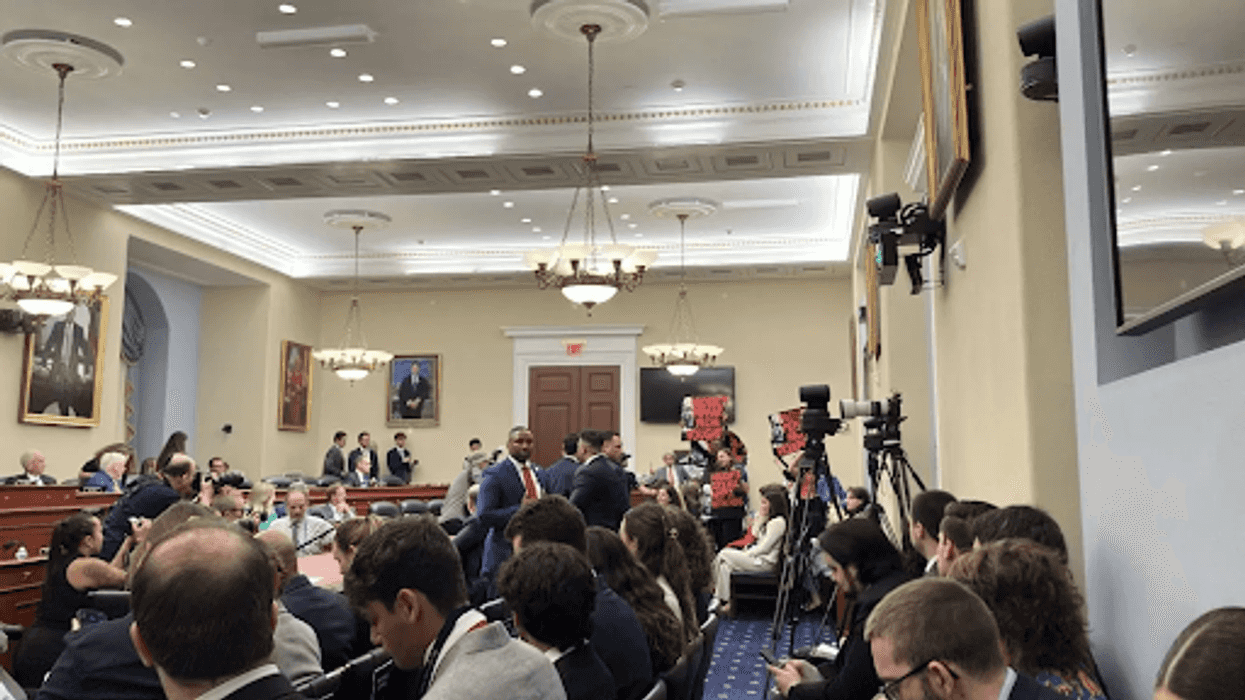
Within the first half hour, protesters began chanting about their discontent with Trump’s plans to cut the President’s Emergency Plan for AIDS Relief program.
“PEPFAR saves lives, spend the money,” several people repeated. Some of their signs read, “PROTECT PEPFAR FROM VOUGHT” and “VOUGHT’S CUTS KILL PEOPLE WITH AIDS.”
U.S. President’s Emergency Plan for AIDS Relief, also referred to as PEPFAR, was created in 2003 by Republican President George W. Bush. According to the U.S. Department of State, PEPFAR is credited with saving 26 million lives. Congress provided over $4.6 billion in FY 2026.
The administration, in its budget request, declared that 60% of PEPFAR funds were misused and announced its plans to “eliminate disease-specific accounts.”
Congress has authority over spending, according to the Constitution, and can accept parts of the budget request, none, or all of it.
Members of Congress questioned Vought about cuts to health care. He often redirected the conversation to fraud when Democrats questioned him about the pain deep cuts could cause.
For example, Rep. Brendan Boyle, D-PA, referred to the Congressional Budget Office’s estimate that 16 million Americans would lose healthcare because of the “One Big Beautiful Act” and two other policies under the second Trump administration.
“Are they really all, according to you, really, you’re going to sit here with a straight face and say, ‘They’re all illegals. They’re all defrauding the system.’ That’s actually your position?”
Vought responded by saying, “Yes, with regard to people who—” Boyle interjected by saying, “That’s laughable.”
Vought clarified that he does not think all 16 million who will lose health care are illegal, but he thought that the rest are able-bodied and should not receive subsidized health care.
Boyle later asked, “Okay, so they’re all either illegals or defrauding the system?”
“Well, that’s certainly not a provocative statement that we got fraud all over the country,” Vought said.
Rep. Bonnie Watson Coleman, D-NJ, asked Vought if he would apologize to the people who died because of cuts to international aid.
Worldwide, over 300,000 people have died due to USAID cuts, according to a tracker created by Brooke Nichols, an associate professor of global health at Boston University and an infectious disease mathematical modeler.
She also pressed Vought about children in poor countries who lack health care because the U.S. government stopped providing it.
“If a mother came before you, and told you that her child died because she didn’t have access to healthcare or medicine that usually would be available because of the kindness of the United States of America, that you and this administration have eliminated, would you have anything of empathy, compassion, and humanity to say to her?” Coleman asked. “Would you say to her, ‘I am sorry that was a mistake?’”
Vought responded with, “I always have empathy for individuals, including those that get improper and false information from the media that pumps this false and ignorant information out to the American people.”
Rep. Josh Brecheen, R-OK, asked if Vought had any suggestions on how Congress can address healthcare fraud.
“Are there further reforms that Congress should consider to help reduce fraud in the healthcare system?” Brecheen said.
Vought said that a review should be done to check “whether agencies have enough resources to do the fraud hunting.” He also said there are obstacles to consider that make it “impossible” to identify fraud. The example he provided states withholding information about the recipients on their “roles” He did not clarify which roles he was referring to.
Rep. Pramila Jayapal, D-WA, said the “One Big Beautiful Bill” was unpopular because of its impact on healthcare and the national budget.
“Congratulations, Mr. Vought, both you and Donald Trump have managed to successfully take the futures of millions of Americans. It is not beautiful to strip healthcare for millions of Americans,” Jayapal said.
Amy L. Wong is a graduate student in journalism with Northwestern University’s Medill School of Journalism.