

Skip to content
Search

Latest Stories

Follow Us:
Top Stories

Trump’s second term is a murky, embarrassing and costly spectacle

Opinion

Trump’s second term is a murky, embarrassing and costly spectacle

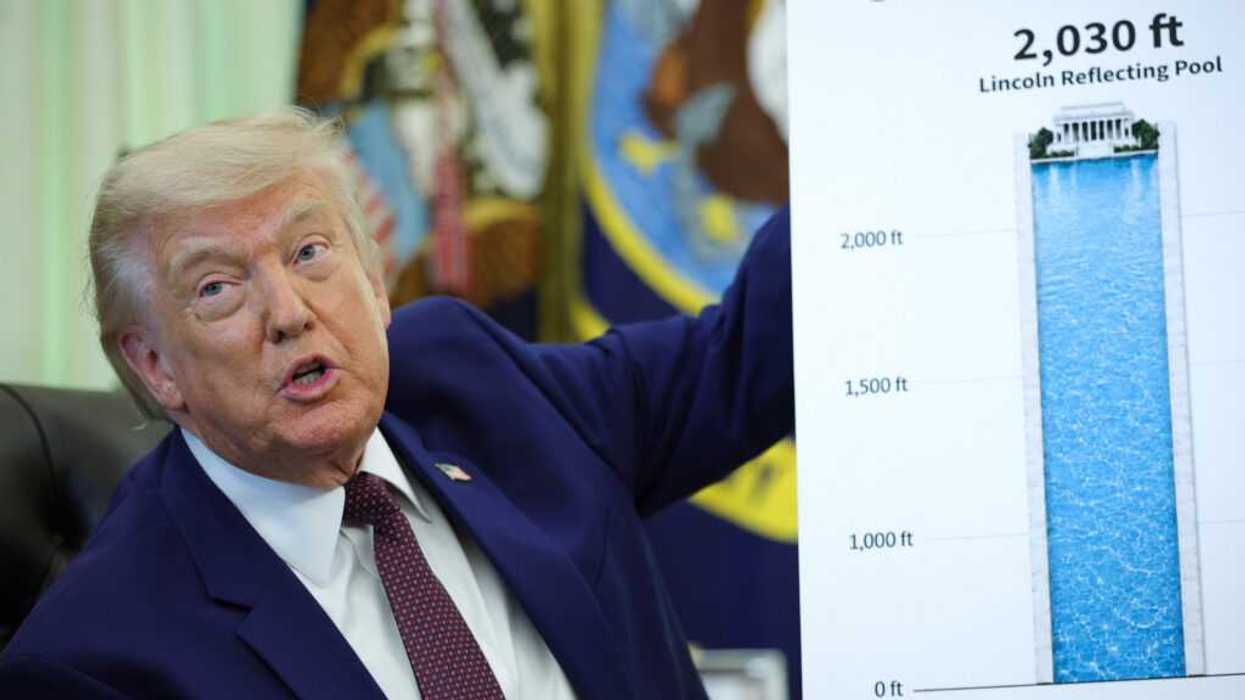
U.S. President Donald Trump displays a graph entitled "Our Pool is Bigger than Skyscrapers" as he speaks on his renovations to the Lincoln Memorial Reflecting Pool during an event in the Oval Office of the White House on June 3, 2026, in Washington, D.C.

(Kevin Dietsch/Getty Images/TNS)

Every time I get asked by a TV anchor what I think about the drama of the Lincoln Memorial Reflecting Pool, my favorite “historical” headline from the Onion comes to mind: “World’s Largest Metaphor Hits Ice-Berg.”

And every time I do, I hear from defenders of the Trump administration complaining about the disproportionate media coverage of what should be a very minor story in the grand sweep of things. They have a point. President Trump has done some good work rehabbing Washington, D.C., where I live. But the Reflecting Pool has bedeviled him. Algae keep returning to the pool, despite the administration’s best efforts, and attempts to remedy the problem have yielded further problems.


I can think of scores of stories that deserve more attention on the merits.

But there are two problems with this complaint. First, it was Trump who invited extensive scrutiny of the effort. “I’m very proud of it,” he said before the algae counteroffensive. “I’m very good at building things and constructing things, so I hope you go take a look at it.”

Second, there’s the metaphor-on-the-Mall problem. The Reflecting Pool is a microcosm of nearly everything that vexes people about the second Trump term. We can start with his decision to ignore the usual rules and procedures to give a no-bid job to a contractor for the repair and paint work. Trump said it would cost $1.8 million. The costs have grown nearly tenfold. To deal with the insurrectionist algae, he gave another no-bid job to a Mar-a-Lago crony, campaign donor and convicted felon who looks like a villain from the old Dick Tracy comic strip.

The man who vowed to “drain the swamp” of D.C.’s corrupt cronyism used figurative swampy means to deliver literal swampy ends.

Another familiar aspect of the pool fiasco: A project Trump touted as proof of his genius and expertise becomes proof of unpatriotic enemies undermining him when it flounders. Without any evidence, Trump claimed that the only reason the Reflecting Pool’s paint is peeling and algae blooming is because anti-American “vandals” sabotaged it with a “300-foot long gash.”

How vandals evaded park police, security cameras and his own National Guard deployment remains unknown. Never mind how they put a 300-foot gash in a paint job Trump described as “So very strong. You couldn’t, if you had a knife — I don’t want to give anybody ideas — if you had a knife, you can’t even cut it. So strong, so powerful.”

But the metaphorical meaning of the miasma on the Mall hardly ends there.

During a May 27 Cabinet meeting, Trump boasted at length about the Reflecting Pool job and then handed the meeting off to his secretary of Defense. “I think, actually, your efforts on the Reflecting Pool are actually a great segue,” Pete Hegseth said.

“If you look at Washington and Lincoln, these are two men that faced monumental tasks and stood up in historic fashion and delivered for the American people,” Hegseth gushed. “And, when you step back and look at 47 years of what Iran waged … there’s only one man, over the course of both presidencies, who has stood up and said they will never get a nuclear weapon.”

As with so much Hegseth says, this is not exactly true. Every president since Bill Clinton has said that a nuclear Iran was unacceptable. It’s true that Trump is the only president to use massive military force in the name of preventing it. Whether his efforts have made the “never” claim a reality is, at best, an open question.

What isn’t an open question: Trump’s unilateral Iranian adventure did not go as planned. What began as another example of Trump trying to will into existence the reality he wanted segued into a murky, embarrassing and costly spectacle with no satisfying end in sight. Talk about metaphors.

That’s because, as the saying goes, the enemy gets a vote. Trump can bypass or ignore many laws, but not the law of unintended consequences. The defining feature of Trump’s presidency is his unvanquishable belief that laws, rules and norms are impediments to his will and genius.

He expects, nay demands, Hegseth-like sycophancy and praise recognizing that alleged genius. And when events conspire against Trump, the fault must lie in vandals and lies from “fake news.”

The international order, like the domestic order, is not natural. They are more like a man-made garden constructed out of the wilderness of the human condition. When the garden is not maintained, when the rules go ignored, the jungle grows back. Just like the algae.

Jonah Goldberg is editor-in-chief of The Dispatch and the host of The Remnant podcast. His Twitter handle is @JonahDispatch.



Read More

A Sudden Vacuum: Unpacking Lindsey Graham’s Legacy and Implications for the GOP’s Senate Agenda

U.S. Sen. Lindsey Graham (R-SC) speaks during a Senate Appropriations Committee hearing on the FY2027 budget request in the Dirksen Senate Office Building on Capitol Hill on May 12, 2026 in Washington, DC.

(Photo by Chip Somodevilla/Getty Images)

A Sudden Vacuum: Unpacking Lindsey Graham’s Legacy and Implications for the GOP’s Senate Agenda

On July 11, 2026, South Carolina Senator Lindsey Graham unexpectedly passed away at age 71. The likely cause of death was a tear in the main vessel that carries blood out of the heart, otherwise known as aortic dissection. According to a medical examiner’s preliminary report, the aortic dissection itself was due to a “brief and sudden illness” known as arteriosclerotic cardiovascular disease, which hardened Graham’s arteries.

Graham’s death prompted widespread, bipartisan tributes from across the political spectrum. President Trump ordered all flags to be flown at half-mast in the senator’s honor, later exclaiming that “Lindsey will be greatly missed!!!” on social media. On the global stage, key international allies mourned the loss of a fierce advocate for overseas alliances, with tributes coming from Ukrainian President Volodymyr Zelenskyy, Israeli Prime Minister Benjamin Netanyahu, and German Chancellor Friedrich Merz.

Keep ReadingShow less
Woman struggling to pull blue donkey with rope

How can the Democratic Party regain public trust? Ronald Hirsch argues for a renewed mission centered on equality, opportunity, fiscal responsibility, and American democracy.

Klaus Vedfelt / Getty Images

Can the Democratic Party Still Lead?

During the 20th century and for the first part of the 21st, the Democratic Party certainly led the nation in advancing the cause of equality and the ability of people to pursue their right to life, liberty, and happiness. At the same time, they led the nation by increasing its military might and advancing its power around the world to protect the human rights of others.

The American worker would likely still be toiling for low wages in industrial hell-holes were it not for the laws that Democratic-led Congresses passed to increase the rights of workers vis-a-vis employers and the rights of unions. Black individuals and other people of color would still be burdened by widespread discrimination—official and otherwise—were it not for the laws that Democratic-led Congresses passed to protect their rights as American citizens. This is not to say that we have achieved equality, but we have made much progress.

Keep ReadingShow less
As Cruelty Normalizes, America’s Authoritarian Drift Deepens

Josh Hokit on April 11, 2026 in Miami, Florida.

(Photo by Carmen Mandato/Getty Images)

As Cruelty Normalizes, America’s Authoritarian Drift Deepens

It happened in a moment so small that many viewers may have missed it. After a UFC fight, athlete Josh Hokit used his victory speech not to celebrate his win but to demean former First Lady Michelle Obama, repeating a long‑running racist and sexist trope by calling her a man. Standing beside him, the President of the United States did not correct him. He did not defend a woman who served this country with dignity. He did not reject the bigotry embedded in the remark. Instead, he offered a smirk — a half‑smile of approval that traveled farther than any microphone could carry.

That smirk mattered. It was a signal. And millions recognized it for exactly what it was.

Keep ReadingShow less
The Roots We Planted: How U.S. Foreign Policy Shaped the Immigration Crisis

Supporters of Nicolas Maduro burn a United States flag during a gathering near Miraflores palace after explosions and low-flying aircraft were heard in the early hours on January 03, 2026 in Caracas, Venezuela.

(Photo by Jesus Vargas/Getty Images)

The Roots We Planted: How U.S. Foreign Policy Shaped the Immigration Crisis

“Right now, we have more workers than at any time in the history of our country…And people want to come in, and in some cases, they want to take advantage of that, and that’s okay,” President Donald Trump said in a 2018 statement. “And we want them to come in, but they have to come in through merit.”

These narratives paint a vivid picture of America’s struggle with immigration: a "city on a hill" slowly becoming overrun by foreign nationals, purportedly due to open-border policies. The rhetoric suggests the United States suffers from its own success, attracting immigrants who arrive in search of "government handouts" or to evade criminal charges.

Keep ReadingShow less