

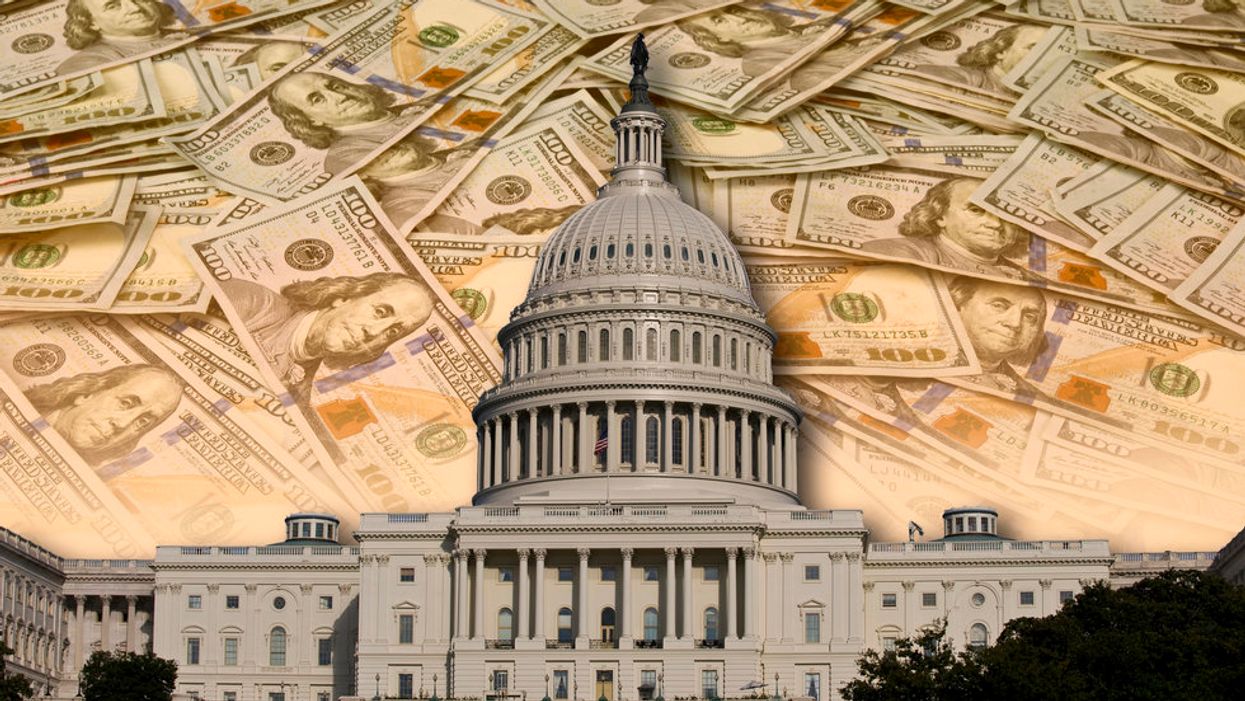

Earlier this year, I tried to explain to Congress how today's special-interest-controlled pay-to-play campaign finance system is hostile to the conservative agenda.
It puts Republicans at an electoral disadvantage, I testified. It floods swing races with torrents of out-of-state negative advertising dollars. It guts federalism and the 10th Amendment. Crony capitalism now dominates our economy. Alarming to conservatives, young voters subjected to this rigged and corrupt economic system prefer socialism over free markets.
Support for campaign finance reform in Congress remains nonetheless deeply partisan. But what may finally compel conservatives to action is the grave threat to national security posed by the status quo.
Pay-to-play crony capitalism is much more profitable than the rough-and-tumble, generally incremental gains of market competition. Companies can generate a stunning 760-to-1 return on lobbying and campaign contributions in the form of no-bid supply contracts, regulatory favors, loan guarantees, bailouts and tax loopholes. Monopolies and market concentration are up. Innovation and new business startups are down. This is why we have the world's highest drug prices, way too many broadband and cellular dead zones and ethanol in our gasoline.
National security cannot be walled off from our corrupt and corrupting political money system.
Crony capitalism is why we have failed weapons systems like the trillion dollar fleet of F-35 fighters, the $30 billion Littoral Combat Ship and $85 billion in redundant ground-based nuclear weapons. All are designed more to spread pork and campaign money into almost every congressional district than to enhance our defense.
It has also been made weaker by the industrial concentration wrought by crony capitalism. The Center for Strategic and International Studies found there was no "effective competition" for more than half of military procurement four years ago — and only one viable recipient for 80 percent of the aircraft dollars. And the big five suppliers — Lockheed Martin, Boeing, Northrop Grumman, Raytheon and General Dynamics — are claiming most new contracts, leaving competition "at extremely low levels."
Under "crony cap," in other words, weapons makers have militarized American foreign policy to grow revenue — and the result is a more destabilized world. Since 9/11, with crony cap military policy in full flower, the United States has engaged in a series of quagmire wars lacking defined missions or exit strategies. We have lost every one.
Today, we are flying military drones in the airspace of 17 nations and dropping bombs on seven. Silenced into submission by rivers of campaign money from the weapons industry, revolving door sinecures and a fog of think tank opinion-shaping, Congress has abandoned its non-delegable and sole constitutional authority to declare war. This summer, a bipartisan House Armed Services Committee majority memorialized its neutering of Article I, Section 8, voting to kill a measure to block war against Iran without congressional approval.
Republicans in Congress have ceased even pretending to be fiscal conservatives. The $1.2 trillion spent in the past year on national security got just added to our nation's record-shattering credit card balance. Our economy is only temporarily being insulated by the Federal Reserve's easy money policy. Most of the cost of this debt accretion and monetary distortion is dumped on our kids and grandkids. Of the world's 25 economically "advanced" nations, the United States has by far the largest national debt growth forecast. It's gotten so bad we are fast approaching a time when the U.S. dollar will lose its status as the world's reserve currency. Admiral Mike Mullen, a former Joint Chiefs of Staff chairman, ranks this credit-card patriotism as the single greatest threat to our national security.
Most unbearable, though, is the abuse of our armed forces by crony-driven military policy. During this generation of failed wars without defensible security objectives, our troops and their families have suffered over 300,000 deaths and injuries and record rates of active-duty suicide and PTSD. But most policy-makers are insulated from this suffering because neither they nor their family members have worn a uniform.
Money-equals-speech conservatives must confront yet another threat to national security. Supreme Court rulings in Citizens United v. FEC, which opened the door to unlimited campaign spending, and McDonnell v. U.S., which legalized most quid pro quo public corruption, have eliminated most of the guardrails in the political money system that Congress and states raised in the previous century in the wake of intolerable corruption.
The hawkish Alliance for Securing Democracy has issued a report cataloguing how Iran, China and Russia use our loophole-ridden system against us to influence our elections and foreign and military policies.
Our overseas enemies use unrestricted money to finance online political ads and web publishers. These hostile acts are concealed using in-kind contributions, favorable terms on loans from state-controlled banks, untraceable shell companies, American subsidiaries of foreign companies, nonprofit organizations, think tanks and "dark money" political groups. It's also likely software-based bots are pouring millions of untraceable cash into campaigns through straw donors giving $200 or less, the cutoff for remaining anonymous.
Writing in Foreign Affairs, Sarah Chayes makes the case that all this "weaponized corruption" is possible only because we soiled our own nest first — by allowing domestic crony capitalists to corrupt our political money system.
The solution is reform so candidates and elected officials are motivated to serve citizens rather than big businesses and our adversaries. Foremost among these reforms is to amend our Constitution to restore power to Congress and the states to impose reasonable limits on campaign money. Conservatives must confront the reality that our corrupt campaign finance system is dangerously weakening our ability to protect ourselves from foreign enemies.