


Skip to content
Search

Latest Stories

Follow Us:
Top Stories

Society needs to take a breather

Opinion

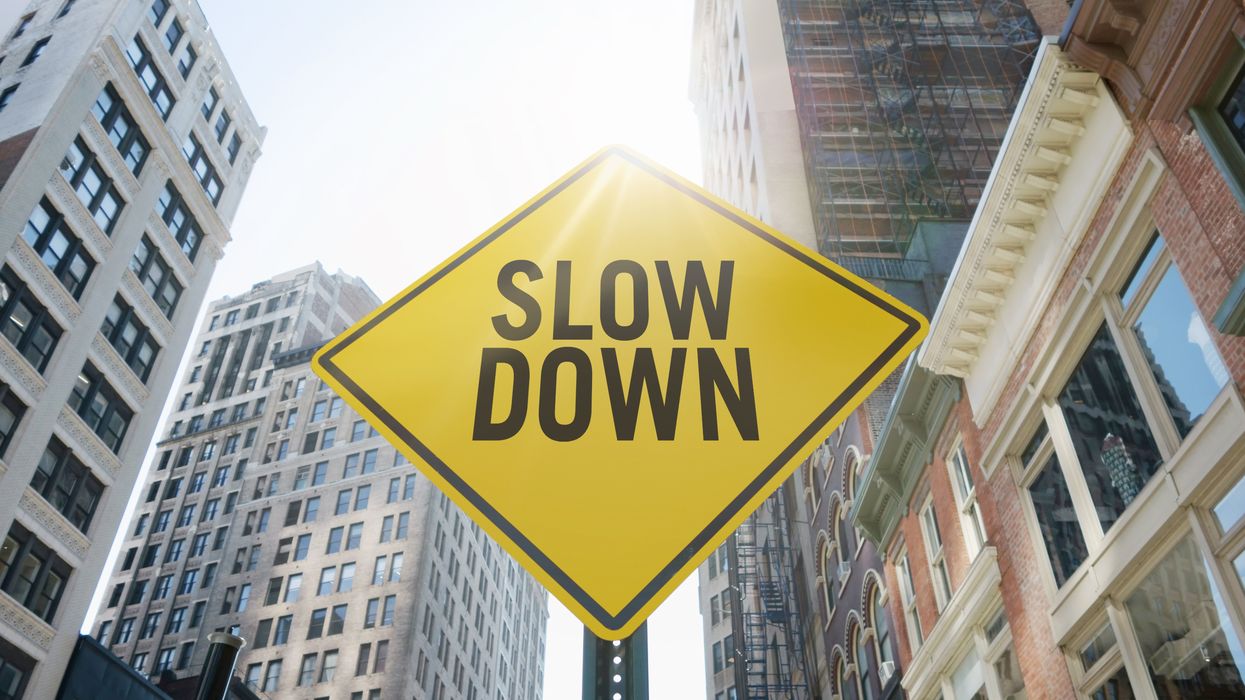
Sign saying "slow down"
gerenme/Getty Images

Frazier is an assistant professor at the Crump College of Law at St. Thomas University. He previously clerked for the Montana Supreme Court.

Patience is a virtue. It’s a simple refrain I learned well in Mrs. Campbell’s class — rather than read the instructions on a pop quiz, I rushed to start answering the questions. Turns out I missed three bonus points for simply writing my name on the back of the page rather than the front. Speed, though, has become the dominant social, political and economic norm.

We need our food delivered in minutes — you can even pay to have your UberEats order prioritized over others. We need real-time updates on our social media feeds — news and nonsense from friends and foes alike, full of instantaneous “hot takes” rather than reasoned analysis. We demand our politicians deliver progress on our ideological aims now — candidates jockey to be viewed as the one most likely to succeed on short-term policy goals and partisan preferences. And, we expect and encourage companies to compete to be the “first mover” instead of the “steady and responsible actor.”

It’s time to slow things down. We need to resist our urge to act with haste. So here are a few suggestions for how we can exercise more patience — and, by doing so, save some lives, improve our politics and enhance our discourse.


First, let’s lower the speed limit just about everywhere and let’s enhance the use of automated ways to ticket those who prioritize their speed over the safety of others. It’s not rocket science that fewer bad things can happen when cars move slower — but don’t take my word for it. Instead, consider that officials in Edmonton, Canada, saw a 50 percent drop in fatal and injurious crashes following a 6 mph drop in the speed limit. These benefits can come at relatively low cost, too. The European Union mandated the use of intelligent speed assistance systems in all new cars to increase driver awareness of excessive speeds and to ease enforcement. We can and should do the same in the United States.

Next, let’s consider granting our elected officials a single, longer term. Imagine if senators only served a single, eight-year term. Do you think they might reevaluate how they spend their time in office? I sure do. Rather than waste a third or half of their day calling donors, they could spend more time talking with their colleagues about substantive reforms. And, in place of prioritizing bills they know will please their “base,” they can more thoroughly consider legislation that may not score political points but will nevertheless further the public interest.

Finally, let’s turn to social media. This may be the most obvious place where our addiction to speed has caused poor social outcomes. Speaking from unfortunate personal experience, I know that it can feel impossible to pull away from the drama and debates that endlessly populated my apps. And you may be able to relate to my temptation to post hot takes just to see how folks respond. Those urges are understandable because that’s what the apps are built to do. We can and should advocate for more responsible platform design. The Prosocial Design Network, a community of behavioral science and design experts, has a menu of proven strategies that platforms can incorporate to make their respective feeds more aligned with quality deliberation – ideally platforms would voluntarily adopt these straightforward approaches for a better social media experience.

Realizing a slower society won’t be easy. The steps mentioned above, though, can help create space for safer streets, a more responsive democracy and a more deliberative social media ecosystem. Here’s to moving slowly and thinking about things.
Read More

A U.S. flag flying before congress. Visual representation of technology, a glitch, artificial intelligence
As AI reshapes jobs and politics, America faces a choice: resist automation or embrace innovation. The path to prosperity lies in AI literacy and adaptability.
Getty Images, Douglas Rissing

Why Should I Be Worried About AI?

For many people, the current anxiety about artificial intelligence feels overblown. They say, “We’ve been here before.” Every generation has its technological scare story. In the early days of automation, factories threatened jobs. Television was supposed to rot our brains. The internet was going to end serious thinking. Kurt Vonnegut’s Player Piano, published in 1952, imagined a world run by machines and technocrats, leaving ordinary humans purposeless and sidelined. We survived all of that.

So when people today warn that AI is different — that it poses risks to democracy, work, truth, our ability to make informed and independent choices — it’s reasonable to ask: Why should I care?

Keep ReadingShow less
A person on their phone, using a type of artificial intelligence.

AI-generated “nudification” is no longer a distant threat—it’s harming students now. As deepfake pornography spreads in schools nationwide, educators are left to confront a growing crisis that outpaces laws, platforms, and parental awareness.

Getty Images, d3sign

How AI Deepfakes in Classrooms Expose a Crisis of Accountability and Civic Trust

While public outrage flares when AI tools like Elon Musk’s Grok generate sexualized images of adults on X—often without consent—schools have been dealing with this harm for years. For school-aged children, AI-generated “nudification” is not a future threat or an abstract tech concern; it is already shaping their daily lives.

Last month, that reality became impossible to ignore in Lafourche Parish, Louisiana. A father sued the school district after several middle school boys circulated AI-generated pornographic images of eight female classmates, including his 13-year-old daughter. When the girl confronted one of the boys and punched him on a school bus, she was expelled. The boy who helped create and spread the images faced no formal consequences.

Keep ReadingShow less
Democracies Don’t Collapse in Silence; They Collapse When Truth Is Distorted or Denied
a remote control sitting in front of a television
Photo by Pinho . on Unsplash

Democracies Don’t Collapse in Silence; They Collapse When Truth Is Distorted or Denied

Even with the full protection of the First Amendment, the free press in America is at risk. When a president works tirelessly to silence journalists, the question becomes unavoidable: What truth is he trying to keep the country from seeing? What is he covering up or trying to hide?

Democracies rarely fall in a single moment; they erode through a thousand small silences that go unchallenged. When citizens can no longer see or hear the truth — or when leaders manipulate what the public is allowed to know — the foundation of self‑government begins to crack long before the structure falls. When truth becomes negotiable, democracy becomes vulnerable — not because citizens stop caring, but because they stop receiving the information they need to act.

Keep ReadingShow less
A close up of a person's hands typing on a laptop.

As AI reshapes the labor market, workers must think like entrepreneurs. Explore skills gaps, apprenticeships, and policy reforms shaping the future of work.

Getty Images, Maria Korneeva

We’re All Entrepreneurs Now: Learning, Pivoting, and Thriving the Age of AI

What do a recent grad, a disenchanted employee, and a parent returning to the workforce all have in common? They’re each trying to determine which skills are in demand and how they can convince employers that they are competent in those fields. This is easier said than done.

Recent grads point to transcripts lined with As to persuade firms that they can add value. Firms, well aware of grade inflation, may scoff.

Keep ReadingShow less