



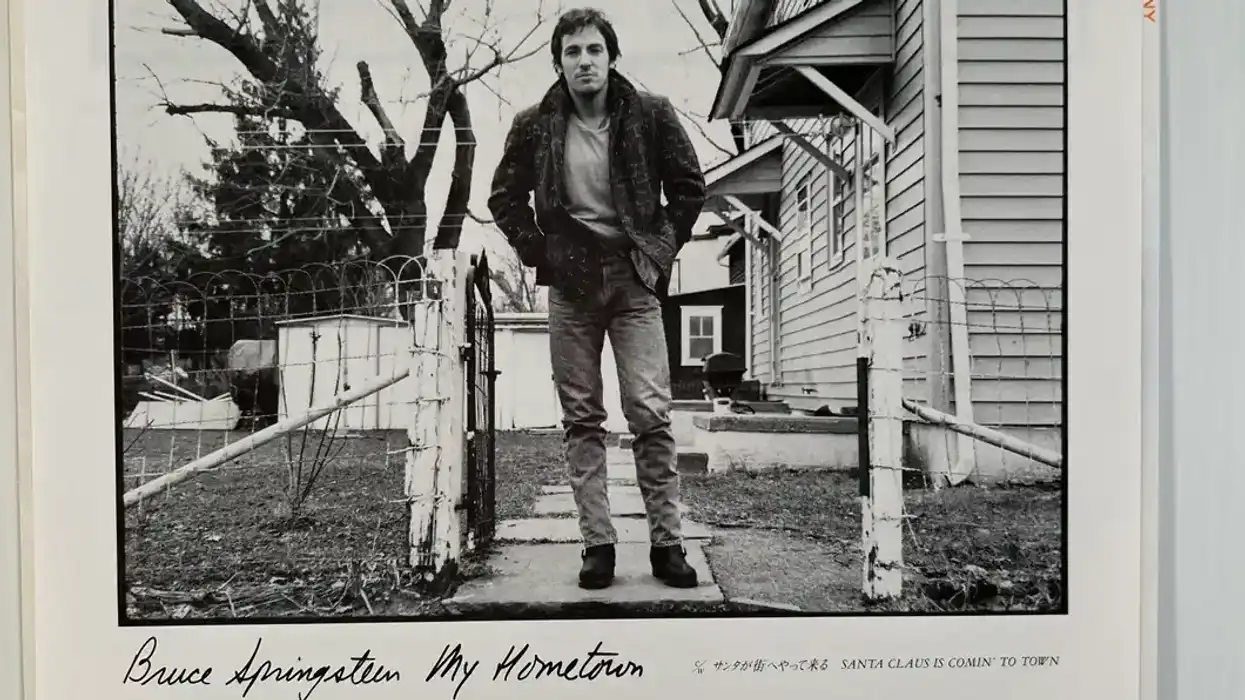

Remember that Bruce Springsteen song, “My Hometown.” That’s actually my hometown. Not in the figurative sense of, “Oh, that reminds me of…” It’s my hometown of Freehold, NJ.
Technically, by the time I got to high school, about twenty to twenty-five years after Bruce, “The Boro” was just one of five separate campuses within the greater Freehold Regional High School district. But we still had some of those same teachers, like Doc Hussey, who had the gift of shepherding angst-ridden teenagers on how to fall in love with something other than weekend crushes and our own afflictions. Sophocles and Shakespeare began to course through our veins and our imaginations.
Doc must’ve had a similar effect on Bruce as he had on all of us. Because once we were old enough to drive ourselves down the Shore, Route 88, and Highway 9, and the Tilt-A-Whirl of our youth had been mythologized for us by Springsteen’s poetry. And we had our own Wendys and Janeys. They were just named Traci, Cheryl, and Heather, the girls we tried to talk to at the skating rink in Bricktown or on a Sunday night at Birch Hill. Romance meant a night of skee-ball at Jenkinson’s or running around in the rain on the beach with only the neon signs above the boardwalk to light the way.
Many of us are still in touch. As much as we’ve all been trying to detox from the effects of social media, we benefit from its more benign features. Like a lot of kids, I graduated high school and ended up moving thousands of miles away—whether it was to a far-off college, to chase an even further-off dream, or to escape a life that didn’t resemble Family Ties or Growing Pains. Still, we had each other. And by the early to mid 2000s, these platforms allowed us to continue growing up and then start growing old together.
Something I began noticing by the second or third reunion, and then in subsequent conversations, is a question that starts with “Whatever happened to…”
During that first reunion, the question was more about what happened to so-and-so, who didn’t go to college or had already moved off somewhere, and we were just wondering where they were. At a certain point, “Whatever happened to” became a mournful question, as we began to lose one or two of our friends way too soon.
These days, we’re still asking where in the world our high school friends are. And each reunion brings a few more sad surprises. But now, “Whatever happened to” is often a question about losing a friend in another way.
I always took Bruce’s song about our hometown as a lament on how events beyond our control were changing the fabric of that place. The textile mill and then the 3M plant are closing. By the time I was growing up, there were more big houses being built where the cornfield used to be, the one I almost burned down, and where the woods used to be, the secret wild with our fort. Doc Hussey passed away many years ago. But a couple of the kids we graduated with became the teachers and the coaches. So maybe, like Doc, they’ll let their students “get away with” writing a song about Antigone in lieu of a regular book report.
The harder losses weren’t the ones you could drive past.
We hung out with Kim every weekend. When her parents were away, she and her older brother put on some of the first keggers any of us went to. We all felt like friends even when there was a bit of romantic drama happening here and there. She and I never had a fling. But there was a dance. I couldn’t swear whether it was Rosalita or maybe Brown Eyed Girl that came on the boom box. It was the kind of moment two kids can have before we really learn about gravity. And then into our 20s and 30s, we rooted for each other. For each other’s families. For each other to “make it.” For each other to be happy. And that made it all the sweeter when we did get back “home” in our adult lives.
I think it was about a year into COVID. Masks became a thing. I mean, for most of us it wasn’t really a thing except an inconvenience we had to carry around. But for Kim, it was definitely a thing. And then the vaccines were an even bigger thing. That’s when we started noticing more of her posts.
It was a picture. I recognized the expression before I understood the photo. She was bundled up against the cold the same way she wore that scarf when the calendar flipped to November, and we were all huddled together at those Friday night football games. She was gripping a police barrier the way she’d steady herself on the railing in those old bleachers, cheering for our buddies on the field. Except now she was screaming at someone. An opponent this time. Almost like she was screaming at all of us.
Then there was Jason. We got to know each other in grade school. In that spring of sixth grade and the fall of seventh, we’d hang out in the afternoons and practice fighting. No punching in the face, eye gouging, or anything like that. We were just toughening each other up. You know, if one of those rich kids from Marlboro ever started something. It seemed to make perfect sense to us at the time.
Jason was a really nice kid. A little shy, especially around girls. He had this demeanor and a perpetual smile that made it easy to feel relaxed around him. Even when we were punching the crap out of each other for “practice” on that hill in front of Lafayette Mills.
So over the last few years, as I started seeing several posts a day about “Dems,” “the Left,” “Dumocrats/Demoncrats,” and the like, I wondered if a remnant of that smile still remained. Then one day, when I saw one about “the Jews,” I finally had to click that button. I want to remember that towheaded boy and hope he’s still somewhere in there.
There’s another fellow who never moved too far from that area. Glenn always had a wry sense of humor. He was the guy who introduced me to bands like the Kinks, the Clash, and early Genesis when Peter Gabriel was still with them.
He came out for the high school wrestling team. By then, I had already been a “Mat Rat” for a few years. And I wore that dominance. Until senior year. I took it for granted that I could always beat him pretty handily. But then there was that wrestle-off. It’s a moment that’s suspended in time: Down by one with less than thirty seconds left, I went for a hip toss. Risky, but I’d pulled it off a thousand times. This time, Glenn caught me just as I was most exposed and put me right on my back. And that was that. To the guy’s credit, he never held my unearned assuredness against me.
So I was heartened when he started showing up in my IMs. It’s always nice to be able to account for the misgivings of my youth.
The other day, he sent me a note about something I’d published. He wasn’t looking to get into a public pissing contest. So he brought it to me the way we drank our whiskey the last time we hung out: straight. He couldn’t reconcile my promise of a good-faith conversation against an opening that questioned whether anyone who supported Trump had even a basic sense of decency.
Over the years, we’ve talked more than once about why people vote the way they do, and he thought I understood. But in the piece, he couldn’t get past the way I quoted scholars to say that people like him were in the grip of some group grievance. Beautifully written, he allowed. Yet peppered with not-so-veiled insults.
Here’s the thing. As I read it, it felt a lot like that moment he caught me going for the hip toss. I knew my old friend was right.
He wasn’t done. He thought I’d get further building on what works than dwelling on what doesn’t. And then he offered me something I hadn’t managed in my own essay. The ones who’ve wandered off the path of logic and reason, he wrote, we should treat as the exception, not the majority. The dude I’d just insulted in print was talking me back toward my better self.
I knew that voice. It was the one from the last time we saddled up to the bar together, over at the American Hotel in downtown Freehold, an establishment that’s been around for over two hundred years. Long enough to outlast the mill and the cornfields and most of us who scattered.
Glenn took my argument apart and handed the pieces back to me in a way that made me want to build something better with them. That’s a trick I thought only Doc Hussey could pull off. “Mr. Nathan, I’m gonna send you to the MOOOOON without a spaceship!” Doc would say in his falsetto voice with traces of a Southern gentleman’s drawl. “Don’t you hand me something I know you can do a million times bettah.” And all the while, there was no other place in this given world I’d rather be.
Corey Nathan hosts Talkin' Politics & Religion Without Killin' Each Other and writes about faith and civic life on Substack. He came to Christian faith from an observant Jewish upbringing.