
Democracy, by design, constantly calls for courageous efforts to co-create a world that has yet to be—a commonwealth with limitless opportunities for everyone to participate and reach their full potential. Today, people's commitment to a thriving democracy is being tested as systems that should support everyone's health and safety, economic prosperity, educational achievement, environmental sustainability, spiritual life, and civic life are strained by compounding crises. Visible cracks in the systems that shape our lives together present historic opportunities to renew the promise of democracy as a way of life for everyone, without exception. The challenge, as Harry Boyte emphasizes, "is to rise as citizens—co-creators and stewards of the commons, not its consumers and claimants."[1]
What exactly does it mean to see oneself and others as co-creators and stewards of a common world? In America, democracy's founding ideals spring from the proposition that equality comes from shared humanity, not from state authority, family heritage, or any other source. At the same time, our democracy has co-existed with sweeping forms of inhumanity, such as the dispossession of Indigenous peoples, the enslavement of Black people, as well as the exclusion of women and the poor from full citizenship. These and other kinds of inhumane exclusion are part of America's origin story. But they do not define our destiny because the Framers oriented the entire democratic endeavor toward perpetual improvement: it is a never-ending quest to become "a more perfect union." Each generation is therefore called to help realize the full promise of democratic ideals by refusing to accept imperfect, inhumane exceptions.
The nation's wider track record toward becoming a more perfect union—with conditions that support everyone's freedom to thrive together—is marked by a mix of hard-won achievements and outstanding challenges. Looking ahead, we believe ordinary people can do even more extraordinary things to enrich civic life—if they have the courage to make great strides as shared stewards of a thriving future.
What is Shared Stewardship?
Few have done more to elevate the significance of shared stewardship than Elinor Ostrom. After decades of worldwide work with countless colleagues, she was awarded the Nobel Prize in Economics in 2009 for demonstrating that whole communities can successfully govern common resources through pragmatic, democratic action. Her foundational insight is that people can be either good or bad stewards of things in their common, vital interest. Ostrom also noted that caring for common resources is best accomplished as a civic endeavor among people with mutual accountability, rather than as a technical task for government agencies or unchecked markets. Ostrom helped launch the field of Civic Studies and was a founding pioneer of The Rippel Foundation's ReThink Health initiative, which has since pursued a 15-year inquiry into what it takes to thrive together through shared stewardship.
At Rippel, we have consistently found that shared stewardship differs in meaningful ways from conventional leadership (which concentrates power in a few) and from state-centered citizenship (which frames people as voters, service recipients, or claimants). Shared stewardship, by contrast, is open to everyone, in every walk of life. "Stewards," as defined by Rippel, are "people and organizations who work with others to create the conditions that everyone needs to thrive together, beginning with those who are struggling and suffering." The key words are "work with": stewardship is relational, distributed, and firmly oriented toward a future with all people and places thriving together—no exceptions.
Essential Stewardship Practices
Research with thousands of stewards identified 15 essential stewardship practices grouped into three broad areas: connecting across differences, creating transformative opportunities, and learning and adapting.
 Source:The Rippel Foundation’s ReThink Health Initiative. (2023). What Do Stewards Believe, Know, and Do? A Primer on Essential Stewardship Practices.
In diverse communities, with infinite combinations of life experiences and intersecting identities, stewards deliberate with others and work across differences. They strive to weave vested interests, value unheard voices, earn trust, strengthen interdependence, and build shared power. Such practices are the relational fuel for courageous, concerted action.
But stewardship doesn't stop at building relationships. Stewards carry those connections into concrete action, co-creating things of lasting civic significance. They expand what communities believe is possible, change the prevailing story about who belongs and what we owe each other, and commit to multisolving—approaches that advance multiple goals at once rather than tackling problems in isolation. They bridge timescales, making decisions that honor both immediate needs and future generations. And they align investments, ensuring resources flow toward conditions that allow everyone to thrive.
Through it all, stewards learn and adapt in a constantly changing world. Unlike citizenship by birth—which is conferred automatically and held passively—stewardship is an active practice to be deepened over time. Stewards are not born; they grow. They develop the inner conscience, humility, and civic identity that allow them to turn toward complexity rather than away from it, and to sustain commitment across the long arc of change. They promote abundance over scarcity, build learning into their work rather than treating it as an occasional obligation, consider legacies past and future, and use data to chart progress in ways that honor multiple cultures and identities.
Taken together, these specific practices shed light on the routine things that make democracy possible in the first place: it is not enough to inherit a democracy—each of us must choose to practice it as a valued way of life.
A Great Stride: Courageous Citizenship and a Rising Movement
Across the country, stewards are making a bold, measurable commitment: a 20-point increase in the share of people thriving within a decade. At Rippel, we call this a "Great Stride"—ambitious enough to require transformation, specific enough to focus effort, meaningful enough to inspire action. Grounded in Gallup's life evaluation index, a 20-point shift would represent a genuine transformation. It's the difference between a world where 52% of U.S. adults are struggling and suffering versus one where the vast majority are thriving.
History shows transformative change is possible—but only when people make specific, publicly accountable commitments. The abolition of slavery, the Civil Rights Act, Social Security, and voting rights expansion all required generations of stewards to hold fast to an audacious north star despite fierce resistance. What made those endeavors effective was not the absence of obstacles, but the depth of commitment to a humane, morally compelling future.
At the heart of this commitment lies a fundamental question about the relationship between government and citizens. Frank Benest captured it in a pair of metaphors: a vending machine versus barn raising.
In the vending machine model, citizens pay taxes and expect services in return. This positions people as individual consumers—it's a deficit model, assuming something is missing that the government must fix. Even excellent customer service, Benest argues, "undermines people's confidence in and their allegiance to government."
The barn raising metaphor suggests something different. In rural communities, no single family can raise a barn alone—so neighbors gather, each contributing what they can. Someone hammers; another holds the ladder; someone brings food. The barn goes up through concerted effort toward a shared goal. People don't ask "Why doesn't someone do this for us?" They ask, "What can we build together?"
This shift captures the essence of shared stewardship. Government workers become fellow stewards rather than the sole source of authority. Residents become fellow stewards rather than claimants to a distant bureaucracy.
What makes barn-raising ventures possible is something that cannot be delivered by any program or mandated by any policy. It must be grown, relationship by relationship, across lines of difference through persistent efforts to earn trust. That something is the heart of the vital conditions framework: belonging and civic muscle—the feeling of connection to others and the power to shape a common world.
Vital Conditions for Health and Well-Being

Belonging and civic muscle is both a vital condition and a practical capacity necessary for success in every other kind of work. It's a reliable multisolver: when strengthened, it advances multiple conditions at once, creating a virtuous cycle where people who feel they belong develop more civic muscle and become more capable of co-creating conditions that draw in even more.
Courageous citizenship is rarely about individual heroism. It's mostly sustained, relational, often unglamorous acts of working together across color, class, gender, and other differences; across institutional boundaries; and across generations.
A movement to thrive together—animated by savvy stewards—is real and rising across America. It's mostly invisible because mainstream media and disaster entrepreneurs divert attention to chaos and conflict, not to green shoots of civic renewal from coast to coast. Those committed to making great strides are not utopian dreamers; they are principled changemakers who know a 20-point shift is achievable if enough of us see a thriving future and believe we can navigate there.
The path ahead calls for qualities stewards already exhibit: ambition and humility in equal measure; curiosity about experiences not yet seen; skill in spotting patterns across scales of action; and relentless effort to pursue new paths and defuse barriers of burnout, backlash, and disbelief.
Imagine, a decade from now, celebrating a 20-point rise in people and places thriving together. That achievement—propelled by belonging, civic muscle, and democratic renewal—could be our greatest gift to future generations.
Shared stewardship is not an alternative to democracy. It is democracy in its most active, generative, and fully human form.
What role will you play in building the barn?
Every steward has a story. To learn more, visit https://rippel.org/stewardsrising/, a storytelling platform that centers and celebrates the journeys of stewards from all walks of life.
This piece is adapted from a larger paper, “Stewards Rising with Courageous Commitments to Thrive Together,” published by the Braver Angels Civic Scholars Council ahead of the Braver Angels 2026 National Convention.
Komal Razvi is a contributor for The Fulcrum, a nonpartisan publication dedicated to strengthening democracy by fostering informed civic engagement and elevating diverse perspectives.
Bobby Milstein is a Director of Systems Strategy at The Rippel Foundation.
Anna Creegan is a Director of Systems Change at The Rippel Foundation.
Correction: A previous version of this story stated that "48% of U.S. adults are struggling and suffering..." when the percentage would be 52% of U.S. adults, based on information from Gallup's life evaluation index.







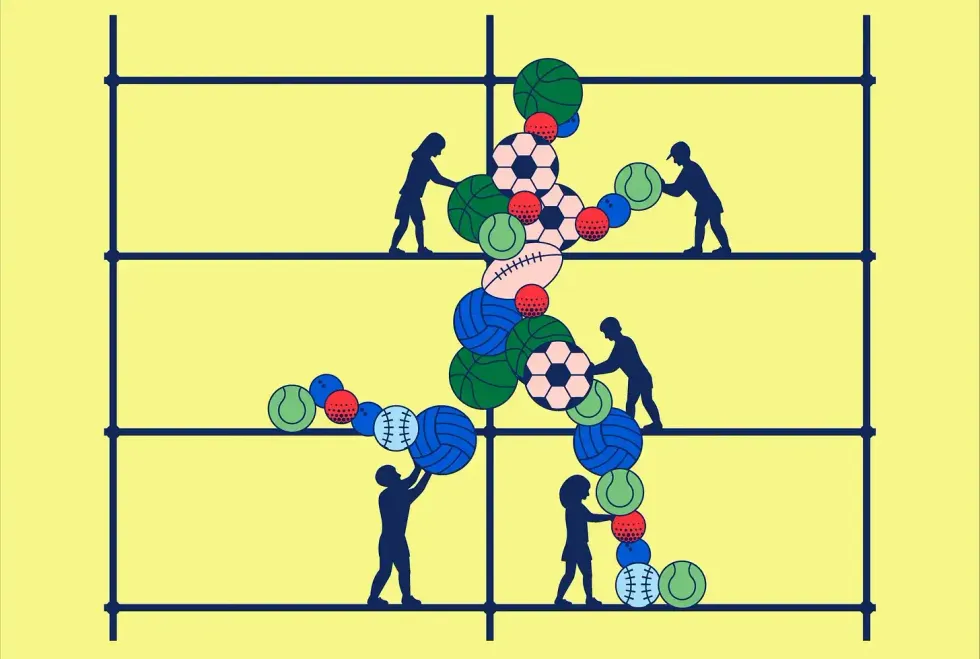 Following our HWF Civic Futures kickoff last week with Eric Liu, our design partners at Public/Official have created a unique visual to capture the “civic scaffolding” spirit of this conversation.
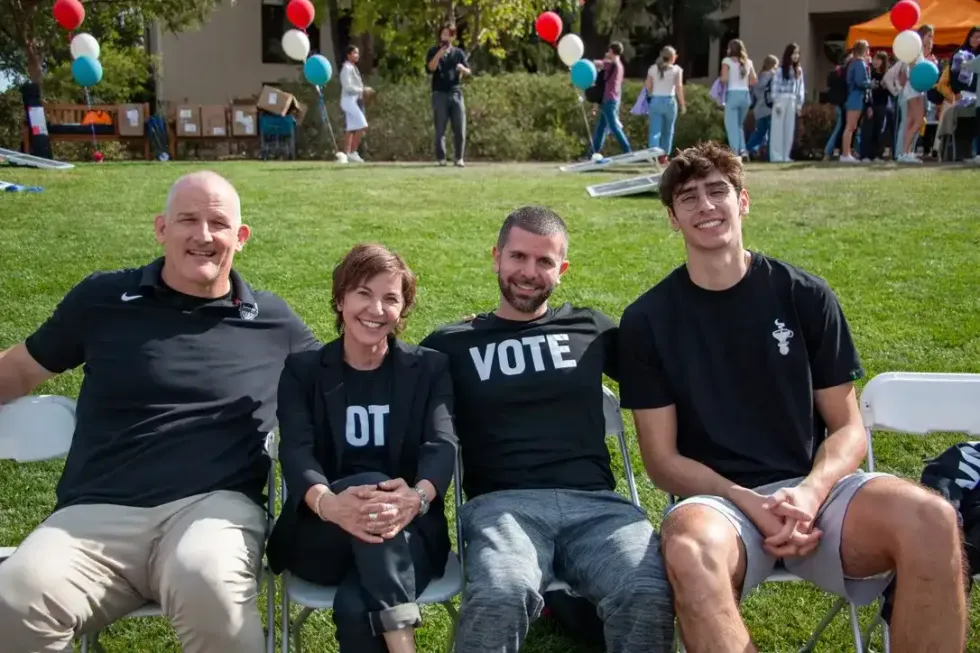 Lisa, Coaches Rev and Matt Elkin, and former Stanford Men’s Basketball star Maxime Raynaud at Stanford’s “All Vote No Play” Democracy Day, 2025