



From the moment my youngest daughter was born, she carved out her own space in my world. I remember the pediatrician remarking on her long eyelashes, my brief panic when she didn't cry right away, and then the overwhelming relief and joy of holding her as she looked up and seemed to smile.
Growing up in the United States, most children called their fathers “Dad.” She chose something different. She called me Nanna—the Telugu word for father. It was a small, sweet choice that signaled the unique intellectual and emotional bond we would share. I have three daughters, and while my relationships with her older sisters are deep and powerful in their own ways, this is the daughter who shares this particular story with me.
Our linguistic bond went even further. When she was three, my own mother passed away. In my grief, desperate not to lose the word I cherished most—Amma, the Telugu word for mother—I began calling my little daughter Amma. We both loved it. It became our private sanctuary of language and affection, a tradition that has evolved so that nowadays I sometimes call her Madre, the Spanish word for mother.
Even as a child, she possessed a rare ability to think with striking objectivity and plan far ahead. At twelve, she mapped out her life timeline: she would marry at twenty-seven and have two or three children soon after. Life followed her plan almost exactly; she married at twenty-eight—delayed slightly by the pandemic—and now has two children, precisely on schedule.
While my wife and older children looked on with amusement, I often found myself asking this little girl for advice. When I spoke to her, she gave me her full attention and responded with complete sincerity. Over the years, she wrote me beautiful letters. One of them moved me so deeply that I framed it; it still hangs on my office wall. Titled “The Special Relationship between My Dad and Me,” it recounts a childhood trip we took to the Secret Garden in Las Vegas. Even then, she observed the world with clear eyes, writing about how we stood before the gorilla exhibit and discussed the biological similarities between primates and humans—realizing, through that shared logic, just how closely our minds operated on the same wavelength.
By the time she was seven, I sensed she had the makings of a leader—an ambition she wrote about in a second-grade essay we still treasure. When I proudly told a professor at a university event that I was encouraging her to become a CEO, he smiled and remarked, “Ah, so you want her to start from the top.”
Because our relationship was built on mutual respect and freedom, she discussed everything with me, including her dating life. When it came time to choose a husband, I offered only the loosest of boundary criteria. Eventually, she became deeply excited about a young man and invited him over.
I took him on an hour-and-a-half walk around the lake in the park next to our home. I interviewed him—probing his personality, his technical ability, his career potential, and his capacity to be a good father. He passed with flying colors. Only after the wedding did I learn a delightful truth: my new son-in-law knew exactly what I was doing and was actively working to impress me. I felt a wave of joy realizing my son-in-law had outsmarted the father-in-law—a testament to my daughter’s sharp objectivity in choosing him.
Her personality—a delicate balance between wanting to make others happy and harboring a strong inner drive—became especially clear when it was time to choose a university. She was accepted to both UCLA and UC Berkeley. Sensing her wavering out of a desire to please us, I reframed the question: “Which choice will make you less unhappy?” With a very narrow margin, she admitted that Berkeley would make her less unhappy. Hearing that narrow truth was all I needed. I told her she must go for the best option with zero compromise. She chose Berkeley, and later, medical school in Chicago.
Today, she is a practicing psychiatrist, a dedicated wife, and a mother to two young children. Her life is beautifully full. Yet, despite being exceptionally busy, she makes time to read the articles I write. When I gently told her not to feel obligated, she shook her head. She told me she reads her Nanna’s articles not out of duty, but because she genuinely loves them—even if it is just a small part of an essay each day.
We know each other as close friends. We still laugh and reminisce about the exact names and quirks of every tourist who shared an unforgettable eleven-day European bus tour with us. We are keepers of the same memories.
This brings us to the polling booth.
Politics is a subject we discuss thoroughly. We agree on most things, but when we diverge, it is a matter of perspective rather than logic. My daughter feels a deep, personal connection to the DACA program, having gone to medical school alongside brilliant classmates whose careers and lives in this country were constantly under threat. When she reads the news, she feels that vulnerability acutely on behalf of her peers. For my part, while I understand and respect that passion completely, I tend to view the same issue through a broader policy framework.
There is a small, quiet part of me that once wished I could bring her around to my perspective. Not out of ego, but out of the lifelong habit of wanting to share every conclusion with her the way we once shared every idea. But that small sting is quickly overtaken by something larger. I raised all three of my daughters to be independent thinkers—to pursue their passion without compromise, to follow their own conviction wherever it leads. That was always the goal. So when she stood her ground on her vote, armed with genuine reasoning and conviction, I felt the deepest possible pride. She was not agreeing with me. She was proving that I had succeeded as a father.
We both understand and appreciate how the other person arrives at their conclusion. Because our relationship has always been anchored in a lifelong habit of critical and integrated thinking, we respect each other’s cognitive processes entirely.
On Election Day, we climb into the same car, the atmosphere filled with warmth and easy conversation. We joke that we are driving all this way for a “net zero” benefit because our ballots will neutralize each other. But beneath the laughter lies a shared sense of satisfaction.
We walk into the polling booth side by side. Standing next to each other—separated only by those thin cardboard dividers—we exchange a glance that needs no words. Then we cast our ballots for two different candidates.
As we walk back to the car, we do not feel defeated; we feel a quiet, powerful wave of pride. We have fulfilled our responsibility as good citizens. More importantly, we have proven that different perspectives do not mean a divided heart. We may cancel each other’s votes, but we amplify each other’s lives.Meda Parameswara Reddy, Ph.D., is Director of the Reddy Center for Critical and Integrated Thinking. A former R&D executive with 30 U.S. patents, he focuses on analyzing human behavior, public health, and global affairs, drawing on an interdisciplinary background. He has published in multiple RealClear platforms, Proc. Natl. Acad. Sci., The Humanist, AFRO American, South Asia Monitor (on the editorial board and host of a show), and others.











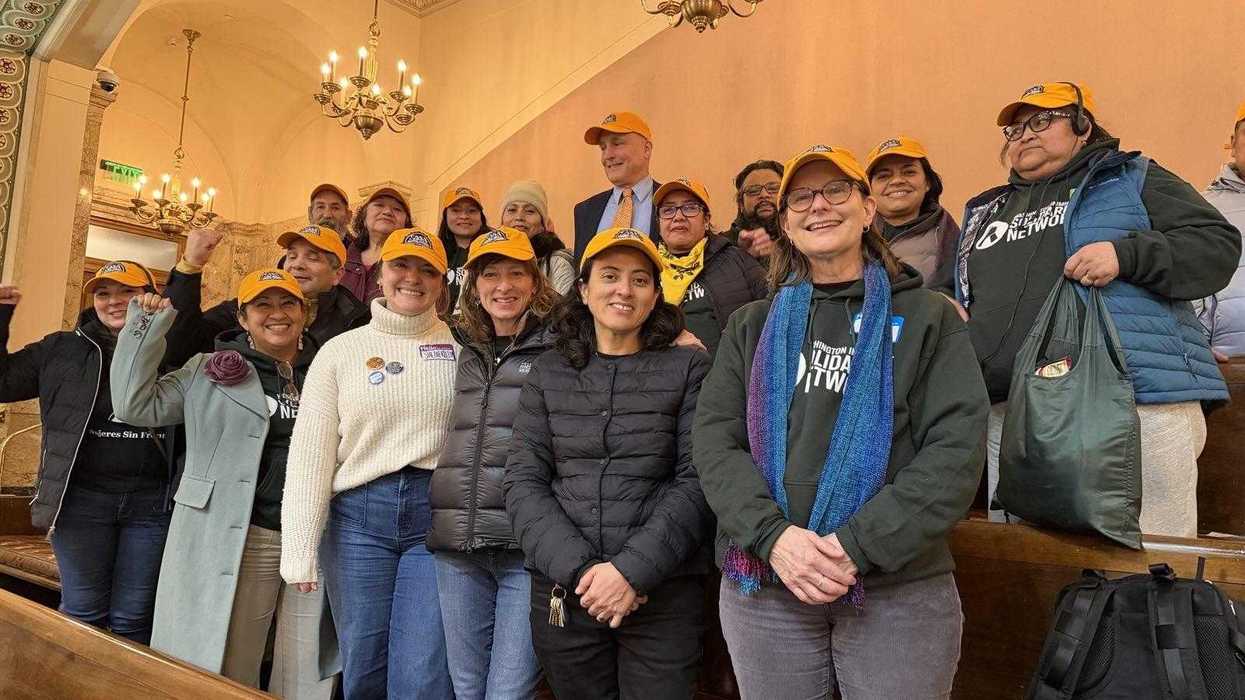
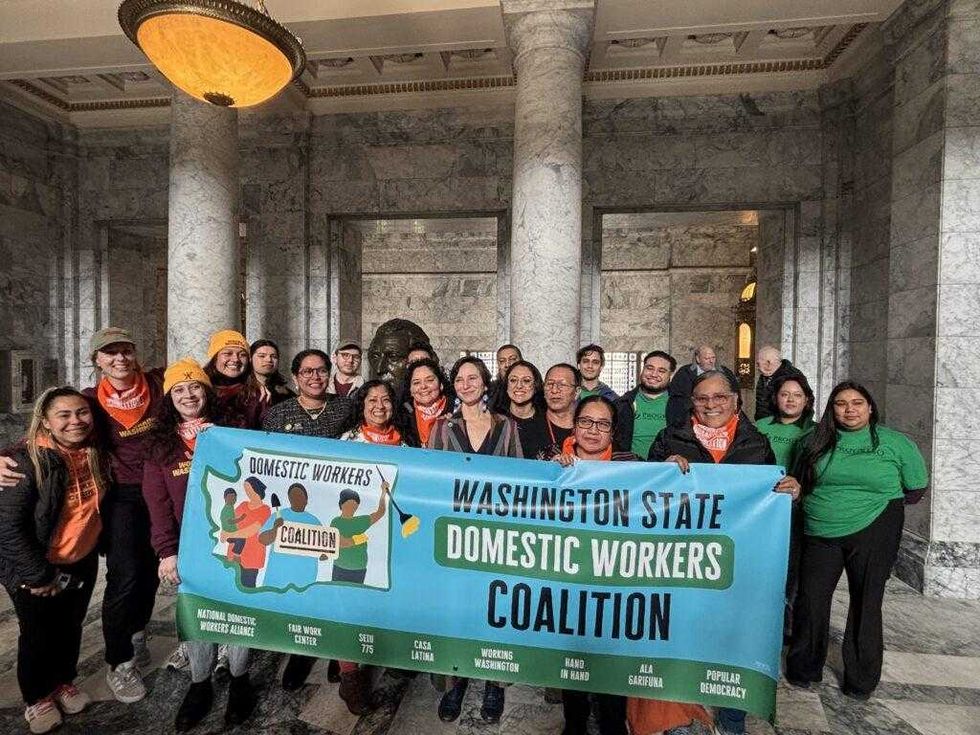 State Sen. Rebecca Saldaña, center, stands with members of the Washington State Domestic Workers Coalition at the state Capitol on Feb. 28, 2026. The Domestic Workers Bill of Rights passed in the House that day, before being signed into law in March. (Photo courtesy of Casa Latina)