




Deciding to go to war is as consequential a decision as any government can make. That has always been the case and is even more so at a time when the weapons of war are so lethal and destructive.
Wars are also very costly to the fabric of democracy in any nation. Whether a war of choice or a defensive conflict, the metric of success in war is victory, not popular approval.
Writing in 1944, as World War II raged, Supreme Court Justice Robert Jackson offered an unusually candid assessment of the inexorable tension between the military's wartime needs and the health of a constitutional republic. Jackson wrote: “It would be impracticable and dangerous idealism to expect or insist that each specific military command in an area of probable operations will conform to conventional tests of constitutionality. When an area is so beset that it must be put under military control at all, the paramount consideration is that its measures be successful, rather than legal.”
“The armed services,“ he explained, “must protect a society, not merely its Constitution. The very essence of the military job is to marshal physical force, to remove every obstacle to its effectiveness, to give it every strategic advantage. Defense measures will not, and often should not, be held within the limits that bind civil authority in peace.”
Then, as if foreseeing the current moment in American history, Jackson warned, “If the people ever let command of the war power fall into irresponsible and unscrupulous hands, the courts wield no power equal to its restraint. The chief restraint upon those who command the physical forces of the country, in the future as in the past, must be their responsibility to the political judgments of their contemporaries and to the moral judgments of history.”
Since February 28, when President Trump launched a war of choice in Iran, America has been living with the consequences of making him the Commander-in-Chief. Since a ceasefire was declared in April, the president has regularly announced that a peace deal was imminent.
But no deal has materialized, and the machinery of war has come back to life.
A headline in the June 11 edition of the New York Times got it right when it said, “U.S.-Iran Strikes Risk Dangerous New Phase.” As the Times noted, “The United States and Iran traded a new round of attacks early Thursday, bringing the countries back to the precipice of all-out war after President Trump vowed to keep up military pressure on Tehran to make a peace deal.
As gas prices rise and the global economy teeters, we are learning the hard way that the concentration of war powers in the hands of one person is dangerous, especially one as impulsive as our current president. Congress has failed, as it has so often in the past, to exercise its constitutional authority or rein in the use of military force in Iran.
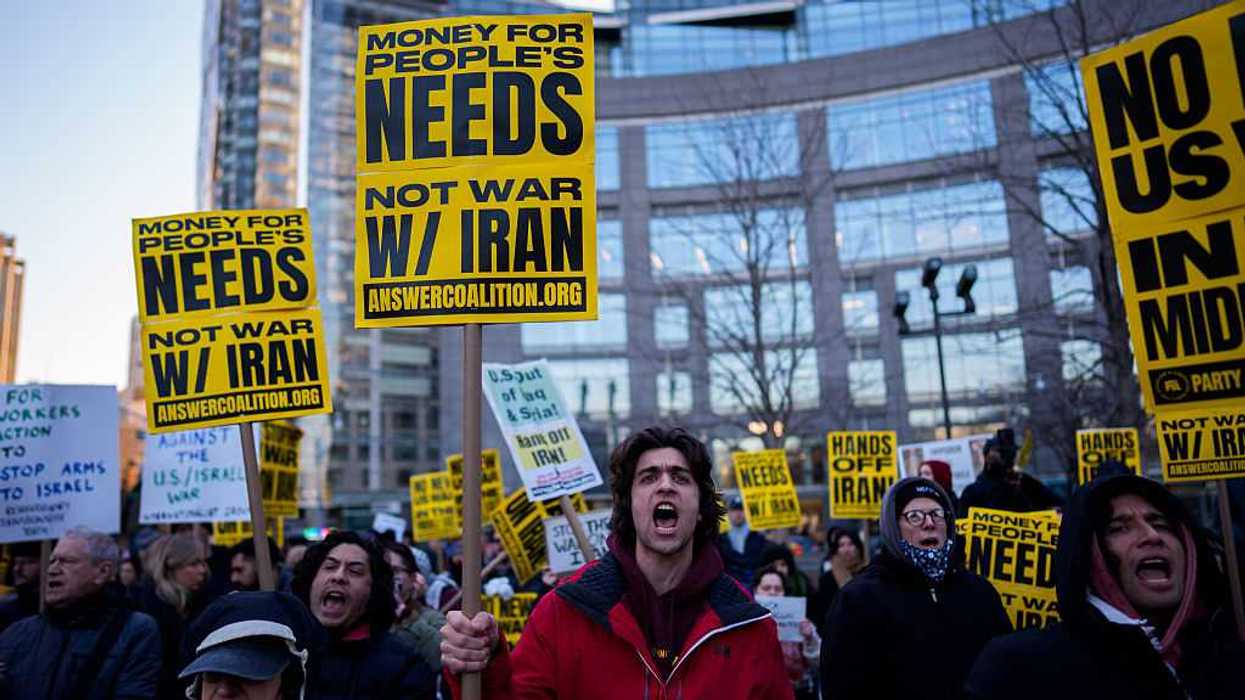
But the problem is not one that can be blamed solely on our Representatives and Senators. Where are the anti-war protests, the demonstrations demanding an end to the conflict?
It is not enough for the American people to register their unhappiness with the Iranian war in public opinion polls. They have to take the kind of action that has helped end unpopular wars in the past.
Recall Jackson’s admonition about the role of the people in rendering their “political judgments.” Before saying a bit more about the history of anti-war protests in the United States, let’s recall how the Framers of the Constitution thought about war-making and democratic politics.
As a Cornell Law School report explains, “Prior to the Constitution, all of the national government’s powers under the Articles of Confederation were lodged in a single, unicameral body—the Confederation Congress. Because the Constitution divided the federal government’s power between three distinct branches, questions arose as to which branch of government should receive the Confederation Congress’s power to 'determin[e]' war and peace.”
James Madison argued that “security against foreign danger is one of the primitive objects of civil society….The powers requisite for attaining it must be effectually confided to the federal councils.” But he warned that in a republic, the war power and the military should be “an object of laudable circumspection and precaution.”
He called that power “inauspicious” to the liberties of the people.
Some delegates to the Constitutional Convention wanted the war power lodged exclusively with the president. Others thought that doing so would be fatal to the plan for a republic. For example, South Carolina’s Charles Pinckney opposed a plan to give the president the power to declare war. In his view, that would make the president “a Monarchy, of the worst kind….”
As they often did, the delegates ended up lodging the power to declare war in one branch, the legislative, while making the president commander in chief of America’s forces. They intended that the question of whether to go to war be left to the people acting through their elected representatives.
Because of the weightiness of that decision, they wanted it to be subject to the to and fro of democratic debate. And they did not want it to be easy to take the nation into a war.
As Professor Elaine Scarry explains, in a representative democracy, “The representatives feel empowered not only to speak on behalf of the population’s judgments and sentiments but to give away the lives of that population. The second is perhaps always entailed in the first since, by committing the country to a path of war, Congress puts lives at risk.”
Absent a declaration, the people’s voice is silenced.
But throughout American history, people have found other ways to make their voices heard on questions of war and peace. They have used their votes to back candidates who have promised to keep them out of wars.
Donald Trump was supposed to be one of those candidates. The night he was re-elected in November 2024, he promised, “I’m not going to start a war. I’m going to stop wars.”
And he pledged that he would “keep our promises. Nothing will stop me from keeping my word to you, the people.“
In his inaugural address, he doubled down on his election night commitment. “We will measure our success,” he said, “not only by the battles we win but also by the wars that we end – and perhaps most importantly, the wars we never get into.”
What happened to that president?
Beyond voting, the people can make their voices heard by taking to the streets in peaceful protest. As the historian Christopher Klein argues, “The history of anti-war protests in the United States is as old as the country itself. Every war in American history—even the one that spawned the country—generated internal dissent from pacifists who rejected all wars and from citizens who objected to specific military conflicts on moral, religious, political, and economic grounds.”
Klein pays particular attention to protests during the war in Vietnam in the late 1960s and early 1970s. He calls them “the largest and most organized anti-war movement in American history….”
Another recent spasm of anti-war protests occurred after the American invasion of Iraq in 2003. By their participation, thousands of people made it clear that they wanted the war to stop, whether or not Congress condoned it.
That was then. Today, many Americans are focused on other problems, and others are worn out or demoralized.
Understandable.
However, before we give in to those feelings, we should recall Madison’s warning that: “The strongest passions, and most dangerous weaknesses of the human breast; ambition, avarice, vanity, the honorable or venial love of fame, are all in conspiracy against the desire and duty of peace.”
It is now up to the American people to stand against those “passions” and “weaknesses” and for the proposition that no war should be started in our name unless our elected representatives or we consent to it. As Scarry puts it, “The grant of power by the population to the executive government was never a grant of power to give or retract the lives of millions of people, our own or other populations.”
Austin Sarat is the William Nelson Cromwell professor of jurisprudence and political science at Amherst College.










The President Invited Iran to Bomb My Home