




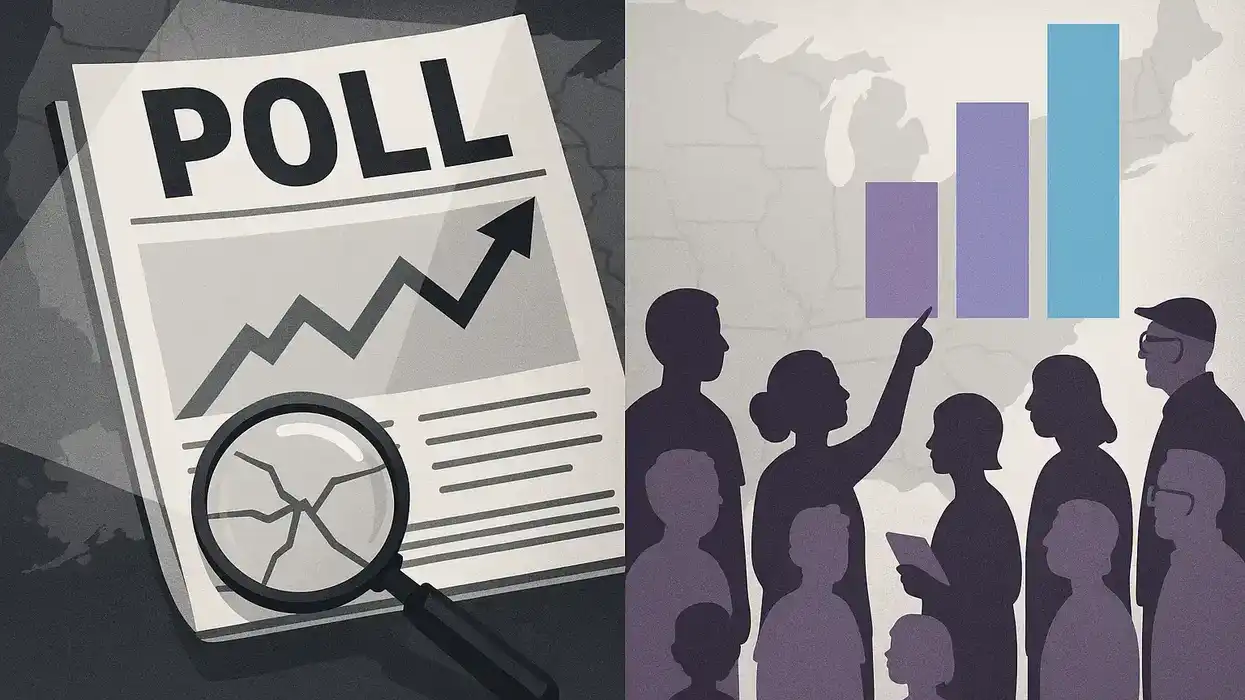

Politico published a story last week under the headline “Poll: Americans don’t just tolerate gerrymandering — they back it.”
Still, a close review of the data shows the poll does not support that conclusion. The poll shows that Americans overwhelmingly prefer either an independent redistricting process or a voter-approved process — not partisan map-drawing without voter approval. This is the exact opposite of the narrative Politico’s headline and article promoted. The numbers Politico relied on to justify its headline came only from a subset of partisans.
The most unambiguous indication of how Americans view redistricting came from the first question in the survey, which was asked of all 2,098 adults.
Respondents were presented with only four choices describing who should draw political maps:
“Political maps should be drawn through an independent, politically neutral process.”
“Political maps should be drawn by state legislatures, but approved by voters.”
“Political maps should be drawn by state legislatures, without approval by voters.”
“Don’t know.”
The results showed 38 percent favored an independent, politically neutral process. Another 34 percent supported legislature-drawn maps only if voters approved them.
Only 7 percent supported legislature-drawn maps without voter approval.
21 percent said they did not know.
A combined 72 percent either supported independent map drawing, supported voter oversight, or were uncertain.
Only a small minority favored giving state legislatures unchecked authority. Yet the headline for the poll in POLITICO says: “Poll: Americans don’t just tolerate gerrymandering — they back it.”
Independent and undecided voters showed even less support for partisan map drawing. Among those respondents, 29.8 percent supported an independent process, and 15.4 percent favored legislature-drawn maps with voter approval. Just 2.7 percent supported legislature-drawn maps without voter approval.
A majority, 52.1 percent, said they did not know which option they preferred. These results do not in any way indicate that Americans outside the two major parties support gerrymandering.
A chart in the story also contains a misleading headline, “A majority of Americans support partisan map-drawing…Percentage of Americans who support redrawing congressional districts to neutralize the other party — and those who support doing so to gain a midterm advantage.” But the chart includes only the responses of Democratic and Republican voters.
Only those who planned to support Democrats were asked whether they would support Democrats redrawing congressional districts “to gain an advantage” over Republicans. In that subgroup, 54.25 percent supported the idea, 29.55 percent neither supported nor opposed it, 9.80 percent opposed it, and 6.39 percent said they did not know.
A parallel question was asked only of those who planned to support Republicans, asking whether their party should redraw districts to gain an advantage over Democrats. Among that subgroup, 52.76 percent supported the idea, 28.06 percent neither supported nor opposed it, 12.26 percent opposed it, and 6.92 percent said they did not know.
The poll did not ask independent, undecided, or non-aligned voters these questions. It did not ask all adults whether they support partisan gerrymandering generally. The only majorities favoring partisan redistricting appeared when partisan voters were asked whether their own party should act in its own political interest in a hypothetical scenario. Those results cannot be generalized to the population at large.
The survey asked all respondents how each party should respond if the opposing party gerrymandered first. In the scenario where Republicans acted first, 20.5 percent said Democrats should challenge the maps in court, 28.8 percent said Democrats should draw maps to neutralize the impact, 19.3 percent said Democrats should draw maps to gain an advantage and 31.3 percent said they did not know.
In the reverse scenario, where Democrats acted first, 19.9 percent said Republicans should challenge in court, 30.5 percent said they should neutralize the impact, 16.0 percent said they should draw maps to gain an advantage, and 33.5 percent said they did not know.
Support for offensive, advantage-seeking gerrymandering was low in both cases, at 19.3% and 16.0%. In both questions, the most common response was “don’t know.” These numbers do not indicate that “most voters” favor using redistricting as a political weapon.
The poll also includes a breakdown of Republican respondents by whether they identify as “MAGA Republicans” or not. MAGA-identifying respondents were more supportive of partisan advantage in the Republican-only question than non-MAGA Republicans, but neither subgroup showed majority support for unchecked legislative control when all four map-drawing options were presented.
Both groups showed high levels of uncertainty in the neutral structural questions.
Politico’s article about its poll included a pro-gerrymandering quote from John Bisognano, president of the National Democratic Redistricting Committee, who said there had been “an extraordinary public outcry in favor of fighting back against Donald Trump’s overreaches in basically every forum.”
The story did not mention that the largest share of respondents in the poll favored an independent, politically neutral process or that more than half of independent voters said they did not know how maps should be drawn.
The poll was conducted not by a U.S.-based election research organization, but by Public First, a London-based firm. The use of a foreign research company to measure Americans’ views on U.S. election rules is unusual, particularly for a story framed around the claim that “Americans” support gerrymandering.
Politico announced a new partnership with the firm on October 30, 2025. Neither the story nor the poll contains any information about who financed the Public First poll. Public First is owned by SHGH, Inc., known as Stonehaven Global Holdings. The Executive Chair of Stonehaven is Peter Lyburn, and Public First’s CEO is Rachel Wolf.
Wolf is a former UK political operative for the Conservative Party and Boris Johnson. She is the co-author of the Conservative Party’s 2019 manifesto, which called for leaving the EU and getting Brexit done.
The survey’s stated margin of sampling error is plus or minus two percentage points for the full sample. Politico did not publish full crosstabs publicly, although the complete dataset is available to subscribers of its Pro platform.
Is Politico's Gerrymandering Poll and Analysis Misleading? was first published by IVN and republished with permission.













The President Invited Iran to Bomb My Home