


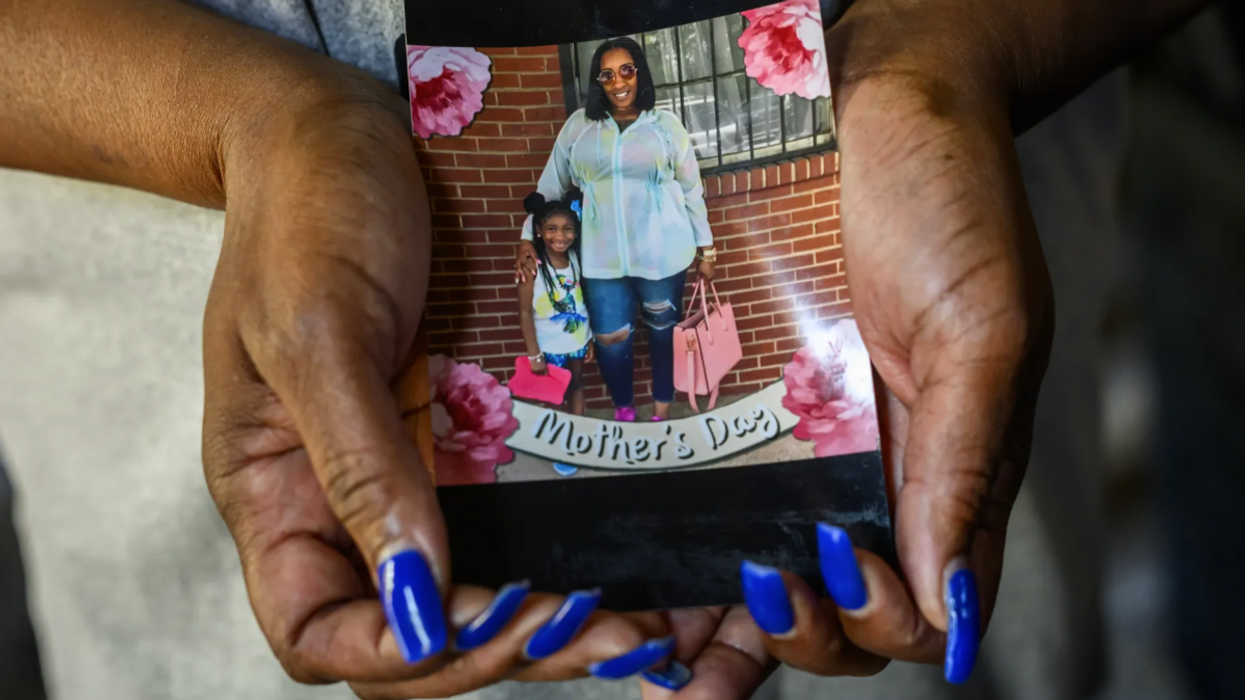
On Oct. 7, 2019, a 30-year-old beautician named Temptress Peebles called the Nashville probation office begging for help. Days earlier, her ex-boyfriend Brandon Horton had come up behind her, choked her and kicked her in the face, according to a court document.
Records show that was just the most recent attack. She had been living in a constant state of fear, her family said, since Horton had broken down her door and pointed a gun at her three months earlier, court records show. He had open warrants for his arrest, so she and her 8-year-old daughter, Khloe, were avoiding the apartment, always taking different roads to get to work or to stay at her family’s house.
Peebles asked the probation manager if Horton could be arrested when he came in for a court date the next day. Horton’s probation file shows the manager said she would try to help.
But Horton never showed up to court, according to his probation file, and Nashville police didn’t arrest him until it was too late.
Ten days after that call, probation and police records show, Horton waited for Peebles outside her apartment. Khloe told WPLN she remembers seeing Horton pointing a gun at her mom. She remembers throwing her arms around his legs and pleading with him, “no, no, no.” She remembers trying to call 911 while her mom, shot in both legs, lay in the street bleeding to death.
Horton is now awaiting trial on charges of killing Peebles. He and his lawyer declined to comment for this story. The case file is sealed and the public defender’s office declined to comment further on whether Horton has entered a plea.
Throughout the period when Peebles reported he was threatening and hurting her, Horton was released repeatedly into the community under the stipulation that probation officers would be actively supervising him. But in Tennessee, a state with one of the highest rates of women killed by men, WPLN and ProPublica found that a deadly blind spot in the probation supervision system emerges at a time when experts say domestic violence victims are particularly vulnerable.
When an offender under probation supervision violates the rules by being charged with a new crime or being found with a firearm, for example, a warrant may be issued for their arrest. When law enforcement serves that warrant, the offender can either end up behind bars or back out on probation while awaiting a court date.
But between the time a probation violation warrant is signed by a judge and when it is served, probation officers stop conducting any in-person supervision: For a high-risk offender, this means probation officers are no longer holding three in-person meetings per month; they also no longer conduct a monthly unannounced home visit to look for drugs and guns. That period of suspended face-to-face checks can stretch for months — in one instance, for more than 400 days.
In Horton’s case, he remained free, armed and dangerous for three months.
That pause of in-person supervision is spelled out in the Tennessee Department of Correction’s standards of supervision. Between 2019 and 2022, WPLN and ProPublica found at least six people, including Peebles, were shot to death during the gap in oversight. All were young Black mothers, ages 20 to 31. One victim was a cheerleading coach and a mom of two. Another woman was shot while her 2-year-old daughter lay on the bed nearby. In a third case, a mother of three was found in a creek days before Christmas with a purple domestic violence bracelet around her wrist. Their deaths left 12 children without their mothers.
TDOC declined to make any probation officials available for this story. In an emailed statement, Sarah Gallagher, a department spokesperson, said that “supervision remains active” for offenders who have warrants but “the objective changes.” Instead of ensuring offenders are abiding by the rules of probation, she said, officers help to bring that person into custody by sharing relevant case information with law enforcement. Gallagher confirmed there is no in-person supervision during that time.
This blind spot is one of the ways that the state failed to stop offenders from harming domestic violence victims. WPLN and ProPublica examined hundreds of fatal domestic violence shootings between 2007 and 2023 in Tennessee’s five most populous cities. The reporting, which expanded on our earlier investigations into Tennessee’s lax enforcement of gun prohibitions, found that among these fatal domestic violence shootings, at least 86 people — about 1 in every 4 — were allegedly killed by a suspect who was legally prohibited from having a firearm. Sixteen of those suspects were also on probation. In a Second Amendment-friendly state like Tennessee where laws make it easy for more people to carry firearms in more places, little can stop a person intent on getting a gun, even if they are legally barred from doing so. One backstop is the state’s probation officers, who are in close contact with violent, high-risk offenders and can search homes for prohibited weapons without a warrant if they have “reasonable suspicion,” TDOC said.
According to the department’s own documents, a probation officer’s mission is to ensure public safety. In cases where there is an open warrant, the department relies on law enforcement to prioritize the arrests of probation violators and on judges to incarcerate repeat violators instead of releasing them back into supervision and the community. The result: Some offenders like Horton return to the street.
“The system did her wrong,” Peebles’ mom, Karen Peebles, said. “If the police department had did their job, and the probation office had did theirs — I think it could have been prevented.”
“The Red Flags”
Peebles’s friends and family called her Chippie because she had a high, singsongy voice, like a chipmunk. She was loud, funny and always smiling. Almost every night, Peebles talked to her mom on the phone, and she never missed a Sunday dinner.
 Karen Peebles keeps a collage of photos of her daughter, Temptress, who friends and family called Chippie. William DeShazer for ProPublica
Her family said she started dating Horton around 2018, giving in after he had pursued her for years. She was hesitant, in part because of his criminal history. Horton had just started 10 years of supervised probation after he pleaded guilty to facilitation of second-degree murder in a robbery where a man was shot and killed.
“Even when she saw the red flags, she would just try anything in her power to try to make him better,” her cousin Princess Pinkston said. “She felt like she could save everybody.”
The probation department classified Horton as a high-risk violent probationer, which meant that every month his probation officer was required to see him face-to-face three times, conduct a home visit and check to make sure he hadn’t been arrested. This kind of supervision is more intensive and time-consuming than what low-risk offenders get.
In some probation departments across the country, probation officers are assigned either high-, medium- or low-risk offenders. Experts say this allows specialized teams to focus on intense monitoring of a smaller caseload of high-risk offenders, while lower-risk probationers are left to newer officers.
“It’s like the medical profession,” said Susan Rice, former president of the American Probation and Parole Association. “If you’re a specialist doctor and you do only the high-risk heart surgeries, you’re not going to have as many clients as a general practitioner who sees everybody that comes in with a runny nose.”
But in Tennessee, officers handle a mix of high-, medium- and low-risk offenders. And Tennessee’s probation offices do not have specialized domestic violence teams or training. A report from victim advocates more than a decade ago said these changes could save lives in the most dangerous cases. “This report should be viewed as a guide for where to begin changing policy,” the report reads, “and by doing so, ultimately reduce the occurrence of domestic violence homicides in Nashville-Davidson County.”
Rice said it is common practice nationwide to have mixed caseloads in probation departments. In an email, TDOC said the same, adding that all officers are “trained in areas like situational awareness and de-escalation techniques to identify warning signs and manage conflict.”
Most of the 16 alleged suspects who WPLN and ProPublica found were both prohibited from having a gun and under supervision by the probation department were deemed high or moderate risks by TDOC.
In addition, all 16 were under supervision in Memphis or Nashville, the state’s busiest offices. In those offices, probation officers handle an average of at least 65 cases annually, according to TDOC data.
Horton was assigned to the Nashville office, eventually coming under the supervision of probation officer Derrick Finch, who had been on the job a little more than a year at the time. Finch told WPLN that at one point he had more than 100 offenders in his caseload. Records show the department fired him in 2024 after seven years on the job for reporting that he conducted a home visit with an offender who was in custody at that time. Finch said he thought he had conducted the visit when he was entering his case notes at the end of the month.
“I got let go because I couldn’t keep up with the caseload anymore,” Finch explained in an interview with WPLN.
By early January of 2019, Horton had been on probation for about a year. His relationship with Peebles was fracturing and she was referring to him as her ex in court records. She joined her own family dinners less frequently, and when she did show up, her mom said, something was always off. She would wear long-sleeved shirts, even in the middle of sweltering Tennessee summers. Once she arrived on crutches, claiming she had fallen down the stairs. Another time she had a black eye, and told her family that a door had swung back and hit her.
Multiple studies have shown that the most dangerous time for a domestic violence victim is when they are trying to leave their abuser, often turning to the courts and law enforcement for protection.
But the case notes in Horton’s probation file seem to only scratch the surface of what her family suspected was happening behind closed doors. The case notes show Finch ticking through a standardized assessment of Horton’s progress, noting his body language, behavior and next steps. “Offender reported as directed.”
“Offender was calm, alert and oriented.”
“Offender seeking full-time employment at this time.”
“Offender advises he is in process of moving in with his mother.”
“Will advise offender next report date.”
Finch said the department wants officers to have a rapport with the offenders they are supervising, “but who’s got time for that? It’s very hard to do everything they want you to do, because there’s so much to do.”
He said when a “problem child” arose in his caseload, there was not much he could do about it.
“If this guy wants to change, we can help him,” Finch said of probationers. “But if he doesn’t — which unfortunately is the case with too many of them — what do you do?”
“A Slap on the Wrist”
In a court document, Peebles alleged that on Jan. 12, 2019, Horton went on Facebook Live and said he would kill her before he saw her with another man. He called her multiple times, she wrote, then showed up at her house, blocking her car with his. They started arguing. He punched her twice in the head. She ran to her car to escape and he chased her, she wrote. He tore the windshield wipers off of her car and used them to strike the glass as she cowered inside the locked vehicle. Horton fled when she called police.
What followed was a string of actions by probation officers, law enforcement and the courts that left Horton free and Peebles afraid.
The Metropolitan Nashville Police Department filed a domestic assault charge against Horton. MNPD arrested Horton and searched his home for weapons, according to probation records. He paid a bond to get out of jail while awaiting his court date.
According to TDOC policy, Horton’s arrest on suspicion of domestic assault required Finch to file a report and request a warrant for a probation violation.
That policy says that warrants for violations posing “an immediate and/or imminent threat to public safety” should be requested “as soon as possible.” Finch submitted a violation warrant to his supervisor and requested a judge sign it on Jan. 22, 2019, according to probation records.
Once a judge signed it, the warrant was sent to police, who arrested Horton two days later. But at a court hearing, Peebles failed to appear to testify on the assault charge and the case was dismissed. Her mom said that Peebles did not show up because she was afraid, and that Horton had threatened her if she pursued charges.
“The victim, more frequently than not, is the evidence,” Christina Johnson, a domestic violence prosecutor with the Nashville district attorney’s office, said. “If the evidence isn’t there, we have no choice, we can’t go forward.”
For this reason, the Nashville Office of Family Safety has called for the district attorney’s office to rely more on evidence such as 911 calls, body camera footage or forensic exams instead of just victim testimony.
Once the assault charge against Horton was dropped, the probation violation that was based on those charges was dismissed. Horton remained in the community under Finch’s supervision.
And it didn’t take long before the process started all over again.
On Jan. 28, 2019, Horton was arrested in nearby Marshall County. Law enforcement officers reported finding four bags of a white substance believed to be cocaine on him, as well as a stolen Glock 26 9 mm handgun.
Being arrested on suspicion of possession of drugs with the intent to sell is a probation violation, as is being a felon in possession of firearms.
So, records show, Finch requested another probation violation warrant to bring Horton in front of a judge. Horton was arrested and released on bond the next day.
Despite Horton’s status as a high-risk offender, his multiple arrests in a month and his possession of a prohibited firearm, Judge Jennifer Smith returned Horton to probation supervision instead of incarcerating him. In a statement to WPLN, Smith said she cannot comment on previous decisions.
In at least two other domestic violence gun homicide cases in 2021 a probationer was caught with a gun prior to the shooting — even though they were prohibited from having a firearm because of a prior conviction and because they were on probation. As with Horton, judges did not revoke their probation for being found with a gun.
“There are people who are telling us over and over again with their actions that they have no desire to change,” said Becky Bullard, deputy director of programs at Nashville’s Office of Family Safety, about abusers on probation who continue to perpetuate harm. “And when someone is waving that flag to us to say, ‘Hey, I’m out here practicing all of these high-risk behaviors with someone I’m supposed to care about,’ that is someone raising their hand and telling us that they’re about to murder.”
Shari Bryant was a Nashville probation officer from 2020 to 2025, and she said she left the job to become an accountant. She said it was common for someone to continuously violate probation with few consequences. Even in these high-risk, violent cases.
In one of the case files TDOC provided in response to WPLN and ProPublica’s record requests, a Memphis offender named Torian Williams was sentenced to probation for aggravated assault and reckless endangerment with a deadly weapon. He was classified as a medium risk and charged while on probation for having two guns. He would go on to shoot and kill his 20-year-old girlfriend Demya Gordon in 2021. For that crime, he took a plea deal for a lesser charge of voluntary manslaughter and was released to probation again. During that probation period, the probation department got a call from an ex-girlfriend and Williams’ mother saying that he was physically abusing them and threatening their lives. Williams died in 2025.
“Obviously, they’re not learning their lessons, right? They just keep getting a slap on the wrist,” Bryant said. “They keep getting out and getting away with it.”
That revolving door allowed Horton to remain on probation and return to the street again.
“He Is Going to Kill Me”
Months before she was killed, Peebles was in the bedroom of her apartment when she heard a loud boom at the back door. It was a stormy summer night, July 13, 2019.
“I got up walked to the door seen Brandon with a gun,” she wrote in a court document. He pointed the gun at her, and she ran out of her apartment. A neighbor later told the court that she was awakened by gunshots that went through her roof, her walls and her mirror. The neighbor, peeking through the blinds, saw Horton running with a gun in his hand. A few moments later, she saw Peebles climbing down a tree.
When police arrived, they could not find Horton. Metro Nashville Police Department charged him with felon in possession of a weapon, aggravated assault and aggravated burglary. And, for the third time in less than a year, Finch requested a probation violation warrant for Horton’s arrest.
 Temptress Peebles requested a protection order against Horton in July 2019 after he showed up at her home with a gun. Obtained by WPLN and ProPublica
Then, as is spelled out in TDOC’s standards of supervision, Finch stopped supervising Horton in person until police could arrest him. In the past, police served the warrant in a matter of days. This time, it would take three months for the police to catch up with Horton. For those three months, all that was required of Finch was a once-a-month check for arrests in the computer system. Police would not arrest Horton until after he allegedly killed Peebles. He has been behind bars ever since.
Probation experts said this practice of stopping in-person probation supervision once a violation warrant has been issued is not uncommon.
“It’s kind of a messed-up process,” said Rice of the American Probation and Parole Association. “Do we really want that period of supervision to stop if they’re not incarcerated during that time?”
In the six cases of domestic violence homicide that occurred during this supervision gap, WPLN and ProPublica found the time between when a warrant was issued and when police made an arrest stretched from as few as nine days to as many as 425 days. In all six cases, the alleged offender was put on probation for a gun-related offense. In some states, probation officers are able to serve violation warrants and arrest probationers themselves. But in Tennessee, officers must contact law enforcement. TDOC said while probation officers cannot make arrests themselves, they work with local, state and federal law enforcement, sharing information such as “addresses, photographs, known associates, and other leads” to assist in locating the offender.
When asked why it took so long to serve warrants in cases like Horton’s, the Metro Nashville Police Department said that “wanted persons frequently change where they stay or leave town and they are often difficult to locate.” MNPD said it works closely with probation officers to serve offenders if they continue to come in for office visits or when they show up for their court dates.
MNPD said it has one documented attempt to serve Horton’s violation warrant between the time it was issued in July and Oct. 17, when Peebles was killed. That attempt was on Oct. 9. Police said no one answered the door at Horton’s address.
 Peebles requested another protection order against Horton in October 2019. Obtained by WPLN and ProPublica. Highlighted by ProPublica.
“Detectives spend their days researching people with outstanding warrants so they can arrest them,” said Debra Fessenden, chief policy adviser with the Shelby County Sheriff’s Office, an agency that handles warrants for Memphis. “No one is ignoring the warrants.”
She said that not all intelligence leads to a timely arrest.
“It’s not unusual — because of resources, training and protocol — that law enforcement decides, ‘We’ll just serve this when we pull someone over’” for a traffic stop, said Julia Weber, a California-based expert who trains law enforcement and probation departments on dangerous domestic violence cases.
“What I tell communities is we have to recognize how dangerous a decision that is.”
In her final days, records show that Peebles was increasingly aware of how much danger she was in.
She had already called the probation department once for help getting Horton’s warrant served at his Marshall County court date. Days later, on Oct. 11, she called again to say that Horton had failed to appear in court “because he spoke to officer finch and was told that he would be taken into custody at that time on his warrant,” the probation file notes. The manager wrote that Peebles was upset and that Horton was threatening to hurt her.
In an interview with WPLN, Finch denied warning Horton.
“Everything that could have been done was done from our end,” Finch said. “Once that warrant is filed, there is nothing else that we can do.”
Six days after Peebles’ final call to the probation department, Horton allegedly shot and killed her outside of her apartment while her daughter, Khloe, struggled to call for help. Horton was arrested the next morning, and Smith, the judge who had allowed his release, later revoked his probation.
“Chippie should be here with her child, with her mom,” said Pinkston, Peebles’ cousin. “She had told you many times, ‘No, he’s serious. He is going to kill me.’ … Now it’s too late.”
 Temptress Peebles holding her newborn daughter, Khloe William DeShazer for ProPublica
Khloe is in high school now. For a long time after her mom died, Khloe said, she heard the gunshots in her sleep. She lives in her mom’s childhood bedroom to feel closer to her.
She’s starting to fully understand the ways the system did not protect her mom from Horton. But the 14-year-old says she has lived each day since her mom’s death struggling with a guilt she cannot shake.
“I always felt like her death was on me,” Khloe said, remembering how she had forgotten her phone in the kitchen that day, so they returned to the apartment to get it. “If we would never went back to that house … maybe she would have still been here.”
She Begged for Help. This State’s Probation Gap May Have Put Her in Danger. was first published on ProPublica and republished with permission.
Paige Pfleger covers criminal justice for WPLN News.
Mariam Elba is a research reporter supporting ProPublica’s local newsroom initiatives.