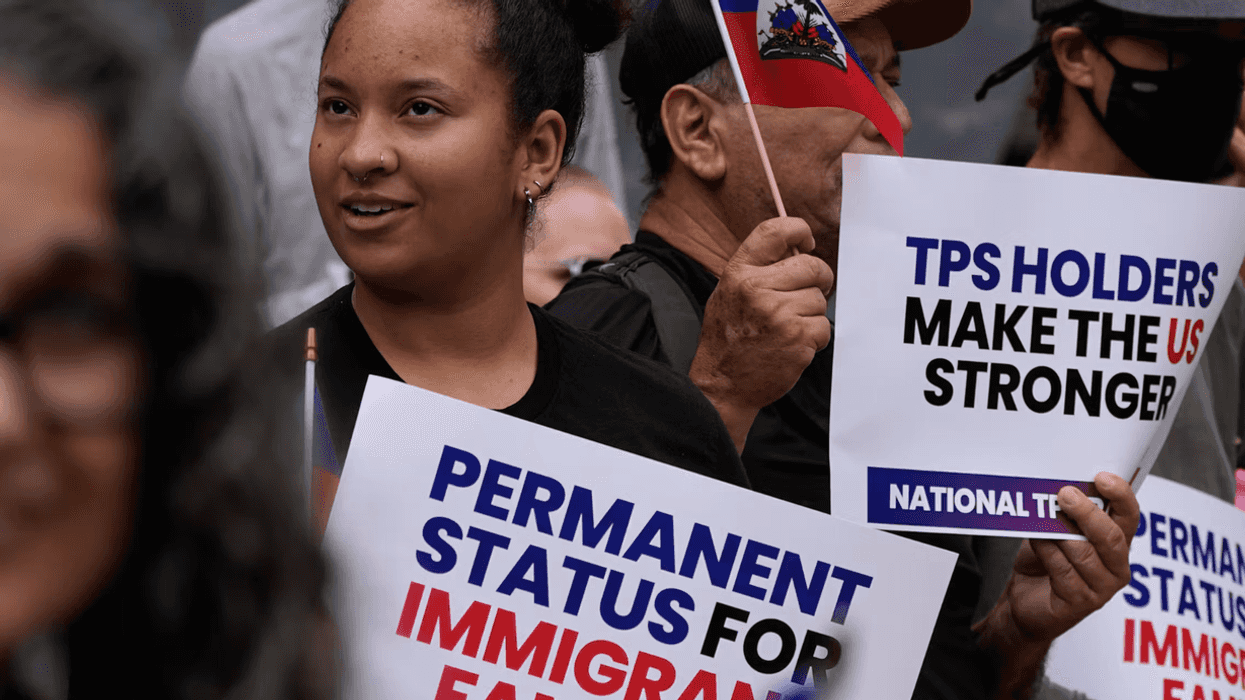

At the beginning of President Donald Trump’s second term, 1.3 million individuals from 17 countries were living and working in the U.S. under Temporary Protected Status, or TPS.
TPS is a humanitarian form of protection from deportation for people who cannot return to their home countries because of an armed conflict, environmental disaster or other extraordinary circumstances.
In 2025, the Trump administration began terminating or not renewing TPS for those countries, making its way through 13 of them. As the administration turns its attention to the few remaining nations, most TPS holders have lost or will soon lose their protection from deportation and their authorization to work. Many will be separated from their families and the communities they have lived in for decades. Some will be forced to return to countries like Afghanistan, Haiti and Syria, all of which are on the U.S. State Department’s “Do Not Travel” list due to war, terrorism or other extreme violence.
As a law scholar who studies immigration detention, I can say that most people with TPS never had a path to anything more permanent, which means, as they face deportation, they have little recourse.
Challenges in court
In the fall of 2025, the Trump White House announced that it would not renew Syrian or Haitian TPS; Syria’s would expire in 60 days, Haiti’s in February 2026. Lower courts blocked both terminations, triggering appeals that took the cases to the Supreme Court.
In June 2026, in Mullin v. Doe, the Supreme Court ruled that federal courts cannot review most challenges to a TPS termination because, in the original 1990 law creating TPS, Congress barred judicial review of the decision to give a country TPS – or extend or end it.
James Percival, the general counsel of the Department of Homeland Security, celebrated the decision, saying “Temporary Protected Status was always supposed to be temporary and can be canceled at the appropriate time.”
But the ruling means no court can consider whether a cancellation is, in fact, “appropriate,” or whether it follows the law.
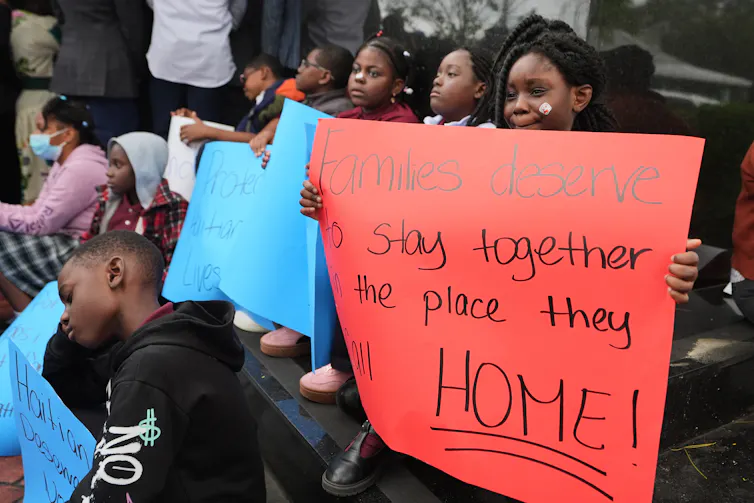 A local student holds a sign in support of Temporary Protected Status in Miami’s Little Haiti neighborhood in January 2026. AP Photo/Lynne Sladky
Unanswered questions
When Congress passed TPS as part of the Immigration Act of 1990, it was responding to a specific failure: the ad hoc and inconsistent use of something called Extended Voluntary Departure, which permitted a noncitizen to remain in the U.S. regardless of their immigration status.
That discretionary relief allowed some displaced Salvadorans to remain in the U.S. during their country’s civil war in the 1980s, but its application was arbitrary and often discriminatory. Because the U.S. backed the Salvadoran government, Salvadorans were denied both Extended Voluntary Departure and asylum more than 90% of the time – not for lack of merit but because of the government they were fleeing.
Congress recognized a humanitarian need for more uniform protection for people who, like Salvadorans, faced a return to violence or extreme danger but were not covered by narrow asylum laws that require proof of targeted persecution.
A new protected status would “standardize the procedure for granting temporary stays of deportation,” Representative Sander Levin explained at the time.
“Refugees, spawned by the sad and tragic forces of warfare, should not be subject to the vagaries of our domestic politics as well,” Levin added. When the 1990 Immigration Act passed, El Salvador was the first country designated for TPS.
Congress avoided placing time limits on these new TPS designations, leaving that to the discretion of the presidential administration, which would evaluate a country’s humanitarian needs at least every 18 months. Whether TPS holders should ever gain something more permanent was left for future congressional action.
No next step
Not every person from a TPS-designated country is eligible for it. Anything that disqualifies someone from asylum – national security concerns, persecuting others or criminal history – also disqualifies them from TPS.
Congress did not want to incentivize unlawful immigration. For that reason, it wrote the law in such a way that TPS itself could not lead to permanent residence. Lawful permanent residents are eligible to become citizens after five years. TPS recipients, though living in the U.S. lawfully, are not classified as lawful permanent residents.
Congress has since passed laws creating a pathway to permanent residence for certain nationalities, including some with TPS – the Nicaraguan Adjustment and Central American Relief Act, for example. It did not do so for most.
TPS designations for some countries have ended after a few years, like Rwanda and Guinea; others have been renewed for decades, like El Salvador, Honduras and Nicaragua. Over the years, TPS became a kind of limbo status, dependent on each presidential administration’s regular evaluation of a country’s humanitarian conditions – and on Congress to turn TPS into a pathway to lawful permanent residence. For most, the latter never happened.
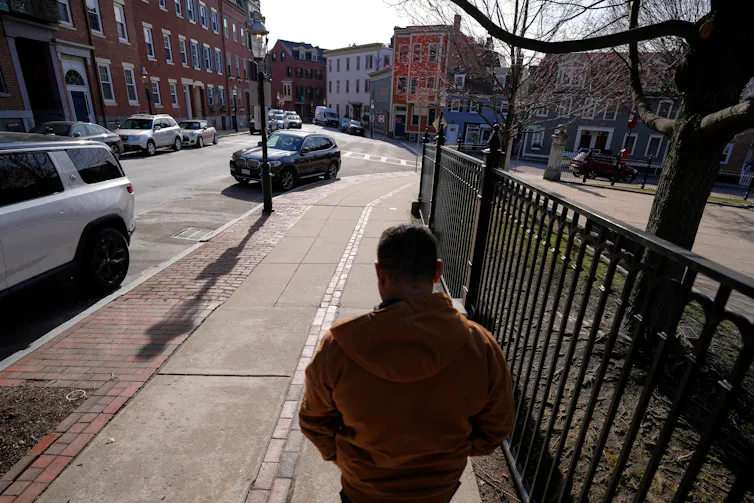 A Salvadoran who has had Temporary Protected Status in the U.S. since 2001 walks along Boston’s Freedom Trail on his way to work in March 2026. AP Photo/Robert F. Bukaty
What happens when TPS ends?
Many people who lose TPS are not eligible for any other immigration status.
Lawful permanent residence, commonly known as a “green card,” is mainly available in three ways: through a close family relationship, like being married to a U.S. citizen or lawful permanent resident; through a job that requires special skills, like being a professional soccer player; or through asylum status.
Even if a person can apply for permanent residence, their immigration history, such as entering the U.S. without a visa or remaining in the U.S. without lawful status for a certain time, may be a permanent barrier.
TPS holders are given at least 60 days’ notice before termination takes effect, at which point they lose authorization to work and become undocumented, meaning they can be arrested by immigration officers at any time. There is little they can do in those 60 days that would allow them to lawfully remain in the U.S.
A TPS holder who has been continuously present in the U.S. for more than two years has a right to an immigration hearing before removal, where they may be able to apply for asylum or other relief. Others may hope to switch to a different status, but most TPS holders cannot obtain a student or employment visa. Some would have to apply from outside the U.S., some face years of quota backlogs, and some are from countries under a travel ban.
Past immigration violations or insufficient financial resources would also disqualify them. Most significantly, TPS holders are unlikely to convince an immigration officer that they intend to return home after their visa’s purpose is complete, as most visas require – especially someone from a country in distress due to violence or environmental disaster, the reason they have TPS in the first place.
Some 300,000 people from El Salvador, Sudan, Ukraine and Lebanon are set to lose status this year. Ukraine and Lebanon are in active war, so terminating TPS means deporting those people to war zones, which is what TPS was meant to prevent. Some TPS holders from El Salvador and Sudan have lived in the U.S. for more than 20 years.
Perhaps the 1990 Congress did not anticipate that individuals with TPS would make the U.S. their home for so long. Whatever it envisioned, it did not limit TPS to a fixed time. In my analysis, Percival’s assertion that TPS was always meant to be temporary is not, by itself, an “appropriate” reason to end protection.
As Justice Elena Kagan stated in her dissent to the recent Supreme Court ruling, even if TPS does not promise “never-ending humanitarian protection,” the end of it for certain individuals – like the plaintiffs in Mullin v. Doe – could deliver them to “devastating, and indeed life-threatening, injury.”
What Comes Next for the 1 Million People Who Have Lost – or Will Soon Lose – Temporary Protected Status was originally published by The Conversation and is republished with permission.