




Skip to content
Search

Latest Stories

Follow Us:
Top Stories

Election experts press news media for transparency on calling races

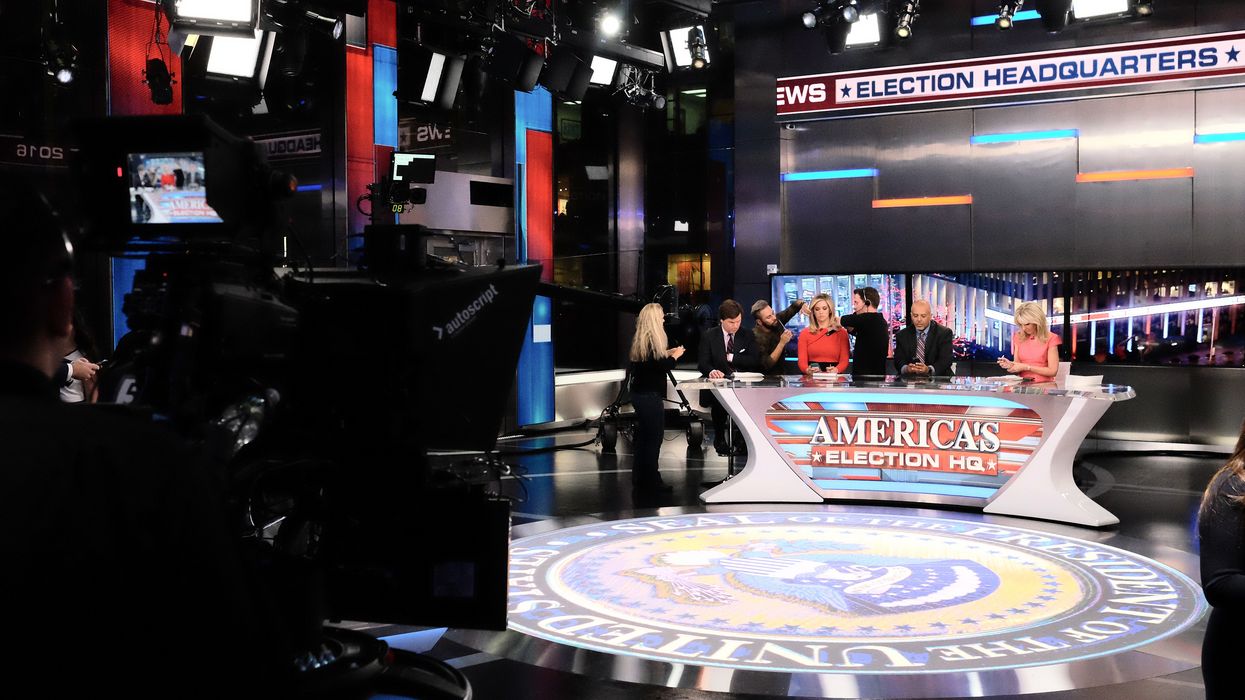
Fox News on Election Night 2016

The task force encourages news outlets to be transparent about their plans for election 2020 coverage.

Nicholas Hunt/Getty Images

With half or more of all ballots coming by mail this fall, it will take days if not weeks for the counting to be completed — likely delaying not only the climax of a close presidential race but also the final word about control of the Senate and dozens of other narrow contests.

Because at least this aspect of an unprecedented election has become easy to predict, the National Task Force on Election Crises, a recently formed group of election experts and academics, is urging the news media to be more transparent about its reporting process in order to give the public more confidence in the integrity of the results.

The task force on Wednesday asked the Associated Press, CNN, Fox News and the three broadcast networks for their detailed plans for reporting returns and calling races. Many other news organizations, including local TV stations and major newspapers, rely on these outlets (the AP most of all) before projecting a winner.


For previous presidential contests, the National Election Pool (just CNN, NBC, CBS and ABC this year) has relied on in-person and over-the-phone exit polling to model likely outcomes on a precinct-by-precinct and state-by-state basis — information they use to augment the returns as they come in. The AP and Fox News say this year they will use a different voter survey, conducted online and over the phone.

But these models will be complicated significantly by the certain surge in mail-in voting. Since most states are expecting unprecedented shares of votes cast remotely, the historical data on mailed ballots won't be much use when coming up with projections. And many states only turn to counting absentee ballots once the tabulating of in-person returns is finished.

To reassure the public about the reliability of results, the task force recommends news organizations publicly share the following at least one month ahead of Election Day:

  • How exit polling and voter surveys will account for the increase in absentee voting.
  • How discrepancies between results in hand the night of Nov. 3 and final results will be contextualized given ballot counting will take days or weeks, especially in battleground states.
  • Policies and procedures for protecting the people in the news division assigned to call races — so-called decision desks — from internal and external pressures to project a winner before results are clear.
  • Plans for covering any politician who declares victory before an accurate, evidence-backed projection has been made.

President Trump has signaled he plans to rely on the election night results to decide if he should claim re-election. Plenty of evidence says that could prove irresponsibly premature — especially in light of polling showing his supporters are much likelier to vote in person while Joe Biden's allies say they'll vote by mail.

The logical consequence would be that early returns suggesting a strong Trump showing will start evaporating, for a totally legitimate reason, as the envelopes are tabulated. The emerging nicknames for this are "the red mirage" or "the blue shift," depending on your point of view.

If news outlets take extra steps to increase transparency around their coverage, it will increase the public's confidence in the election process and outcome, the task force wrote.

"The role of the free press — your role — has never been more important," the letter concludes. "We urge you to take these additional steps towards transparency as part of your mission to inform the public and deliver accurate coverage of election results, especially how you account for the millions of expected absentee ballots. The American electorate — and our democracy — is depending on you."
Read More

Postal Service Changes Mean Texas Voters Shouldn’t Wait To Mail Voter Registrations and Ballots

A voter registration drive in Corpus Christi, Texas, on Oct. 5, 2024. The deadline to register to vote for Texas' March 3 primary election is Feb. 2, 2026. Changes to USPS policies may affect whether a voter registration application is processed on time if it's not postmarked by the deadline.

Gabriel Cárdenas for Votebeat

Postal Service Changes Mean Texas Voters Shouldn’t Wait To Mail Voter Registrations and Ballots

Texans seeking to register to vote or cast a ballot by mail may not want to wait until the last minute, thanks to new guidance from the U.S. Postal Service.

The USPS last month advised that it may not postmark a piece of mail on the same day that it takes possession of it. Postmarks are applied once mail reaches a processing facility, it said, which may not be the same day it’s dropped in a mailbox, for example.

Keep ReadingShow less
The Many Victims of Trump’s Immigration Policy–Including the U.S. Economy

Messages of support are posted on the entrance of the Don Julio Mexican restaurant and bar on January 18, 2026 in Forest Lake, Minnesota. The restaurant was reportedly closed because of ICE operations in the area. Residents in some places have organized amid a reported deployment of 3,000 federal agents in the area who have been tasked with rounding up and deporting suspected undocumented immigrants

Getty Images, Scott Olson

The Many Victims of Trump’s Immigration Policy–Including the U.S. Economy

The first year of President Donald Trump’s second term resulted in some of the most profound immigration policy changes in modern history. With illegal border crossings having dropped to their lowest levels in over 50 years, Trump can claim a measure of victory. But it’s a hollow victory, because it’s becoming increasingly clear that his immigration policy is not only damaging families, communities, workplaces, and schools - it is also hurting the economy and adding to still-soaring prices.

Besides the terrifying police state tactics, the most dramatic shift in Trump's immigration policy, compared to his presidential predecessors (including himself in his first term), is who he is targeting. Previously, a large number of the removals came from immigrants who showed up at the border but were turned away and never allowed to enter the country. But with so much success at reducing activity at the border, Trump has switched to prioritizing “internal deportations” – removing illegal immigrants who are already living in the country, many of them for years, with families, careers, jobs, and businesses.

Keep ReadingShow less
Close up of stock market chart on a glowing particle world map and trading board.

Democrats seek a post-Trump strategy, but reliance on neoliberal economic policies may deepen inequality and voter distrust.

Getty Images, Yuichiro Chino

After Trump, Democrats Confront a Deeper Economic Reckoning

For a decade, Democrats have defined themselves largely by their opposition to Donald Trump, a posture taken in response to institutional crises and a sustained effort to defend democratic norms from erosion. Whatever Trump may claim, he will not be on the 2028 presidential ballot. This moment offers Democrats an opportunity to do something they have postponed for years: move beyond resistance politics and articulate a serious, forward-looking strategy for governing. Notably, at least one emerging Democratic policy group has begun studying what governing might look like in a post-Trump era, signaling an early attempt to think beyond opposition alone.

While Democrats’ growing willingness to look past Trump is a welcome development, there is a real danger in relying too heavily on familiar policy approaches. Established frameworks offer comfort and coherence, but they also carry risks, especially when the conditions that once made them successful no longer hold.

Keep ReadingShow less
Autocracy for Dummies

U.S. President Donald Trump on February 13, 2026 in Fort Bragg, North Carolina.

(Photo by Nathan Howard/Getty Images)

Autocracy for Dummies

Everything Donald Trump has said and done in his second term as president was lifted from the Autocracy for Dummies handbook he should have committed to memory after trying and failing on January 6, 2021, to overthrow the government he had pledged to protect and serve.

This time around, putting his name and face to everything he fancies and diverting our attention from anything he touches as soon as it begins to smell or look bad are telltale signs that he is losing the fight to control the hearts and minds of a nation he would rather rule than help lead.

Keep ReadingShow less