





Almost everything in our public life is organized as a contest — debates, elections, legislation, litigation. Contestation is so pervasive that we mistake it for the natural order. But operating from a competitive mindset is a choice, not a law of physics. A country where all can thrive together cannot be built by defeating one another; it has to be built by a movement that models a different way of governing, one that weaves our differences into social cohesion instead of deepening division.
The path to that renewal starts with an important distinction. Martin Carcasson, who directs Colorado State University’s Center for Public Deliberation, identifies three modes a free people can use to work through disagreement. Debate is built to produce a winner: two sides marshal arguments to defeat each other, and positions harden. Dialogue is built to produce understanding. It enables us to grasp how another person sees the world and to build the mutual trust that safe, healthy communities depend on.
We propose to use widespread public deliberation as the foundation for building and maintaining a new era of collaborative governance. Deliberation is an approach in which everyday citizens learn together about an issue, talk with rather than past each other, usually with the help of a facilitator, and weigh the tensions and trade-offs among diverse views. Using deliberation, those who disagree can reason together toward a consensus decision.1 Most of our hardest problems are conflicts between competing goods, where every path forward asks someone to give something up. Debate can inflame those conflicts; deliberation can resolve them.
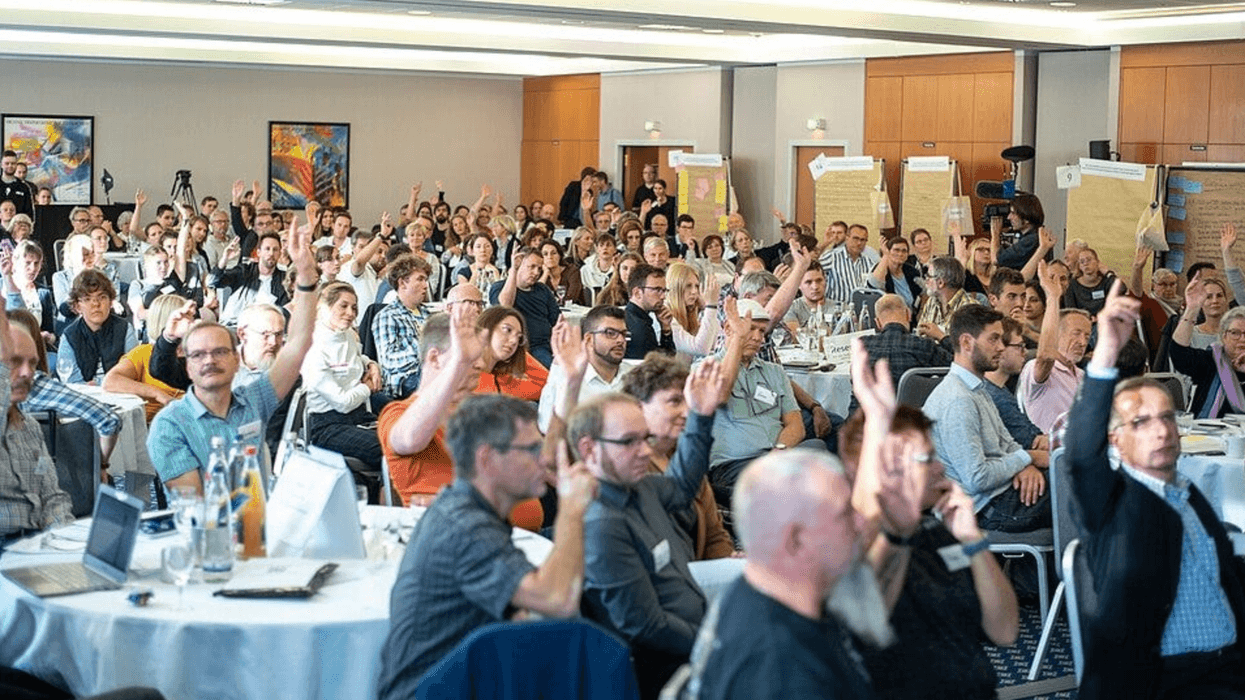
None of this is theoretical. Since the 1980s, a tidal wave of public deliberation has been expanding around the world, with the sharpest rise in the last fifteen years – and it is still growing rapidly.2 Ireland is the pioneer: its citizens’ assemblies took up questions politicians feared most — about abortion, same-sex marriage, and other constitutional questions. Twice, the whole electorate confirmed the assemblies’ measured and nuanced recommendations by referendum. The deliberative wave is rising at home, too, with state-level civic assemblies in New Hampshire, Nevada, South Carolina, and elsewhere taking up everyday concerns like housing, taxes, and energy. The next step is to turn this method toward the structures of our system of self-governance.
The Nationwide Deliberation Campaign
At the heart of the Great American Deliberation is a nationwide campaign — a nonpartisan collective effort to bring Americans, at unprecedented scale, into structured deliberation about our democracy’s future, synthesizing what emerges into a “People’s Proposal”: a common-ground agenda of structural reforms sourced directly from the American people. Deliberations would be conducted through four layers that winnow and refine citizens’ views:
- Grassroots deliberations in libraries, faith communities, and union halls form the widest entry point;
- Online deliberation platforms extend the reach of deliberation to those who cannot take part in person;
- Deliberative polling — where a representative sample of Americans receives balanced information before registering considered opinions — tests which proposals hold up under scrutiny; and
- Citizens’ assemblies — Americans chosen by lot, the way we choose juries — deliberate deeply at the state and national level to produce the final, nuanced People’s Proposal.
The grassroots layer is where the campaign does its deepest work — and where the nationwide campaign brings value from the beginning. In many communities, asking people to deliberate on divisive questions before they trust one another is why such efforts fail. So the campaign begins earlier, with a sequence our partners call mutual aid, mutual understanding, mutual agreement.3 Neighbors first come together around their concrete needs — a food drive, mutual aid, a clean-up, or other shared project — discovering each other as people before they are asked to discuss anything contentious. From there, neighbors build the capacity to talk across differences and bring down the temperature when conflict becomes heated. Only then do deliberate together on the rules of our democracy.
Trust is built as neighbors spend time together, work together for the common good, and talk through their life experiences and hopes in search of common ground. This is the campaign’s quiet power. The process is not merely a way of gathering input around structural reforms to renew our system of self-governance. The process itself is healing. It turns political discourse from a zero-sum battle into shared problem-solving, and channels grievance into dialogue before it hardens into contempt. Even if it produced no proposal at all, a season of structured deliberation would leave the country less polarized and better equipped to govern itself.
America’s common ground is not hypothetical. Among the more than one hundred cross-partisan supermajority positions the University of Maryland’s public-consultation research has identified,4 a distinct cluster rises to structural reform — changes not to this or that policy but to the rules of the game: how we elect and hold Congress accountable, the role of money in politics, the balance between the branches of government, ethics in government, and election integrity. But research only shows what people think; it does confer a mandate. What emerges from the nationwide deliberation campaign will be closer to a jury’s verdict than a poll result5 — carrying the considered judgment of the people who reasoned together.
From the People’s Proposal to a Renewed Social Contract
Renewing our system of self-governance turns on legitimacy — what makes people accept a decision as rightful because they trust the process that produced it. To earn that trust, the Great American Deliberation must pass a few hard tests. It must include everyone: conservatives, progressives, and everyone in between as genuine co-leaders, with participants in the most intensive deliberations selected by lot so the table looks like the country itself. It must reflect considered judgment, elevating the reforms that command broad, informed support across our divides rather than those pushed by whoever speaks loudest. Critically, the people must be able to see that the Proposal is theirs: every recommendation traceable to the deliberations it came from, minority views preserved rather than averaged away, and the whole process audited independently, the way observers audit an election.
Here it helps to be precise about what renewing a social contract actually requires, because, as I argued in the first essay of this series, a Founding has two halves. The first half is cultural: a change in how we treat one another and how we engage the institutions we share. The second is formal: writing our common ground into the Constitution and other foundational documents, beyond the reach of any single election to undo. A change in culture that is never entrenched gets reversed when power turns over; legal entrenchment without a genuine change of heart is a dead letter. A true Founding needs both.
This is why the deliberation is not merely preparation for the real work — it is already half of it. Every community that reasons together across differences, every citizen who discovers that the person across the divide is not the caricature they feared, is already renewing the social contract. The cultural half of a Fourth Founding is not something the campaign proposes for later; it is what the campaign does by design.
The second half consists of carrying the common ground we surface into our foundational documents so that it lasts. A proposal, however broadly supported, is not yet a political settlement. Translating what the people have said into how we govern ourselves requires champions — a broad coalition of conservatives, progressives, and independents, united not by a shared ideology but by shared ownership of what the people produced, and including the officeholders, candidates, and civic, faith, labor, and community organizations that helped convene the deliberations. Reform advanced by one faction invites reversal by the next; that is the toxic tug of war we are trying to end. Reform carried by a genuinely cross-partisan coalition, standing on a platform the people themselves authored, earns the legitimacy to endure. Building that coalition is a task in its own right — the subject of a future essay.
Crucially, renewal need not wait on Washington or the Constitution. Most of it can be won without a constitutional amendment at all — through ordinary legislation, ballot measures, and reform in the states where Americans are already rewriting the rules of the game. Citizens in Michigan created an independent redistricting commission by ballot initiative, taking the map-drawing pen out of legislators’ hands.6 Montanans, after long decades of copper barons buying their politics, made their state a determined laboratory for getting money out of elections. They enacted the bipartisan DISCLOSE Act, which forces the groups paying for political ads to reveal who funds them, and the Supreme Court let it stand.7 An all-volunteer campaign has since gathered nearly fifty thousand signatures, from all fifty-six counties without a single paid canvasser, to put “the Montana Plan” on the 2026 ballot. None of this required amending the Constitution.
Reforms drawn from the People’s Proposal can therefore be enacted at every level at once — by a city council, a state legislature, a ballot measure, and/or an act of Congress. Only the deepest and most fundamental of them — the changes most vulnerable to being undone the moment power changes hands — need to be entrenched in the Constitution and other foundational documents, where no single election can reverse them. That entrenchment is the keystone — the last stone set, the one that locks the arch in place.
As we conduct the campaign, we must keep in mind a grim possibility. If our political system were to melt down faster than the ordinary channels of reform can work, the patient work of deliberation would not be wasted — it would matter more, giving any future effort to renegotiate our public life a reservoir of common ground and cross-partisan trust to draw on rather than starting from nothing. How a divided society can deliberate its way through a democratic crisis and transition is the subject of a later essay.
The Invitation
We have a rare opportunity to do the work of democracy renewal deliberately, in good time, rather than in the aftermath of a rupture. The bonus: the work itself heals. A season of nationwide dialogue and deliberation would (re)build relationships across our lines of difference and let grievances be spoken and heard — reweaving the social fabric in the very act of deciding what comes next.
Importantly, we would not be attempting something alien to us. Twice in the twentieth century — through the women’s suffrage movement and the civil rights movement — Americans renewed the terms of our common life nonviolently. Founding-scale change without catastrophe is not a fantasy; it is part of our inheritance.
But it need not take a lifetime. The process of achieving women’s right to vote, according to the suffrage leader Carrie Chapman Catt, cost American women “52 years of pauseless campaign.”8 Fortunately, we have deliberative processes and tools no earlier generation possessed. With focus, the nationwide deliberation campaign could begin to heal our social fissures and surface a common-ground People’s Proposal in as little as one to two years — in time to inform the platforms and candidates of the 2028 election cycle. What took the suffragists half a century of organizing, we can now begin in a single cycle. What the Great American Deliberation asks is that we claim that inheritance courageously and deliberately at a scale worthy of the whole country — and make our Fourth Founding a peaceful one. The planning has already begun.
Danielle M. Reiff is a retired American diplomat, peacebuilder, and writer. Her new book, The Power of Public Love: Evidence and Practices for Weaving the Social Fabric of Peace, will be published in late 2026. As a U.S. diplomat for twenty years, Danielle specialized in supporting democratic transitions and peacebuilding around the world. After retiring, she founded the nonpartisan Peacebuilders initiative to promote nonviolent approaches to complex systems change. She also co-founded the Democracy Renewal Group, Renew American Democracy (RAD) platform, and Renew to Thrive initiative. She believes we must renew our system of self-governance so that all Americans can thrive together.
The Great American Deliberation was originally published by The Democracy Renewal Group and is republished with permission.








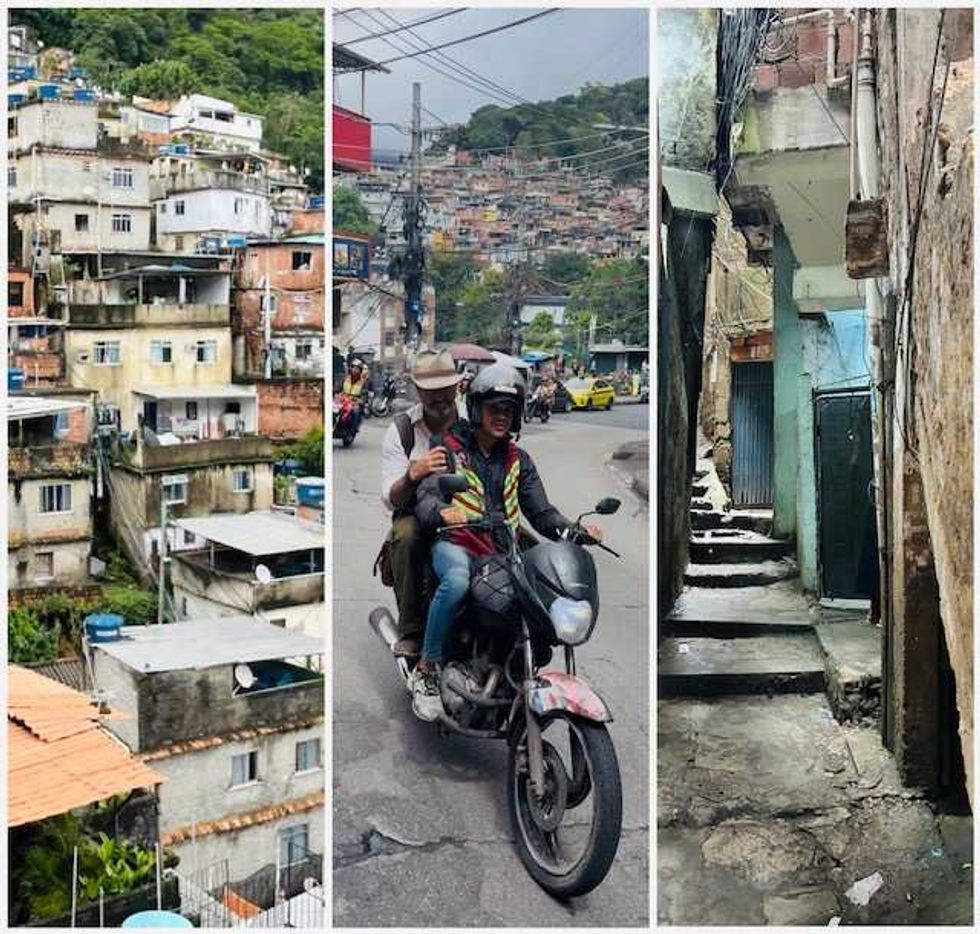 Scenes from Favela Rocinha, Brazil - (R-L) Rows of brick homes, Hugo Balta on a motorcycle taxi, and steep, winding roadsHugo Balta
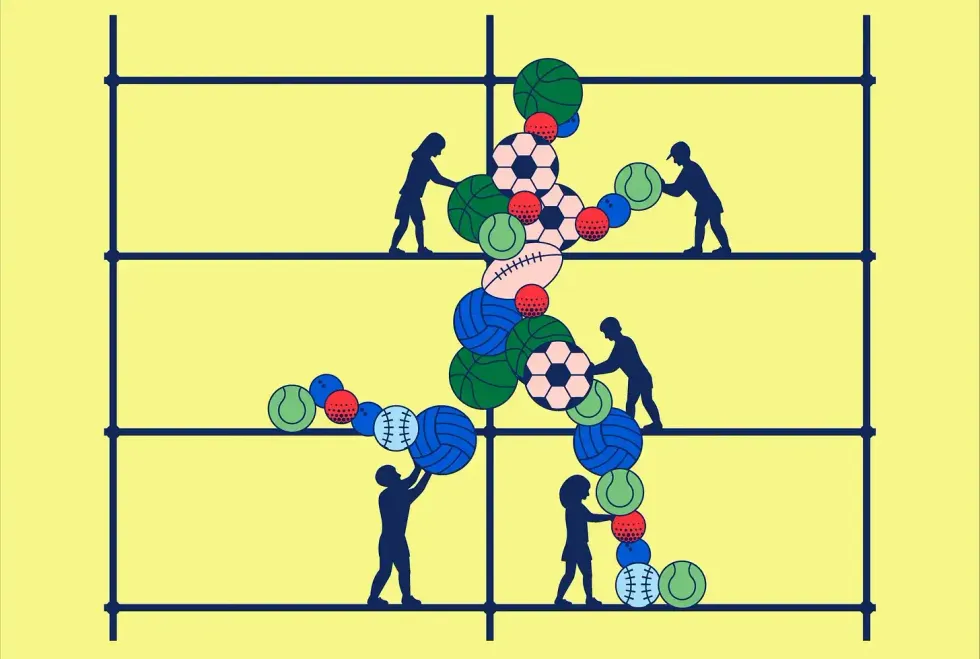 Following our HWF Civic Futures kickoff last week with Eric Liu, our design partners at Public/Official have created a unique visual to capture the “civic scaffolding” spirit of this conversation.
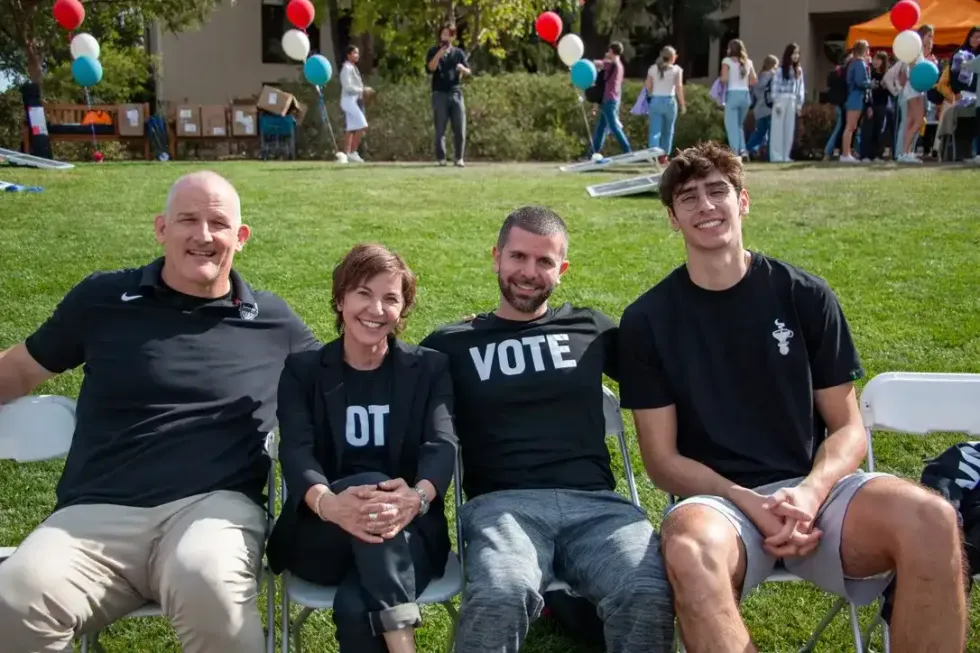 Lisa, Coaches Rev and Matt Elkin, and former Stanford Men’s Basketball star Maxime Raynaud at Stanford’s “All Vote No Play” Democracy Day, 2025