

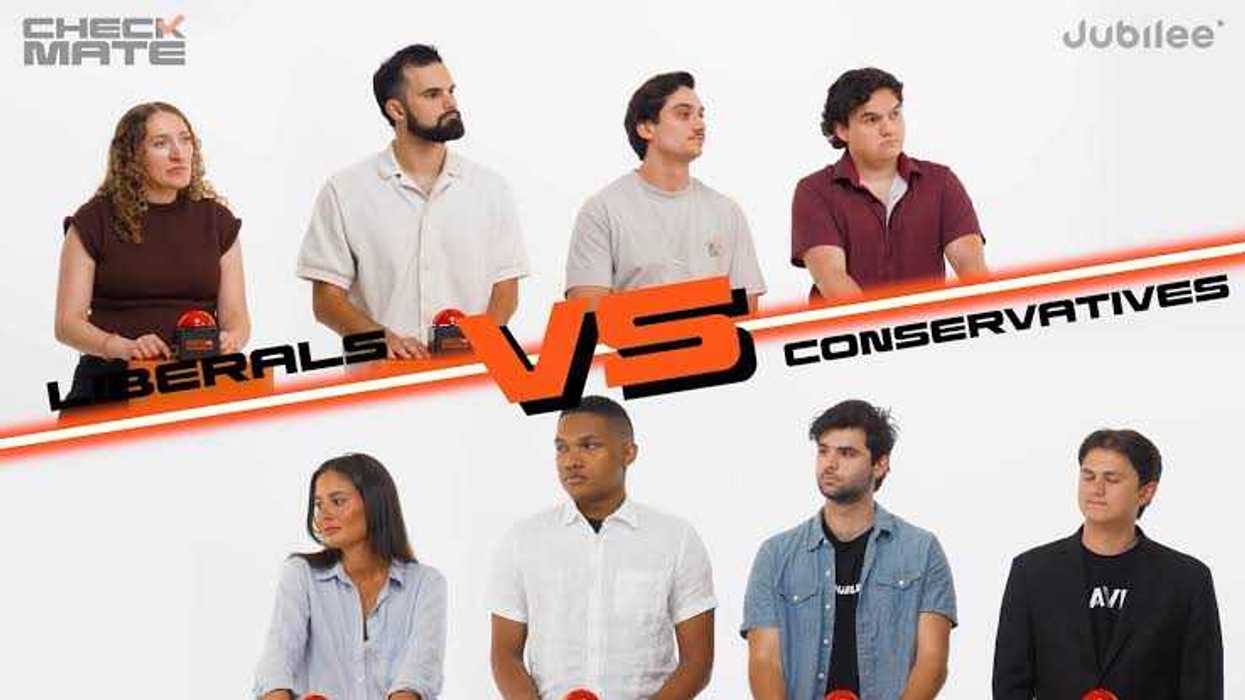
On the set of YouTube’s newest game show, a fact-checker quit in the middle of taping. Her job was to referee the truth, and the rules gave her exactly two words to do it with: true or false. When she objected to a ruling she found indefensible, the director reminded her that fact-checkers are supposed to stay neutral. She stood up and walked off. The scoreboard did not so much as flicker, and the game continued without her.
The show is called Checkmate, the latest offering from Jubilee Media, the YouTube empire behind viral debate series like Surrounded and Middle Ground. The premise is simple: two opposing teams trade claims, live fact-checkers rule on them, and the verdicts convert into points. The premiere’s title announced the enterprise’s founding question: “Who Lies More? We Fact-Checked Liberals vs Conservatives.” Before a single claim was tested, American politics had been reduced to tribal scorekeeping.
- YouTube youtu.be
Every episode ends with a final score, a definitive number that is hard to argue with. What the format delivers is neither pure information nor mindless entertainment but the sensation of having gotten to the bottom of something, handed to viewers who have not. Ignorance, whatever else is wrong with it, is at least unstable. It has an itch that sends you looking. Closure doesn’t itch.
The perversity compounds at every stage of the format.
The referees are the first casualty. According to Nick Matau, a pro-Israel debater who competed on the most recent episode, the production runs on two fact-checkers, working with AI assistance, who get roughly four minutes per claim. Two researchers, a chatbot, and a shot clock. No caveats, no reasoning, no dissent; just the verdict.
What happens when four minutes is all you have to settle a genuinely hard question? In the premiere, the teams fought over whether El Salvador’s Nayib Bukele is a dictator. The ruling came back false, on the basis that no legal classification of dictator exists and Bukele was elected. By that standard Putin is a democrat with an unusually devoted electorate, and Mussolini, who took office at the lawful invitation of a king, was no dictator either. The modern despot gets himself elected first and dismantles the guardrails afterward. Bukele has had presidential term limits abolished so he can run indefinitely, and jailed roughly 90,000 people under a state of emergency now in its fifth year, which rights groups have tied to torture and deaths in custody. He calls himself the “world’s coolest dictator”—a troll that works precisely because the label remains contestable. Checkmate settled it in four minutes, on a technicality, and stamped the answer permanent. There is something fitting in a format that cannot hold a question open ruling on a man accused of closing them.
The Israel episode ran the identical error. A pro-Israel debater claimed the Hamas charter advocates the eradication of the Jewish people. False, the show ruled, because the 2017 charter frames the movement’s fight as one with Zionists rather than Jews. But the debater never said “current” charter, and the qualifier matters less than you’d think. The 1988 founding covenant quotes the hadith promising that the Day of Judgment will not arrive until Muslims fight the Jews and kill them—Hamas has never revoked it. Its own leadership called the 2017 text the movement’s position “for now,” a softening for Western ears rather than a repeal. In 2019 a member of the political bureau urged Palestinians abroad to attack Jews everywhere on earth. The show ignored all of that and returned a single word.
Here is what matters, whether or not the technicality convinces you. A real fact-check would lay the layers out: the founding covenant says this, the 2017 document says that, the leadership insists the second never replaced the first. You would walk away holding the actual state of the evidence, contested and ugly as it is. The binary forbids all of it. A second ruling that same episode, on how much of Gaza lies in rubble, fell into the identical trap. The honest figures swing wildly depending on the date, the method, and whether you are counting buildings destroyed or merely damaged.
Beneath the grand category errors sits a pettier one. Points swung in the premiere on a debater’s use of the passive voice, and on a contestant who said 40 percent when the answer sheet read 35. Welcome to debate-club pedantry with a scoreboard bolted on.
The endgame is the most revealing part. The final round is called Sudden Death. Each team picks a champion, a coin flip decides which side chooses the prompt, and the first debater to slap the button triggers the last fact-check, whose verdict doubles the winner’s points and docks the loser’s. Never mind the seventy minutes of claims and challenges and careful rulings that preceded it. They named the show for the one moment in chess that owes nothing to luck, and then they settled it with a coin.
Checkmate prices the gravest questions like trivia, the way a casino chip flattens a dollar and a life’s savings into the same little disc of clay. The show is only weeks old, and formats like this rarely stand still. They escalate, because audiences acclimate and the next episode has to hit harder than the last. If the founding covenant of a terrorist organization can be settled with a stamp, why stop there? Put “Does God exist” on the card. Put “Does the mind reduce to the brain.” The absurdity is not that Jubilee would ever run those episodes; it is that nothing in the format forbids them. Everything that enters comes out the same channel.
The obvious defense is that the show at least gets young people engaged with politics—better than playing video games and doomscrolling, right? There’s something to this. Jubilee has found a genuine hunger. Its audience is starving for unscripted disagreement in a media landscape where nearly everything else arrives pre-calibrated. The company has fed that hunger to the tune of 382 million views a month. The political class has noticed. Pete Buttigieg, Ro Khanna, and Governor Wes Moore have all walked into Jubilee’s formats, and Democratic strategists now call such appearances necessary to any serious communication plan. The stated goal is to host a presidential debate by 2028—coin flip presumably included. This is no longer a YouTube channel you can wave off; it is becoming large-scale civic infrastructure.
The old worry about political entertainment was that it informs people badly. Checkmate manages to do something worse. Plenty of people watch the Saturday Night Live version of a presidential debate having never watched the actual thing. They come away with something real, a rough semblance of who the candidates are and what they are selling. But the sketch tells you what it is in every frame, so whatever most people take from it arrives hedged. The viewer of Checkmate, on the contrary, walks away holding a verdict in green or red, having done none of the work that understanding actually asks of a person. Real understanding is the difference between the TikTok summary of a book and the hours you spend inside the book yourself, arguing in the margins, dog-earing the relevant pages. It cannot be won at the buzzer.
A public governs itself through a vast division of intellectual labor. You trust the chemist about your water and the historian about your wars. What that division cannot delegate is the judgment of who deserves to be read at all—a judgment that comes only from doing enough of the work yourself to recognize competence when you see it. Older arrangements demanded less of it by making the mediator answerable: the pastor and the small-town editor faced the people they guided, and the networks answered to a Fairness Doctrine and to the arithmetic of scarcity, which made the profitable audience the whole country. All of that is gone now. Checkmate doesn’t need to ask for the trust. The scoreboard is its own credential.
Democracy is the only arrangement that asks its citizens to live with questions that stay open. Whether a man is a dictator, what a nation’s founding document commits it to, how much collateral damage is acceptable in war—these are held, argued, revisited, and held again. Authoritarianism’s central offer has always been relief from that burden. Someone has decided. The file is closed. You may stop holding it; we’ll take it from here. A generation trained to expect that political disagreement terminates in a verdict, on a clock, with a winner and a loser, is being trained out of the one disposition self-government requires.
When she walked off, the cameras kept rolling and the scoreboard kept counting. That is the bargain Checkmate offers American discourse. Truth is welcome so long as it stays quiet and keeps to its two words. A few weeks ago it got up and left the room. The show never noticed.
Yaniv Regev studies democratic governance at Georgetown University and writes on the institutions, pathologies, and ideas that hold liberal democracy together—or don’t.












The President Invited Iran to Bomb My Home